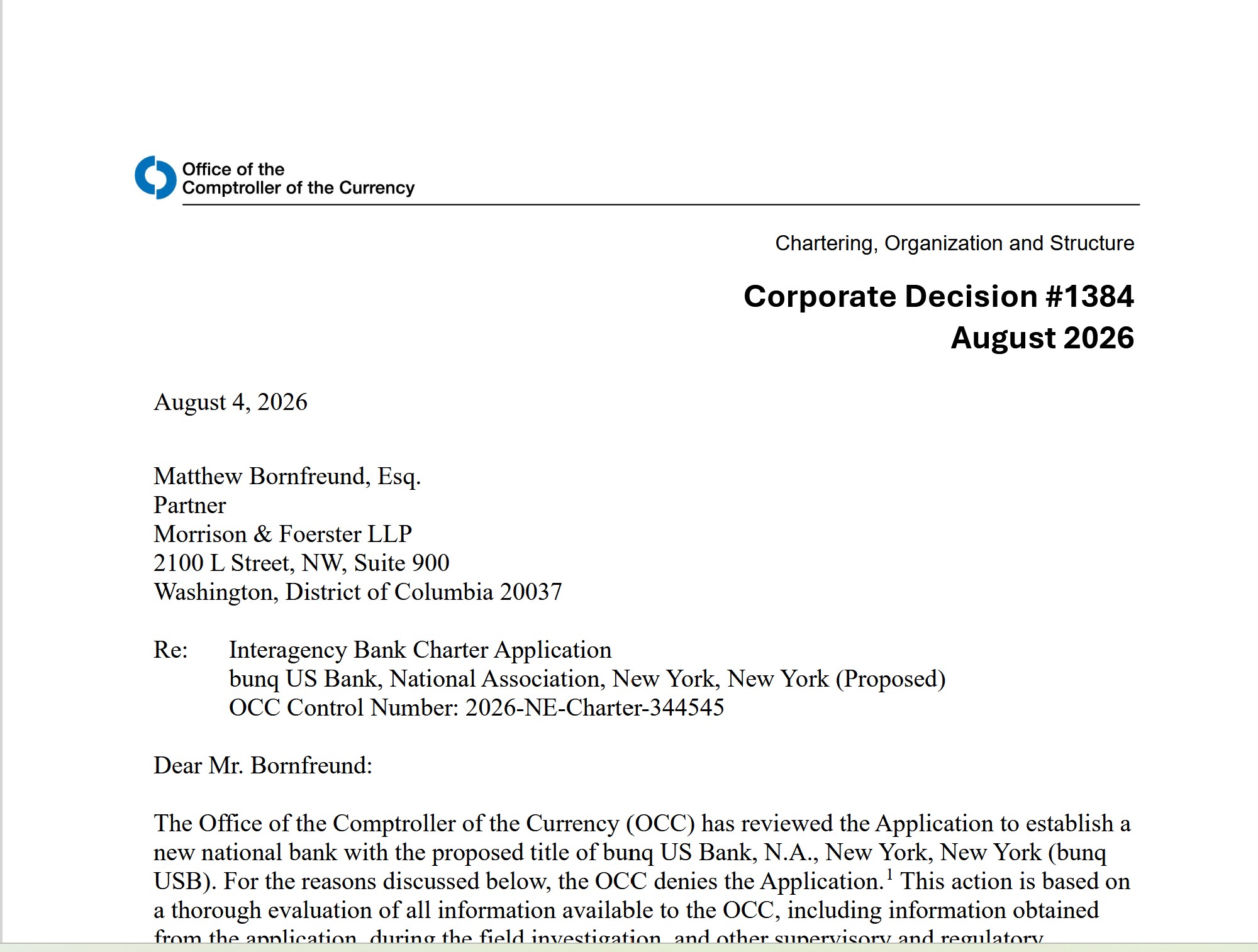
The OCC's Rejection of bunq: A Continuing Fit-and-Proper Question for DNB
The refusal of bunq’s U.S. banking charter is not simply a failed expansion project. For De Nederlandsche Bank (“DNB”), the decision produces information that maps directly onto DNB’s own published criteria for the continuing fitness and propriety of persons connected to a Dutch bank that is already carrying a substantial enforcement history.
On 4 August 2026, the U.S. Office of the Comptroller of the Currency (“OCC”) denied the application to establish bunq US Bank, N.A. In Corporate Decision No. 1384 the OCC identified supervisory and compliance concerns across five dimensions: insufficient capital, management that did not demonstrate the required competence, unachievable profitability projections, operations that could not be conducted in a safe and sound manner, and importantly unfavourable findings on the general character and fitness of management.
DNB is not bound by the OCC’s assessment, and no one suggests it is. bunq US Bank was to be chartered under U.S. law, and the OCC applied U.S. chartering standards. The relevant question is narrower and unavoidable: does the OCC decision constitute new information that DNB must weigh under the continuing fit-and-proper framework applicable to bunq B.V., a Dutch credit institution DNB supervises, and to its policymakers? DNB’s own rules strongly suggest that it does.
The OCC did not assess bunq US Bank in isolation
The OCC declined to treat the new legal entity as a clean slate. bunq US Bank, N.A. would have been operated separately from bunq B.V., but the OCC found that the similarity of the business plans and the common ultimate control made information about the wider structure relevant to its review. Ali Niknam controls the majority of the proposed U.S. holding company and, through holding companies, of bunq B.V. itself. On that basis the OCC examined bunq B.V.’s operating and profitability record, noting that bunq B.V. was not profitable until 2023 and saw profits decline in 2024 and 2025 amid interest-rate movements, together with information obtained from other regulators.
The capitalisation of the proposed bank became the sharpest illustration of the problem. The application initially indicated that USD 50 million would come from Mr Niknam’s personal holdings. Later information indicated the capital would instead originate from a dividend from bunq B.V. to Mr Niknam. According to the OCC, repeated written questions and interviews did not establish clearly how the bank would be capitalised or demonstrate that the funds were available; revised projections then raised proposed initial capital to USD 58.3 million without adequate information as to the source and availability of the additional amount.
Two points of restraint matter here. The decision does not establish that any dividend was in fact paid, nor that any such payment would have breached Dutch prudential requirements. The significance is different, and it is precisely the kind of thing that engages a home supervisor: a foreign banking regulator encountered material inconsistencies about financing that, on one of the versions presented during the process, was to flow out of a DNB-supervised bank. Separate legal personality did not require the OCC to look away where ownership, management, financial resources and business model remained materially connected. That is a supervisory principle, not a peculiarity of U.S. law.
The character-and-fitness finding engages DNB's perimeter
The most consequential element of the decision is the OCC’s unfavourable conclusion on the general character and fitness of management. The OCC tied that conclusion to transparency concerns arising from inconsistencies in what bunq US Bank’s management communicated to the regulator during the process.
The published decision does not identify which individual was responsible for those communications. It would therefore be wrong to attribute the finding personally to Mr Niknam or to any other bunq policymaker without further evidence, and we do not do so. But the absence of a named individual does not remove the matter from DNB’s supervisory perimeter, it defines the question DNB must now put: who was responsible for the communications the OCC found inconsistent, whether those persons are subject to Dutch suitability supervision as policymakers of bunq B.V., and whether the OCC’s findings bear on their continuing fitness or propriety.
DNB's antecedents (track record) framework is difficult to reconcile with inaction
DNB’s published guidance on antecedents lists, among five categories, “supervisory antecedents, such as incorrect or incomplete disclosure to a supervisory authority, rejection of a licence application or imposition of a formal or informal measure.” DNB further states that fitness and propriety are ongoing requirements, so that institutions and policymakers “must always notify us immediately of new antecedents,” and that the reportable measures expressly include those imposed by “a foreign supervisory authority.” DNB also reserves the ability to weigh antecedents cumulatively: it “may at a later time assess any antecedents that in themselves do not justify a negative opinion if they should appear to form part of a behavioural pattern.”
Placed against those criteria, the OCC decision corresponds unusually closely with DNB’s own tests. There has been a rejection of a licence application. There are documented concerns about the accuracy and completeness of what was disclosed to a supervisor. A foreign authority has reached an adverse character-and-fitness conclusion on management. And the applicant was connected, through ownership and through the proposed source of its capital, to an institution DNB already supervises.
None of this establishes that any bunq policymaker is unsuitable under Dutch law. It establishes something more modest and more precise: information capable of triggering a continuing suitability assessment. That reading is reinforced by the suitability regime as revised under CRD VI. Article 91 of the Capital Requirements Directive requires members of the management body to be suitable at all times and provides for reassessment where new facts or changed circumstances could affect suitability. The threshold that matters is therefore not proof of misconduct under Dutch law; it is the emergence of information capable of affecting the suitability assessment. The OCC has supplied exactly that kind of information.
The decision does not arise in a supervisory vacuum
The weight of the OCC findings increases against bunq’s existing Dutch record.
bunq has successfully resisted parts of DNB’s earlier supervisory approach in the Dutch courts, including DNB’s attempt to prescribe how open AML standards had to be implemented, and an earlier fine was substantially reduced by the Rotterdam District Court. Those outcomes should not be waved away: they show that bunq has defeated supervisory findings that were insufficiently substantiated or disproportionate, and any fair account has to carry that forward.
They did not erase the underlying compliance record. In a decision taken in May 2025 and made public in August 2025, DNB imposed a further administrative fine of EUR 2.6 million for serious deficiencies in customer due diligence between January 2021 and May 2022. DNB found that bunq had failed to follow up adequately on transaction-monitoring alerts, that signals of possible financial crime were not investigated in sufficient depth “if at all,” and that ongoing monitoring in the files examined was inadequate. DNB then set the fine in a longer context: between 2018 and 2023 it had carried out several examinations of bunq’s Wwft compliance and had repeatedly identified non-compliance that was “both severe and culpable,” and despite prior enforcement bunq had “not made sufficient progress” in meeting its statutory obligations. In short, DNB’s own conclusion was that earlier enforcement had not produced sustained Wwft compliance. bunq is contesting the fine; it lodged an appeal against the decision on objection on 24 November 2025, and the matter is before the courts.
The OCC decision concerns different legal and prudential issues; it is not an AML enforcement action, and it should not be dressed up as one. But continuing fitness and propriety are not confined to repeated breaches of a single statutory provision. DNB’s own framework expressly allows separate antecedents to be weighed together.
Why the historical financial-crime risk is not theoretical
EFRI’s own casework shows that the financial-crime risk in this period was not abstract: on EFRI’s analysis of the Cologne file concerning P2P GmbH, after German bank accounts were closed following suspicious activity, seven bunq accounts were used between July and October 2018 within a cross-border collection infrastructure that received victim payments from online investment-fraud schemes, a structure whose key elements the Regional Court of Cologne confirmed in a January 2026 judgment. Separately, an ongoing WAMCA class action — the Stichting Collectief Forward Gold Sale (FGS) claim against ING and bunq, likewise puts bunq’s role in a fraud-collection structure before a Dutch court, on the allegation that it opened and maintained accounts despite multiple red flags; that action is at the admissibility stage and establishes no liability.This does not show that bunq knew of or participated in the fraud, and criminal misuse of an account is not in itself an AML failure; the point is narrower, the risk DNB was examining at bunq was real.
A further, separate event belongs on the record. In June 2026 the Netherlands Authority for the Financial Markets (AFM) fined bunq EUR 170,000 for failing to respond within the statutory deadline to seven complaints from customers who had suffered online fraud. That measure concerns complaint handling, not AML controls, and should be treated as such, but it is another recent supervisory event.
Outlook: from Wise to bunq, and on to Qivalis
The bunq decision reinforces the question EFRI raised in “Wise Was Denied a Bank Charter. Will DNB License Qivalis?” In the Wise matter the OCC refused to treat a new institution as a regulatory clean slate where it would continue to depend materially on a wider group control environment affected by existing AML/CFT deficiencies. The bunq decision reaches the same result from the other direction: again the OCC looked past the formal applicant to common control, management capability, the operating history of the existing European institution, information from other supervisors, and the proposed source of the new entity’s capital.
Wise, bunq US Bank and Qivalis fall under different legal regimes, and the OCC’s decisions do not determine the outcome of any Dutch authorisation. What they establish is a supervisory benchmark: a new financial entity cannot be assessed in isolation where its governance, control environment, infrastructure or financial resources remain materially dependent on existing institutions and persons with relevant supervisory histories. That benchmark is directly relevant to DNB’s assessment of Qivalis, the bank-consortium euro-payment infrastructure expected to operate under DNB supervision. The credibility of Qivalis cannot rest on the mere fact that regulated European banks participate in it; the question is whether the supervisory histories, control weaknesses and governance risks of the participating institutions have been identified and addressed before they are built into new pan-European infrastructure.
Our Assessment
The OCC decision does not prove that bunq B.V. is unsafe. We do not claim otherwise, and the honest limits are real: the OCC named no individual, applied U.S. chartering standards to a U.S. entity, and reached its character-and-fitness conclusion in a chartering context rather than an AML one; bunq is contesting the EUR 2.6 million fine and has previously prevailed against DNB in court,
But it is equally difficult to maintain that the refusal has no consequence for Dutch supervision. DNB’s own framework treats licence refusals, incomplete disclosure to a supervisor, foreign supervisory measures and behavioural patterns as potentially relevant to continuing fitness and propriety; DNB already holds an extensive record with bunq, including its own finding that earlier enforcement failed to secure sustained AML compliance; and the OCC has now added a further category of concern around management competence, capitalisation and, above all, regulatory transparency. From a victim-protection standpoint the through-line is not incidental: the same institution whose historical transaction-monitoring and complaint-handling failures touched fraud victims is the one whose management has now drawn an adverse transparency finding from a foreign supervisor. Continuing suitability supervision is one of the few forward-looking levers that operates before the next victim group forms, rather than after which is precisely why the threshold here is the emergence of relevant information, not proof of a completed wrong.
DNB does not need a fresh complaint, a media investigation or a new enforcement proceeding before this information becomes relevant. It is already on the supervisory record. And a continuing suitability framework that is triggered by “information capable of affecting suitability” is not satisfied by noting the OCC decision and moving on. It is satisfied only by resolving the questions the decision raises.
That gives DNB a concrete and answerable task. It should obtain the OCC’s underlying file through its supervisory channels, identify the persons responsible for the communications the OCC found inconsistent, and establish whether those persons are policymakers of bunq B.V. subject to Dutch suitability supervision. If they are, DNB should reassess their propriety on the strength of the foreign finding, weighed, as its own framework directs, against the wider pattern of Wwft antecedents rather than in isolation. If they are not, DNB should be in a position to say so. Either outcome closes the question; leaving it open does not.
After the Wise decision, we asked whether DNB would apply the same substantive approach to Qivalis. After the rejection of bunq, the question is sharper and it has a name attached to the answer: will DNB obtain the OCC file, identify who spoke for bunq, and apply its own continuing fit-and-proper framework to a bank it already supervises or will it treat a foreign supervisor’s character-and-fitness finding as someone else’s problem?