StablR: EFRI Takes EURR and USDR Redemption Freeze to EBA and ESMA
Redemption of the e-money tokens EURR and USDR has been suspended since 25 May 2026. More than four months later, holders still have no timetable and no published procedure, and the Malta Financial Services Authority (MFSA) has made no public statement. EFRI has therefore taken the case to EU level.
- In a letter to the European Banking Authority (EBA), EFRI raises the issuer-side questions and asks the EBA to consider an own-initiative investigation under Article 17 of Regulation (EU) No 1093/2010.
- In a letter to the European Securities and Markets Authority (ESMA), EFRI addresses the conduct of the crypto-asset service providers (CASPs) through which retail clients hold EURR, using a documented case at the Spanish CASP Bit2Me.
Both letters are requests for clarification and consideration, not assertions of an established breach. They follow our reports of 22 July, 24 August and 25 August 2026.
Background
StablR Ltd (Malta, C 104007) is an electronic money institution authorised by the MFSA. It issues EURR and USDR under Title IV of Regulation (EU) 2023/1114 (MiCAR).
- 24 May 2026: StablR detected irregularities “consistent with unauthorised external access”. Third-party analyses reported that one compromised key sufficed under a 1-of-3 multisignature arrangement; StablR has neither confirmed nor corrected this.
- 25 May: StablR suspended minting and redemption. It said the circulating supply was “not fully backed at the 1:1 ratio required under MiCAR”.
- 29 May: StablR activated its Recovery Plan and notified the MFSA.
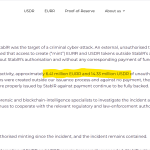
- 25 August: One day after EFRI’s renewed submission to the MFSA, StablR disclosed for the first time that about 6.41 million EURR and 14.33 million USDR created without authorisation and without backing remain in circulation. It says that tokens issued through its authorised process remain fully backed by segregated assets. May estimates were about 4.5 million EURR and 8.35 million USDR; the difference is unexplained. StablR has published no update since.
StablR’s white paper (v3.2, 2 December 2025) states: “In the event of a recovery scenario, EMT holders remain the right of redemption at 1:1.” EFRI first raised concerns with the MFSA on 8 July 2025, partly because of the management’s earlier role at Payvision (our report). On 1 August 2025, the MFSA announced an “exhaustive analysis”. EFRI has not been told the outcome.
The letter to the EBA: who is reviewing the suspension?
Article 46(1)(c) MiCAR, which applies to EMT issuers through Article 55, lists suspension of redemptions as a recovery option. Article 46(4) separately allows the competent authority to suspend redemption temporarily “having regard to the interests of the holders … and financial stability”.
The EBA Guidelines on recovery plans (EBA/GL/2024/07, paras 35, 39–41, 43(d)–(e)) require an action plan with a time plan and communication of next steps, but set no maximum duration. EFRI asks the EBA:
- What limits and review requirements govern a continuing issuer-initiated suspension, given the right under Article 49(4) to redemption at any time and at par? Does the suspension rest on the Recovery Plan, on an MFSA decision under Article 46(4), or on another basis?
- Is an assessment under Article 47 (redemption plan) now required (EBA/GL/2024/13, paras 80–88)? Could validated claims be paid, in whole or in part, from the funds lawfully available while the status of other units is resolved?
- Do units minted through the issuer’s own contract without authorisation and without receipt of funds count as EMTs “issued” under Article 49(2)? What does good-faith acquisition change? Which assets may satisfy such claims, and will a claims-validation methodology be published?
- Is a modified white paper required under Article 51(12), and are corrected marketing communications required under Article 53?
EFRI will also submit these questions through the EBA’s Single Rulebook Q&A tool.
The letter to ESMA: the CASP is the holder’s only interface
Most retail holders bought EURR through CASPs and hold it in omnibus custody or yield products. The CASP’s records decide whether their positions can be documented.
The ESMA letter describes a Spanish client of Bit2Me (BITCOINFORME, S.L.), who complained to the CNMV on 28 September 2026. EFRI has reviewed his documents.
- Pre-incident purchase. He bought EURR with euros on Bit2Me between 8 and 22 May 2026 and placed it in Bit2Me Earn. Bit2Me’s position statement of 17 August 2026 records 105,155.95 EURR in custody. He has been unable to dispose of it since 25 May.
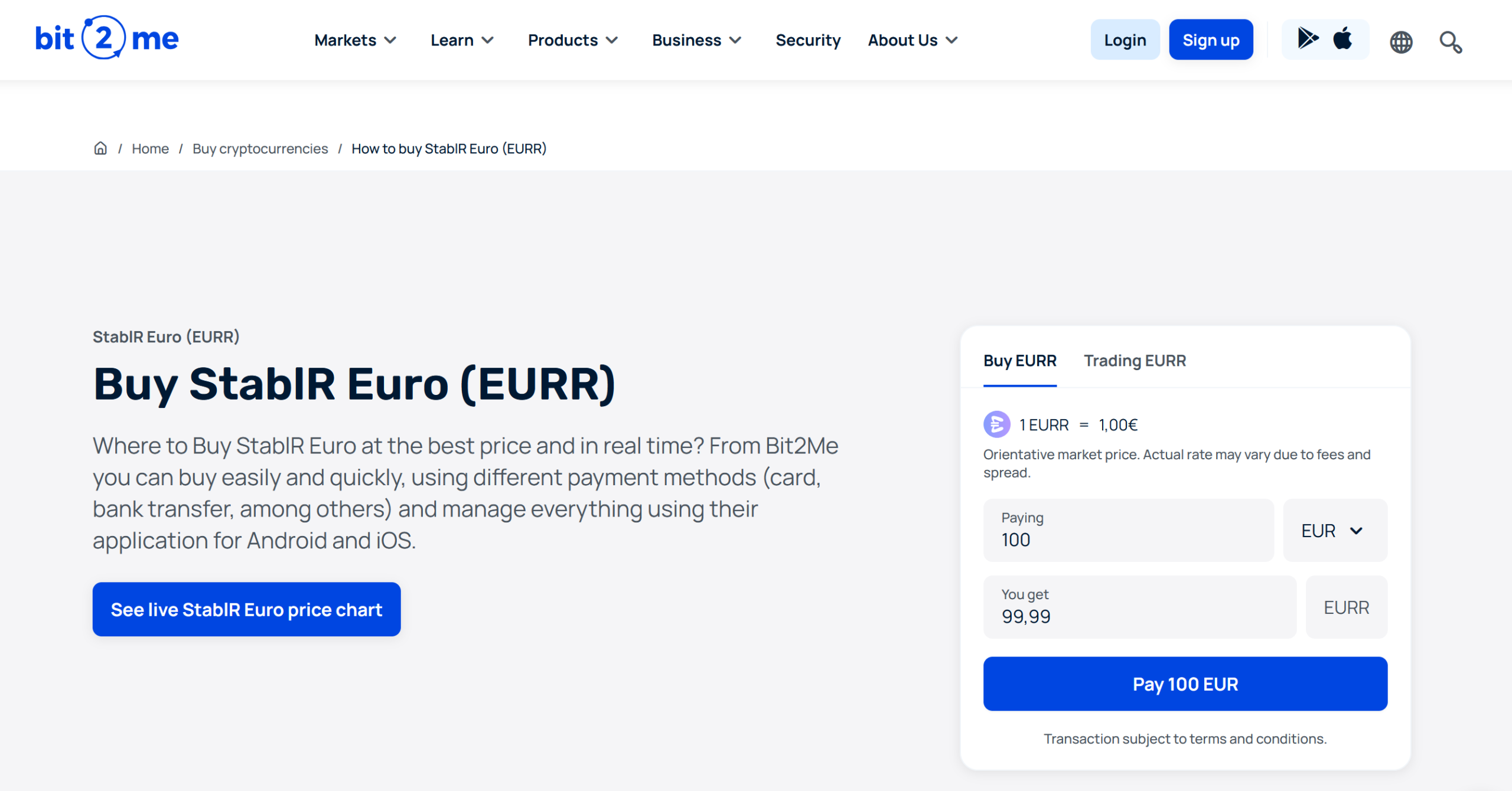
- Marketing. Bit2Me presented EURR as backed 1:1 by euros in segregated accounts “to guarantee the security of funds”. It said the reserves were “regularly audited” and that issuance required “multiple approvals”. On 25 September 2026, these pages still showed EUR 1.00 and “buy” buttons, with no visible warning. The suspension notice appeared only at checkout.
- Yield and loans. Bit2Me advertised stablecoin rewards in Earn of “up to 8% APY”, with EURR available in Earn. It also granted loans denominated in EURR.
- Two treatments.
- Its own claims: On 29 May 2026, Bit2Me sent borrowers, including this client, an addendum. It replaced their EURR debts with EURC “in an identical nominal amount”, retroactive to 23 May, and declared the EURR “extinguished and replaced”. Anyone who did not sign within seven days faced possible early termination of the loan.
- Its client’s balance: On 22 June, Bit2Me told the same client that EURR had become “a pro rata redemption right over the issuer’s reserve assets”. Taking over his EURR against euros was “not legally viable”. Bit2Me referred to an orderly exit or liquidation process supervised by the Banco de España, the CNMV or the EBA. None of these authorities supervises StablR.
- Standing. On 19 August, Bit2Me provided a position statement under Article 75(5) MiCAR. It said it had neither “the standing nor the legal mandate” to act for clients vis-à-vis StablR or the MFSA.
There are counter-arguments. A loan and a custody or Earn position are different legal relationships. The conversion may also have helped borrowers. And only the issuer can redeem. EFRI therefore leaves the complaint to the CNMV and asks ESMA for supervisory convergence under Article 29 of Regulation (EU) No 1095/2010:
- information duties on an EMT whose redemption is suspended (Article 66);
- reassessment of admission to trading (Article 76);
- conflicts when a CASP converts its own EURR receivables at par while describing client positions as pro rata claims (Article 72);
- custody duties when authorised and unauthorised units bear the same name (Article 75);
- the interest ban for EMTs and Earn programmes (Article 50(2)–(3)).
EFRI will publish any response from Bit2Me.
[The letters to the EBA and ESMA of 1 October 2026 are available on request from [email protected].]
Our Assessment
The suspension has outlived its justification. On 25 May, the suspension was a defensible emergency step. A recovery measure that has not restored redemption after four months is no longer a recovery measure. StablR says the funds behind its lawfully issued tokens are intact, yet holders cannot redeem them. That is the situation Article 47 was written for. The MFSA, which EFRI warned about StablR in July 2025, should carry out that assessment now or disclose it.
Purchasers must be protected. The unauthorised tokens were minted through StablR’s own contract because of its own key management. That is the issuer’s operational risk, not the holders’. In our view, the cost must fall on StablR, its own funds and its owners. Holders of pre-incident tokens should be redeemed now from the safeguarded funds. Good-faith purchasers of later units must not be left without a claim, and their losses must not be paid by diluting authorised holders.
The separation is feasible. StablR knows when the unauthorised minting began and where the tokens went. A snapshot as at 24 May 2026, combined with CASP client records, identifies pre-incident positions. There is no reason why a documented pre-incident holder should still be waiting for confirmation that his tokens count.
Bit2Me cannot have it both ways. Treating EURR at par when it is the creditor, and as a pro rata claim when its client is, is not acting in clients’ best interests under Article 66. Nor is selling an EMT at EUR 1.00 for four months after suspension without visible warning. Paying yield on EURR is, in our view, hard to reconcile with Article 50(2). Bit2Me holds the records and is supervised in Spain. It is the obvious party to document client positions and pursue them with the issuer.
Call to affected holders
EFRI is a qualified entity for cross-border representative actions under Directive (EU) 2020/1828. If you held EURR or USDR on 24 May 2026 or acquired them later, please write to [email protected]. Tell us:
- which CASP or wallet you use;
- when you acquired the tokens;
- your balance;
- whether the tokens are in custody or in Earn.