Amsterdam Court Admits WAMCA Class Action Against ING/bunq
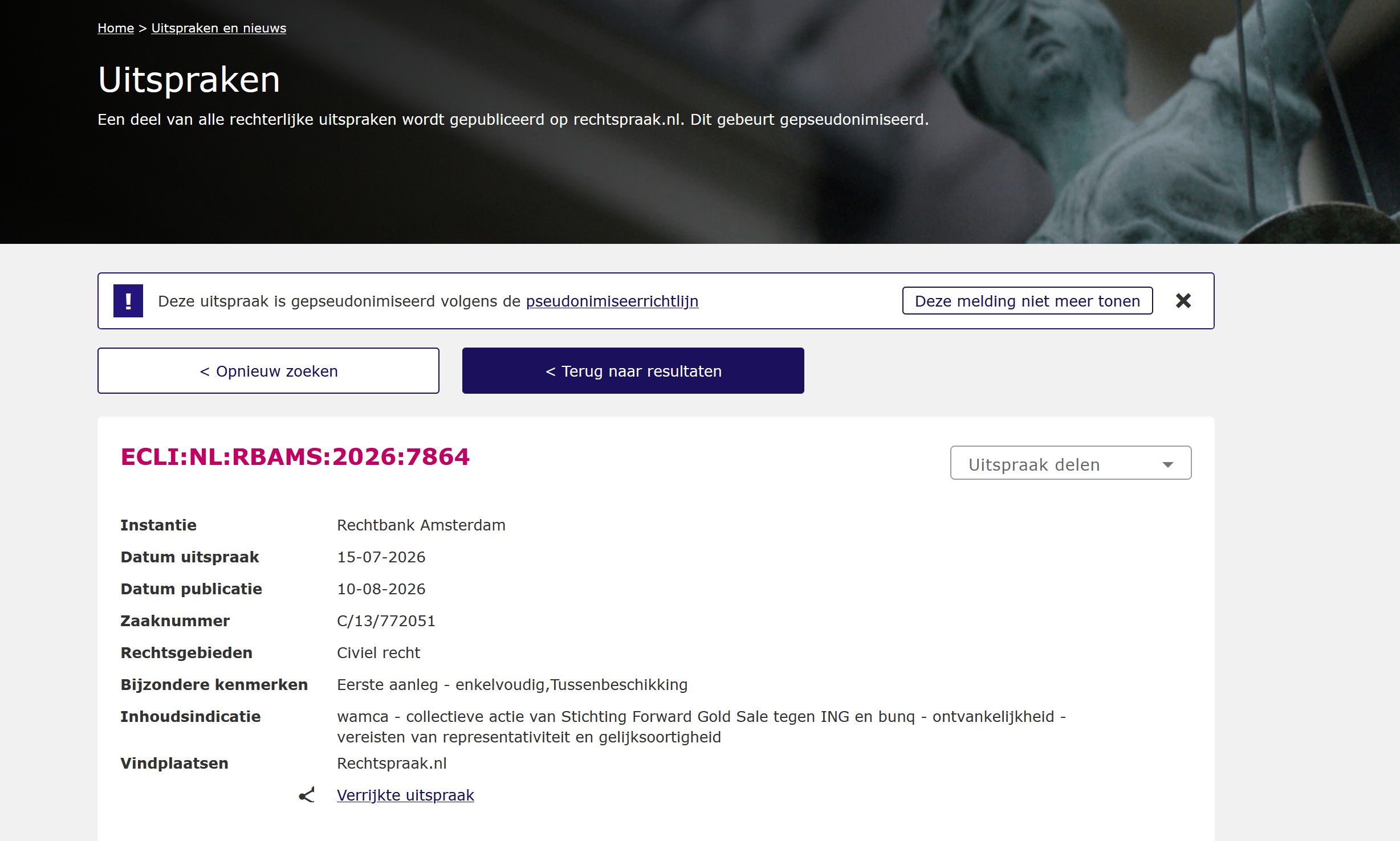
Case note on Rechtbank Amsterdam, 15 July 2026, ECLI:NL:RBAMS:2026:7864 (C/13/772051 / HA ZA 25-1256), published 10 August 2026.
On 15 July 2026 the Amsterdam District Court held a collective action against two banks admissible under the Dutch Act on the Resolution of Mass Claims in Collective Actions (WAMCA). The interim judgment does not decide whether ING and bunq are liable; it decides only that the claimant foundation may bring the claim on the merits. For victim protection organization, the interest lies less in the outcome than in how generously the court read the admissibility thresholds and in its decision to extend an opt-out regime to foreign injured parties. EFRI reported on this action when it was filed in July 2025; the present note follows the court’s first substantive ruling a year on.
Background
Between 2017 and 2019, Ruby Creek Resources Inc. (Los Angeles) and Transeco Minerals & Mining Ltd. (Windsor) sold “Forward Gold Sale” contracts, promising discounted physical gold on a ten-month term, sourced directly from mines in Tanzania and Ghana. The contracts were marketed through Dutch intermediaries. Buyers paid the purchase price into five Dutch escrow foundations, which together held seven payment accounts, three at ING and four at bunq. The first buyers received gold; deliveries stopped in July 2018 and never resumed. A criminal investigation has run since then, and on 1 July 2026 the Amsterdam court convicted defendants for fraud and participation in a criminal organisation. Roughly 700 buyers received no, or too little, gold; some 161 are resident in Belgium.
Stichting Collectief Forward Gold Sale (FGS) argues that the banks ignored a series of red flags, and that
- opening
- or at least not freezing the escrow accounts facilitated the fraud.
It grounds the claim in breaches of statutory duties under the Financial Supervision Act (Wft) and the Money Laundering and Terrorist Financing (Prevention) Act (Wwft), or alternatively in the banks’ special duty of care (bijzondere zorgplicht). It seeks a declaration that the banks acted unlawfully and are jointly and severally liable, and damages equal to each injured party’s deposit.
The admissibility package
Similarity — gelijksoortigheid (art. 3:305a(1) BW). The banks argued that liability turns on account-specific, even buyer-specific, circumstances effectively seven collective actions bundled into one. The court disagreed (para. 5.6). The governing question is whether the banks were aware of circumstances concerning the accounts that required intervention a question common to all injured parties and independent of their individual situations. That the case involves seven accounts across two banks does not defeat bundling; liability may ultimately be assessed per bank, or even per account, but that does not require any categorisation of the injured parties themselves beyond, at most, per bank. Notably, the court accepted that the assessment may in the end turn out differently per account without that undermining similarity: the requirement is directed at the comparability of the liability questions, not at uniformity of the answers, and it does not ask whether the injured parties are themselves in an equal position. Individual issues, contributory negligence, and quantum (orders ranged from 100 to 24,000 grams of gold) are deferred to the merits (paras. 5.7–5.8). The court drew express support from AG De Bock’s conclusion in The Privacy Collective v Oracle/Salesforce (ECLI:NL:PHR:2026:129): similarity does not require that all interested parties are in the same legal position or have suffered the same loss, only that the factual and legal questions are “sufficiently comparable”; at the admissibility stage the court need only make an estimate of similarity, leaving definitive categorisation to the damages phase (paras. 7.25–7.27 of the conclusion).
Representativity (art. 3:305a(2) BW). FGS’s constituency of 101 injured parties, about 14% of the roughly 700 affected, representing some €5.7 million or about 19% of total payments, was held sufficient, and clearly distinguishable from the negligible share that defeated representativity in Airbus (ECLI:NL:RBDHA:2023:14036). The court refused to require a subdivision of the group per account, distinguishing Coronadatalek (ECLI:NL:RBAMS:2024:4264), where the claimant had itself pleaded distinct groups. Here, by contrast, FGS invokes a single overarching event, so it does not artificially construct a group lacking common features (paras. 5.10–5.12).
Prima facie unmeritoriousness against bunq (art. 1018c(5)(c) Rv). bunq’s plea is instructive on where these claims are vulnerable. It pointed to the absence of any prior history with the actors involved; the escrow foundations being new, “blank” clients; the lack of any visible interconnection or criminal-organisation pattern from its vantage point; the CBb’s partial annulment of the DNB fine (18 October 2022), finding no breach of the Wwft duty to investigate the nature and purpose of the relationship at onboarding; the relatively short life of the accounts; and — notably — that its three FIU unusual-transaction reports did not concern the four escrow foundations that banked with bunq. The court accepted that the claim’s prospects of success “may be doubted,” but held that the summary-unmeritoriousness gateway is reserved for the exceptional, manifestly hopeless case; anything short of that belongs to the merits (paras. 5.17–5.19).
Funding and control (art. 3:305a(2)(c) BW). The banks’ objection to a “sole conduct” clause in the litigation-funding agreement fell away once FGS undertook that the clause would be deleted; the funder’s fee remained within the accepted bandwidth (paras. 5.13–5.16).
Opt-out, including for foreign injured parties
Having appointed FGS as exclusive representative (art. 1018e Rv), the court turned to notice and binding effect (art. 1018f Rv). Dutch-resident injured parties fall under the default opt-out regime. For those resident abroad, the statutory default is opt-in (art. 1018f(5) Rv), on the rationale that where the size and nature of the foreign group is unclear, this hampers effective settlement negotiations. Here, however, the foreign group is clearly identifiable — approximately 161 Belgian residents — and the court therefore saw reason to apply the opt-out regime to them as well (paras. 5.25–5.27). The parties will be heard on the wording and manner of publication at the hearing scheduled for 2 September 2026.
Our Assessment
For the victims of online and investment fraud that EFRI represents, the significance of this ruling lies less in its doctrinal detail than in a structural point: it treats the bank as a legitimate addressee of a mass claim, and it treats the heterogeneity of the victims, different amounts, different accounts, different individual conduct, as a question for the merits rather than a barrier at the gate. Cross-border fraud produces exactly that heterogeneity, and it is the standard reason victims are told their claims cannot be pursued collectively. This decision cuts against that reflex.
Two features matter most from a victim-protection standpoint. First, the generous reading of the similarity and representativity requirements means a foundation does not need a perfectly uniform victim group to bring a bank-facilitation claim; it needs a common question about the bank’s conduct. Second, and more consequential across borders, the court extended the opt-out regime to a foreign victim group because that group was clearly identifiable. Where the victims of a cross-border scheme can be named and quantified, as they increasingly can once a scheme has been documented and its victim base assembled, the practical case for opt-out, rather than the far weaker opt-in default, becomes considerably stronger. That is of direct relevance to any effort to secure redress for the tens of thousands of European victims of large-scale online-fraud schemes.
This should not be over-read. It is a single-judge, first-instance interim ruling on admissibility alone, and its threshold is deliberately low, as the court’s own reservations about the claim against bunq make plain. The genuinely hard questions, the knowledge standard governing a bank’s duty of care toward defrauded third parties, causation, and contributory negligence are expressly reserved for the substantive phase. But as a marker of where Dutch collective-redress practice is heading, it is a meaningful step for fraud victims seeking to hold financial intermediaries to account.