German Court Holds Meta Liable for Scam Ads - But What About the Victims?
A German court has taken an important step in defining the responsibility of social-media platforms for fraudulent advertising.
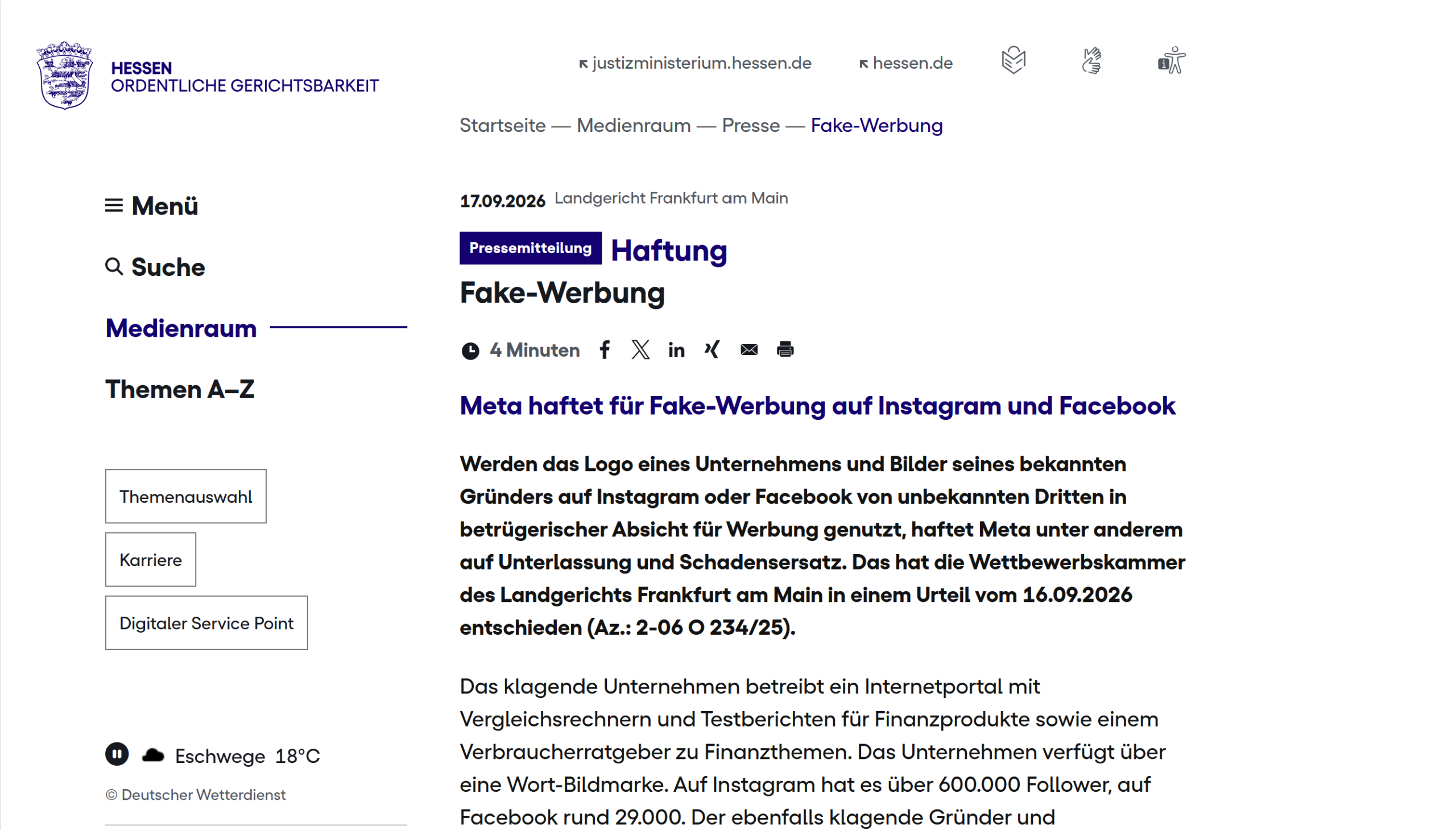
On 16 September 2026, the Regional Court of Frankfurt am Main held Meta liable for fake advertisements and profiles distributed through Facebook and Instagram that unlawfully used the name, images and branding of the German financial information platform Finanzfluss and its founder Thomas Kehl (Az.: 2-06 O 234/25).
The judgment goes beyond the familiar notice-and-takedown debate. Its central finding concerns Meta’s role in distributing the content.
Meta cannot necessarily invoke the liability privilege for hosting providers where its own algorithms determine how, when and in what order content is shown to users.
That distinction could have consequences far beyond this particular dispute.
Hundreds of reports, recurring scam advertisements
The proceedings concerned fake profiles, advertisements and posts using the Finanzfluss brand as well as Kehl’s name and image. The content purported to offer financial information or investment opportunities and was allegedly used to direct users towards fraudulent investments.
This was not an isolated incident.
According to the Regional Court, Finanzfluss reported almost 260 infringements to Meta in August 2024 alone. Nevertheless, identical or substantially similar material continued to appear. The court records that Meta sometimes took up to 62 days to remove reported fake advertisements.
Finanzfluss and Kehl eventually brought proceedings against Meta.
The Frankfurt court granted substantial parts of their claims.
Meta was ordered to refrain from publishing or distributing the specified unlawful content and equivalent infringements. It must also provide information concerning the dissemination and reach of the relevant material and disclose the revenue it generated from it.
The court further established Meta’s obligation to compensate the plaintiffs for damage resulting from the infringements. Kehl is also entitled in principle to compensation for non-material damage.
The judgment is not yet final and may be appealed to the Higher Regional Court of Frankfurt.
The important part is Meta's control over distribution
The most significant part of the judgment concerns the limits of the hosting liability exemption under Article 6 of the Digital Services Act. Article 6 DSA protects providers of hosting services from liability for information stored at the request of users, provided that the statutory conditions are met. The exemption is based on the premise that the provider is hosting third-party information rather than exercising control over it.
The Frankfurt court considered that distinction decisive.
Meta does not merely provide storage space for advertisements and other content. Its systems determine which content is displayed, to whom it is displayed, when it appears and in which order or priority. In the case of advertising, this includes Meta’s automated auction and delivery systems.
The court linked that form of algorithmic distribution to the recent judgment of the Court of Justice of the European Union in the joined cases WebGroup Czech Republic and NKL Associates and Coyote System, C-188/24 and C-190/24, delivered on 16 June 2026.
The CJEU clarified that a hosting provider may fall outside the liability exemption where it exercises control over the information concerned. Importantly, such control may be exercised through the platform’s algorithm itself.
The Court drew a distinction between the mere categorisation or indexing of information in order to make it easier to access, and a system that goes further. Where an algorithm determines, in the interest of the operator or its service, the conditions under which information is disseminated, the manner in which it is disseminated and its order of priority, the operator may be regarded as exercising control over that information.
The fact that those decisions are automated does not in itself preserve the hosting exemption.
The CJEU’s reasoning is particularly relevant to modern advertising platforms. A platform may therefore no longer be characterised as a merely passive host where its own systems actively determine the conditions and priority of dissemination.
The Frankfurt court applied that reasoning to Meta.
This does not mean that every form of algorithmic sorting automatically removes the protection of Article 6 DSA. The legal distinction lies between technical organisation intended merely to facilitate access to stored information and algorithmic systems through which the platform itself controls the conditions, manner and priority of dissemination.
That distinction is fundamental for fraudulent advertising.
For years, one of the central arguments advanced by online platforms has been that unlawful advertisements remain third-party content: the advertiser creates the advertisement, while the platform merely provides the infrastructure.
Algorithmic advertising makes that distinction increasingly difficult to maintain.
A platform that determines the target audience, controls the timing and placement of an advertisement, establishes its ranking and receives payment for distributing it is performing considerably more than passive storage.
The Frankfurt judgment recognises that difference.
The court did not award the victims their investment losses
The judgment must nevertheless be read carefully.
It does not establish that Meta must compensate consumers for money lost in the investment scams advertised on Facebook or Instagram.
The plaintiffs were Finanzfluss and Thomas Kehl.
Their claims concerned the unauthorised use of their name, image, brand and corporate identity. The court found violations of rights belonging to them and recognised Meta’s liability for damage arising from those infringements.
That is legally different from the loss suffered by a consumer who sees a fraudulent advertisement, communicates with the fraudsters and subsequently transfers €50,000 or €100,000 to a fraudulent investment scheme.
Whether such a victim can recover that loss directly from Meta remains unresolved.
A claim by the victim would raise additional questions: Which substantive cause of action applies? Does the relevant rule protect the consumer against precisely this type of financial loss? Was Meta’s conduct sufficiently connected to the transfer of funds? Can causation be established where the fraud continued through telephone calls, WhatsApp groups, trading platforms or other intermediaries? Which national law governs the claim?
These are substantial questions.
But the starting point has changed.
If Meta exercises legal control over the distribution of fraudulent advertisements, the discussion no longer necessarily begins with the proposition that Meta is merely a neutral host of somebody else’s content.
From takedown obligations to financial responsibility
The court also requested Meta to provide information on the extent to which the unlawful content was disseminated and accessed and to disclose the revenue generated from it.
This connects two sides of the same transaction. The fraudulent advertiser purchases distribution. Meta provides that distribution and receives revenue. The victim is reached through the resulting advertising infrastructure. Until now, the financial relationship between the platform and fraudulent advertisers has received remarkably little attention in discussions about victim compensation.
Regulatory enforcement tends to focus on whether platforms remove illegal content, operate adequate reporting mechanisms or comply with systemic-risk obligations under the DSA.
Those questions are important. But they do not restore victims’ money.
The distinction becomes particularly relevant as European authorities consider substantial DSA fines against platforms for failures relating to fraudulent advertising. EFRI has previously pointed out the structural problem: regulatory fines can punish a platform without providing compensation to the consumers whose money was lost through the scams.
The Frankfurt judgment addresses a different part of the problem. It concerns civil liability.
For the moment, however, the people whose identities and brands were misused have obtained a judicial route towards damages. The consumers who financed the fraud through their losses have not yet obtained an equivalent judicial answer.
That asymmetry is difficult to ignore.
An important judgment, but not the end of the discussion
The Frankfurt decision is a first-instance judgment. It is not yet final. It concerns specific infringements of the rights of Finanzfluss and Thomas Kehl, not a general compensation regime for victims of online investment fraud.
Nor does the judgment mean that every piece of unlawful user content automatically creates liability for Meta.
But the court applied the CJEU’s recent interpretation of intermediary liability to the technological reality of algorithmically operated social-media platforms. The relevant question is no longer simply who uploaded the illegal content. It is a first step into the right direction.
It is also who controlled its distribution.
For fraudulent online advertising, that distinction is fundamental.
The next legal question is therefore already visible.
If a platform controls the distribution of a fraudulent advertisement, earns money from its dissemination and delivers it algorithmically to the consumer who ultimately suffers the financial loss, under what circumstances should that platform also bear responsibility and liability towards that consumer?
The Frankfurt judgment does not answer that question.
European courts will increasingly have to determine where algorithmic control over the distribution of fraudulent advertising ends and civil liability towards the resulting victims begins.