ING has a Payvision Accounting Problem
Contradictory figures, missing audit evidence and unresolved victim claims demand documented answers.
ING announced Payvision’s phase-out in 2021, citing commercial reasons, and reported its operational completion in 2022. Years later, the Payvision companies’ latest accounts – just filed with KvK – contain material contradictions that prevent creditors from reliably assessing their financial position.
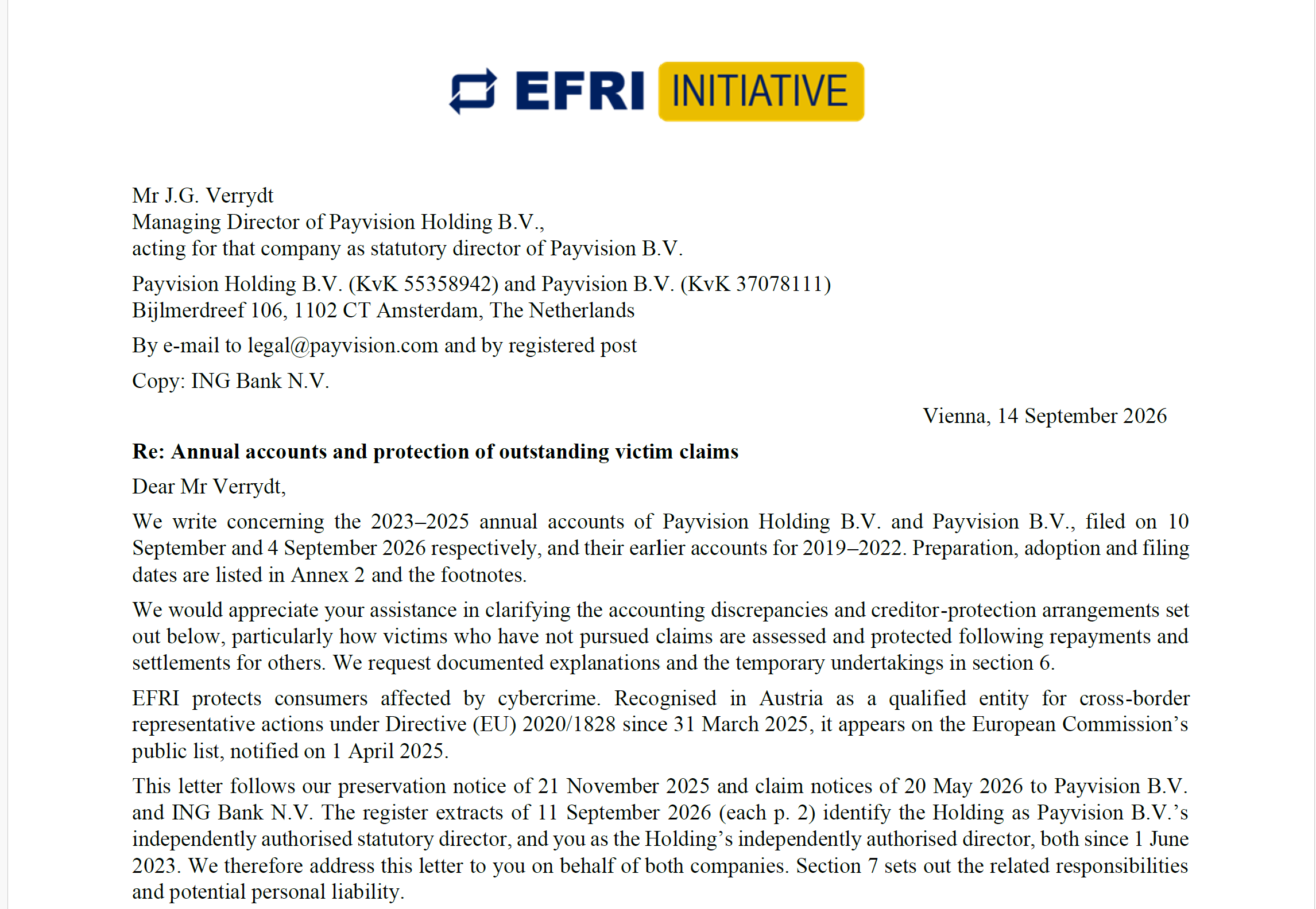
EFRI’s letter of 14 September 2026 asks management for documented explanations, corrected figures and protection of outstanding victim claims. Those requests concern people who have already pursued compensation, but also people who may never come forward because they do not know of Payvision’s role or are unable to act because of illness or dementia.
One date with two sets of figures
The uncertainty begins with two sets of figures for the same date. At 31 December 2024, Payvision B.V.’s 2024 accounts report assets of €8,419,697, equity of €3,085,612 and provisions of €5,041,079. The comparative column in its 2025 accounts gives €11,573,772, €440,502 and €10,764,896 respectively for that same year-end. The 2025 filing repeats the principal 2024 balances as its current-year figures and the earlier 2023 balances as its 2024 comparatives. A transfer or labelling error could explain this, but creditors still need the correct figures and a reconciliation.
Meanwhile, the Holding’s financial fixed assets rise from €3,086,438 to €4,232,097 in 2025, although Payvision B.V.’s reported equity remains unchanged. Management needs to explain the movement by investment and valuation method; the increase does not establish the subsidiary’s actual profit as Payvision B.V. has been inactive since 2023. These discrepancies concern the Payvision companies’ filings and do not establish a misstatement in ING’s consolidated accounts. ING nevertheless has a direct connection to the questions as ultimate shareholder, funding counterparty and the provider of accounting-related assistance described in Payvision’s own disclosures.
Micro-entity accounts and unanswered audit questions
Payvision B.V.’s 2023 filing classifies the company as a micro-entity. Yet its 2022 accounts report approximately €17.89 million in assets, €8.69 million in revenue and an average workforce of 67 full-time equivalents. These figures meet none of the micro-entity criteria and only one of the three small-company criteria, even using the increased thresholds. The ordinary two-year transition rules therefore raise substantive questions about both the 2023 classification and any reliance on a small-company audit exemption. Returning the payment-services licence or having a smaller business when filing in 2026 does not resolve the requirements applicable to an earlier financial year.
EFRI has asked management to identify any other exemption relied upon, provide the relevant auditor’s report where required, and explain how the licence withdrawal during 2023 affected DNB’s reporting and audit requirements. The letter also questions the basis for Payvision Holding B.V.’s micro classification for 2021–2024 and its switch to the small-company regime for 2025, including the relevant group figures.
These questions remain open. A missing published auditor’s report does not itself prove that no audit occurred, but creditors are entitled to question whether the appropriate reporting regime was used and all applicable audit and disclosure requirements were met.
Management confidence without sufficient audit evidence
The evidence behind the accounts raises further concerns. KPMG’s report of 22 June 2026 contains a disclaimer of opinion on Payvision B.V.’s 2022 financial statements because substantial requested evidence was unavailable and alternative procedures did not resolve the limitations. Management acknowledges missing data, restricted system access, closed bank accounts and departed staff, yet considers the financial position and results fairly and completely presented. The same note describes ING’s assistance in maintaining IT systems, retaining expertise and providing financial and legal information. What supported management’s assessment, why was it insufficient for KPMG and which ING functions held or could access the material? A disclaimer does not itself prove false accounts or auditor misconduct, but the unresolved gaps matter for the opening balances, provisions and investment values in the later accounts, prepared on 7 August 2026.
Falling provisions and unresolved victim claims
Reported total provisions fell from €23.516 million in 2021 to €5,041,079 in the 2024 accounts. The 2025 filing repeats that exact amount, but the conflicting comparative figures leave the correct year-end balances unresolved.These totals cover different obligations, including wind-down costs. The category containing claims and disputes stood at €10.254 million in 2021 and €6.359 million in 2022. It was not a fund exclusively for fraud victims.
A reduction can reflect payments, releases to profit or reclassification. Only a reconciliation can establish which occurred. Releasing a provision may improve reported profit to the mother company without compensating a creditor.
The risk history is documented. The accounts describe an independent investigation into high-risk client relationships requested by DNB and conducted in 2020. In April 2024, the Dutch Public Prosecution Service announced penalties against two former directors, through out-of-court criminal orders, following findings of inadequate customer due diligence and ongoing monitoring during 2016–April 2020.
EFRI’s report of 15 May 2026 examines criminal-file evidence concerning chargebacks, continued processing and third-party settlements connected with the Barak and Lenhoff fraud structures. How was that evidence assessed before the later accounts were prepared?
The absence of a class action as of the end of 2025 cannot replace an assessment of known facts. Equally, each victim’s enforceable claim against Payvision requires assessment. Management should explain which potential claimants and risks it considered, including people who have neither sued nor approached Payvision but are well known to them due to the card processing history.
Funding figures and reporting exemptions need explanation
The Acapture disclosures are inconsistent. The 2020 accounts record €5.551 million in share premium from an Acapture asset-and-liability transfer. The 2021 accounts record a separate €24.449 million contribution, shown as cash received. Yet the 2022 equity statement labels that 2021 movement as an acquisition of Acapture assets and liabilities. The €24.449 million also needs reconciliation with the €15 million stated as received under the September 2021 funding agreement.
Facility disclosures add another question: different notes refer to €20 million terminated on 13 March 2025, and €5 million and €20 million cancelled on 25 March 2025. Management should identify the arrangements, correct any errors and explain what support remains enforceable.
Victims who cannot come forward
Behind these accounting questions lies a disparity in access to redress. Payvision has made settlement payments where victims pursued claims, including through litigation. According to information available to EFRI, it also bore repayments to issuing banks through chargebacks following UK Financial Ombudsman Service proceedings concerning services not provided. The Ombudsman’s role in such disputes concerns complaints against banks and lenders; this should not be confused with a direct order against Payvision or compensation funded solely by an issuer. EFRI has asked management to clarify the numbers, amounts and treatment of these payments.
These outcomes make it necessary to ask what happens to otherwise comparable victims who have never complained or sued. A person may know the fraudulent platform’s name without knowing that Payvision processed the deposits or that its conduct may give rise to a claim. Online fraud victims living with dementia may be unable to reconstruct events, recognise a possible claim or instruct a lawyer. A seriously ill person may have neither the strength nor the practical support to pursue years of correspondence and litigation. Relatives or carers may not know the loss occurred, let alone which companies were involved. Silence in such circumstances says little about the underlying harm or the merits of a possible claim.
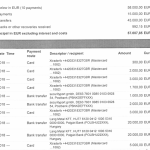
Payvision’s transaction schedules, supplied by its former CEO to the investigating authorities, provide a starting point for identifying payments connected with the relevant platforms. Individual entitlement still requires assessment. But those records allow management to look beyond the people who have already asserted claims. Have assumptions that others will never come forward influenced provisions, releases or plans for closure? EFRI asks management to distinguish its assessment of liability from expectations about whether victims are able to pursue it.
Payvision and ING should explain how they will provide access to redress without requiring each victim to bring a separate lawsuit. EFRI calls for an independently administered compensation process with transparent eligibility criteria, accessible claim assessment and payment of qualifying claims. Existing transaction records should support the identification of potentially affected victims and appropriate outreach, including through issuing banks. People who do not know about Payvision’s involvement must also have a meaningful opportunity to obtain redress. Dementia, serious illness and lack of financial resources make this need particularly urgent, but the principle applies to every victim.
Or is ING prepared to let Payvision’s wind-down proceed while leaving these victims without a meaningful route to redress?
Answers before closure
EFRI’s letter asks the management of Payvision B.V. and Payvision Holding B.V. for explanations of current resources and any planned dissolution steps, preservation of evidence and correction of the accounts. It requests confirmation or an explanation by 21 September, substantive answers by 28 September and temporary protection against specified asset transfers and closure steps until 12 October 2026. These are requested undertakings; the letter itself does not suspend liquidation. As the wind-down continues, Payvision and ING should explain how they intend to address the claims of people who cannot advocate for themselves. A person’s illness, dementia or lack of knowledge should not determine whether their loss is ever considered.
How does this meet ING’s governance and reporting standards?
EFRI does not understand how accounts containing these unexplained inconsistencies and unresolved audit questions can be reconciled with the governance and reporting standards expected within the ING group. Payvision’s own accounts describe ING’s assistance with IT systems, financial information and legal matters. ING should therefore explain what oversight it exercised, how these filings were reviewed, and what corrective action it considers necessary. How will it ensure that reliable financial reporting and the fair treatment of outstanding victim claims are integral to Payvision’s wind-down?