US and EU Asset Recovery is Failing Fraud Victims
Authorities routinely celebrate their successes in tracing, freezing and confiscating criminal assets. Yet the crucial final step — returning those assets to the victims — remains fragmented, discretionary and painfully slow.
Current cryptocurrency forfeiture proceedings in the United States expose the consequences. The state can seize hundreds of millions or even billions of dollars linked to fraud. But victims may still face excessive tracing requirements, uncertain administrative procedures and competition from claimants seeking preferential recovery.
The same structural failure exists in Europe. The P2P proceedings in Germany and assets linked to convicted fraudster Gal Barak in Bulgaria demonstrate that identifying and securing criminal property does not ensure that victims receive it.
The problem is no longer primarily the power to confiscate.
It is the absence of a reliable mechanism for restitution.
It is the absence of a reliable, transparent and enforceable mechanism for victim resititution.
The USD 225 Million USDT Seizure
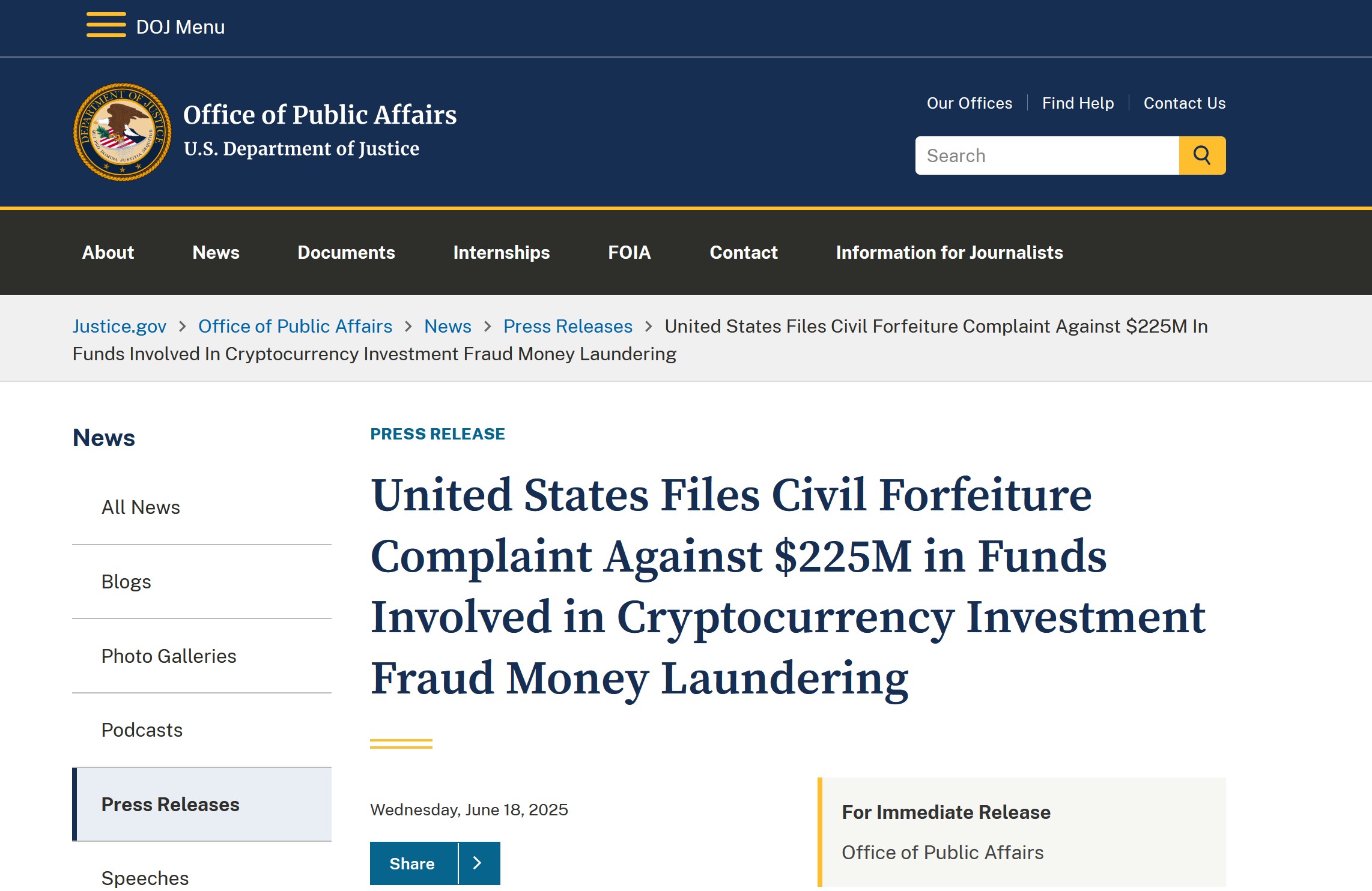
On 18 June 2025, the US Department of Justice filed a civil forfeiture complaint against approximately 225.36 million USDT before the US District Court for the District of Columbia.
The defendant is formally the cryptocurrency itself. In this type of civil forfeiture action, the United States alleges that the property constitutes proceeds of wire fraud or assets involved in money laundering and should therefore be forfeited to the state.
According to the complaint, an international criminal network stole funds from more than 430 suspected victims and laundered the proceeds through numerous blockchain transactions, intermediary wallets and 144 accounts held with the crypto exchange OKX.
Tether froze approximately USD 225 million in November 2023 at the request of the US Secret Service. The assets were later seized pursuant to a court warrant.
The authorities presented the seizure as an important step towards victim compensation. But forfeiture does not automatically return property to victims. It first transfers control of the assets to the United States.
Victims must then establish their rights through judicial claims or discretionary administrative procedures such as remission or restoration.
The Government Can Trace a Criminal Pool — but Victims Must Trace Their Individual Money
The US government relies on a network-level analysis to justify forfeiture of the entire asset pool.
Investigators allege that the wallets received fraud proceeds, that the funds were repeatedly transferred and commingled, and that the assets formed part of a large money-laundering structure.
The complaint does not trace every victim payment through every transaction. That would be nearly impossible in a laundering network designed to obscure the source of funds.
Individual victims may nevertheless face a significantly stricter standard. To assert a direct ownership interest, they can be required to show that their particular funds are traceable into the specific assets now held by the government.
This creates an obvious imbalance:
The state may rely on aggregate tracing to seize the entire pool, while victims may be required to reconstruct the precise laundering trail created to defeat that very exercise.
In the USDT proceedings, the government has reportedly also argued that certain victims did not retain a sufficient property interest because they voluntarily transferred their cryptocurrency to the scammers, even if those transfers were induced by misrepresentations.
That distinction may reflect technical concepts of payment authorisation. It is nevertheless difficult to reconcile with the reality of investment fraud.
Victims initiate the transaction because the offender has deceived them. The fact that they pressed the transfer button is not evidence of genuine consent to the loss.
The government should not characterise assets as proceeds of fraud when seeking forfeiture, but as voluntarily surrendered property when victims seek their return.
The Prince Group Seizure Reveals a Wider US Problem
The controversy is not limited to the USD 225 million USDT case.
In October 2025, US authorities announced the seizure of 127,271 Bitcoin connected to Chen Zhi and the Cambodian Prince Group. The assets were then valued at approximately USD 15 billion.
The Prince Group was accused of operating a transnational criminal organisation involving online scam compounds, forced labour and human trafficking.
By March 2026, lawyers representing hundreds of alleged victims told the International Consortium of Investigative Journalists that the Department of Justice had rejected numerous victim claims while failing to provide sufficient information about the origin and movement of the seized Bitcoin.
Victims were allegedly expected to establish a precise connection between their individual losses and the recovered assets, even though the government itself had not publicly disclosed the information needed to do so.
Victim advocates have therefore called for an independent, court-appointed administrator; transparent eligibility and tracing criteria; a dedicated compensation fund; and binding rules requiring seized fraud proceeds to be used for restitution.
Concerns increased after suggestions that some forfeited Bitcoin could be retained in the United States’ Strategic Bitcoin Reserve.
There is no public confirmation that the Prince Group Bitcoin will be transferred to that reserve. The more fundamental problem is that victims lack a clear, enforceable right to know how the assets will be distributed.
A seizure celebrated as a victory for victims can therefore leave the assets under government control.
The USDT Case Now Has Competing Claimants
The USD 225 million proceeding is no longer simply a dispute between the United States and the alleged operators of the laundering network.
The public docket identifies several competing claimants, including larger victim groups, corporate claimant Infiniweb Technology Inc. and individual claimant Nivedita Kaul.
No publicly available final decision has yet determined who owns the assets or how they will be distributed.
This means the victims may be competing not only with the government, but also with each other.
That competition becomes particularly problematic when individual claimants seek amounts substantially exceeding their alleged original losses.
One Claimant Seeks More Than Three Times Her Alleged Loss
On 17 March 2026, Nivedita Kaul filed a verified claim concerning Wallet Group G, which reportedly contained approximately 87.46 million USDT.
Kaul alleges that approximately USD 8.7 million was stolen from her between April and December 2022.
She claims substantially more than that amount:
- approximately USD 8.7 million in principal;
- approximately USD 14.4 million in interest;
- and approximately USD 2.35 million in Turkish legal and enforcement costs.
Her total claim therefore exceeds USD 25.46 million, before additional interest, US legal fees or other claimed damages.
Kaul does not present herself merely as a victim requesting administrative compensation. She asserts direct ownership, innocent-owner status and priority as a judgment creditor allegedly holding a judicial lien arising from Turkish proceedings.
She also argues that her own investigations identified the relevant wallet and contributed to its freezing by Turkish authorities.
That work may have been important. But investigative assistance, creditor status and ownership of specific cryptocurrency are legally different concepts.
A Verified Claim Is Not Proof — and Secondary Claims Must Not Consume a Common Victim Pool
Kaul’s filing is verified under penalty of perjury, but that does not prove that every asserted amount is valid, traceable or entitled to priority.
The publicly available claim does not include bank or exchange records proving the alleged USD 8.7 million loss, complete blockchain tracing into Wallet Group G, certified copies of the Turkish decisions, a detailed interest calculation or evidence supporting approximately USD 2.35 million in legal costs.
This does not mean the claim is false. It means that the principal loss, the connection to the seized USDT and each additional component remain to be proved.
A payment order or judgment against an alleged fraudster also does not automatically create ownership of cryptocurrency held in a commingled victim pool. Kaul would need to establish a legally enforceable proprietary interest in the specific USDT and priority over both the United States and other victims.
That matters because she seeks more than three times her alleged original loss: approximately USD 8.7 million in principal, USD 14.4 million in interest and USD 2.35 million in legal costs.
In a pool containing money allegedly stolen from hundreds of victims, every dollar paid as interest or private enforcement costs is unavailable to compensate another victim’s actual capital loss. Secondary claims should therefore rank behind the proven net principal losses of all verified victims unless a claimant establishes a specific legal priority.
Investigative or enforcement work may justify reimbursement where it preserved assets for the common benefit. But it does not, by itself, confer ownership of other victims’ money.
Victims Must Not Be Forced to Compete for Their Own Money
The US proceedings expose victims to pressure from two directions.
First, the government may obtain control of the recovered assets without being legally required to distribute them promptly and completely to victims.
Second, sophisticated claimants may seek preferential recovery through interest, legal expenses or broadly asserted proprietary rights.
The remaining victims receive only what is left.
This is not a defensible victim-protection model.
Where the seized assets constitute a mixed pool of fraud proceeds, the starting point should be each victim’s proven net principal loss. Interest, consequential damages and private legal costs should rank behind the principal losses of all verified victims unless a claimant proves a specific and legally enforceable priority in the particular assets.
Europe Has the Same Missing Final Step
The United States is not an exception.
European authorities also consistently emphasise the importance of following the money and depriving criminals of their profits.
The European Union has recently strengthened its rules on asset tracing, freezing, confiscation, management and cross-border recognition with Directive (EU) 2024/1260 on asset recovery and confiscation entered into force in May 2024. Article 18 expressly requires Member States to take victims’ rights to compensation and restitution into account. Where a victim has an enforcable compensation or resititution claim, confiscated propery may have to be used to satisfy that claim. Where a victim is entitled to the return of particular property, authorities must take appropriate measures to preserve it for restitution.
But the Directive does not create a single European restitution prosedure for cross-border mass fraud. it does not establish a central claims portal, mandatory direct notification of foreign victims, uniform tracing standards for commingled funds or binding EU-wide deadlines for payment. Nor does it clearly require proven principal losses to be satisfied before interst claims, private legal costs or state retention.
The European framework remains focused primarily on cooperation between states: determining which authority may freeze an asset, which country must recognise an order, how the property should be managed and which jurisdiction ultimately controls it.
The reamining gap is oprations and victim-speicific: EU law is becoming increasingly effective at moving assets between criminal proceedings and state authorities, but it still does not ensure that the assets move promptly from the state to the victims.
The P2P Case: Money Frozen Since 2018, Victims Still Waiting
The German P2P GmbH proceedings illustrate the problem.
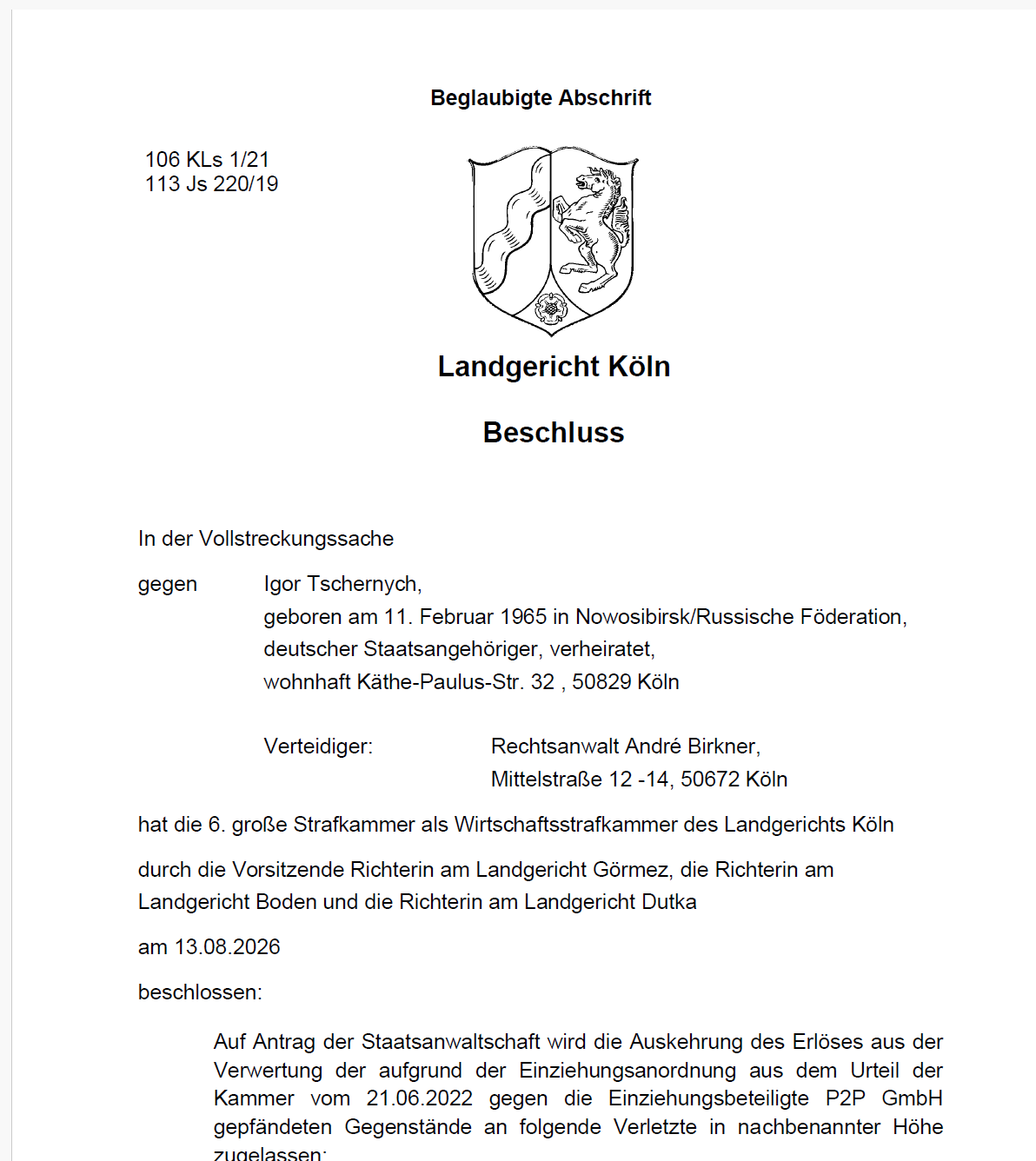
In the German P2P GmbH proceedings, approximately EUR 1.8 million paid to scammers from victims all over Europe was frozen in autumn 2018 in connection with a criminal case prosecuted in Cologne.
Only in the summer of 2025 did the Cologne Public Prosecutor’s Office publish a notice in Germany’s Federal Gazette, the Bundesanzeiger, inviting victims to register claims for the distribution.
That form of publication is plainly inadequate for a cross-border mass-fraud case. German retail victims cannot reasonably be expected to monitor the Bundesanzeiger for recovery notices. Victims in the United Kingdom, Scandinavia and other European countries are even less likely to discover such a notice.
EFRI represents more than 60 victims from all over Europe in that matter. In May 2026, EFRI again wrote to the Ministry of Justice of North Rhine-Westphalia and European institutions after almost eight years had passed without an effective conclusion of the recovery process. We are still waiting for positive news from Cologne.
The victims are still waiting for the secured funds to be paid out.
It is a failure to complete the final administrative and judicial steps required to return them.
From the victim’s perspective, money that remains frozen within the justice system for eight years has not meaningfully been recovered.
A seizure may prevent the offender from spending the proceeds. It does not compensate the victim, restore financial security or repair the damage caused by the fraud.
The Barak Assets in Bulgaria: Located, but Still Not Returned
The same structural failure can be seen in the Gal Barak network.
Gal Barak was convicted in Austria for serious fraud connected to the binary-options operation known as the “Wolf of Sofia.” Victims were awarded compensation in the Austrian criminal proceedings.
The criminal network operated through an extensive Bulgarian corporate and banking infrastructure. EFRI’s investigations identified dozens of companies and numerous Bulgarian bank accounts used in connection with the operation.
Substantial sums linked to the network passed through Bulgaria.
Approximately EUR 2 million in assets connected to the case was secured in Bulgaria in January 2019. More than seven years later, those funds have still not been distributed to the victims.
When Marina Barak, wife of Gal Barak, was acquitted in a criminal trial in Austria, she claimed in court that the seized money was her money. The Bulgarian court decided against her, she appealed. Civil litigation still going on. So yet the assets have not been effectively transferred to the victims entitled to compensation.
The criminal conduct was prosecuted. The offender was convicted. Victim claims were recognised. Relevant assets were identified or secured.
But the victims still did not receive the corresponding value.
The prosecuting state may refer to the state holding the assets. The state holding the assets may refer to domestic confiscation proceedings, third-party rights or incomplete cross-border requests.
Each authority performs part of the process. No authority assumes responsibility for the final result.
Authorities Measure Seizures, Not Restitution
Authorities regularly publicise the value of assets frozen, seized or confiscated, the number of criminal networks disrupted and the profits denied to organised crime. They far less often disclose how much was actually returned to victims, how long distribution took, how many claims were rejected or how much property ultimately remained with the state.
This distorts the measurement of enforcement success. A billion-dollar seizure generates immediate headlines, while a delayed or failed restitution process receives little public attention.
Asset recovery should therefore be measured in three separate stages: assets secured, assets finally confiscated and assets actually distributed to verified victims. For victims, only the final figure represents genuine recovery.
Asset recovery should therefore be reported at three distinct stages: property initially frozen or seized, property finally confiscated or otherwise legally secured, and property actually distributed to verified victims. For victims, only the final figure represents genuine recovery.
The United States and Europe Share the Same Structural Defect
The procedures differ, but the institutional weakness is the same.
Authorities are rewarded for tracing, freezing and confiscating assets. No comparable accountability exists for ensuring that those assets are returned promptly and fairly to victims.
In both the United States and Europe, restitution procedures remain fragmented, cross-border victims face multiple legal regimes, evidentiary burdens are shifted back onto victims and recovered assets may remain under state control for years. Above all, no single institution is responsible for ensuring that the process ends with payment to the victims.
The enforcement system is highly developed at taking assets away.
It is poorly developed at returning them.
What a Credible Restitution Mechanism Must Provide
A functioning transatlantic framework should include:
- prompt identification and notification of affected domestic and international victims;
- a single accessible claims process, including for foreign victims;
- transparent evidentiary criteria;
- reasonable tracing standards for deliberately commingled assets;
- priority for proven net principal losses;
- deduction of prior repayments and recoveries;
- proportionate distribution where funds are insufficient;
- subordination of interest, consequential damages and private legal costs;
- strict proof of any alleged proprietary priority;
- an independent administrator for large victim pools;
- judicial review of rejected claims;
- binding deadlines;
- and public reporting on amounts actually paid to victims.
Confiscated fraud proceeds should not become general government revenue where identifiable victims remain uncompensated.
Nor should aggressive individual claimants be permitted to consume a common pool through unsupported principal claims, extreme interest demands or unverified legal expenses.
EFRI's View: Asset Recovery Is Not Complete Until Victims Are Paid
Authorities in the United States and Europe are unanimous about the importance of taking criminal proceeds away from fraudsters.
They are right. But taking the money away is only the first half of asset recovery.
There is still no consistently functioning mechanism ensuring that assets taken from fraudsters are returned promptly, transparently and equitably to the people from whom they were stolen.
Victims can therefore lose their money three times:
First, when the fraudster takes it.
Second, when the state secures it but leaves it trapped for years in fragmented proceedings.
Third, when government retention, legal costs, excessive interest claims and preferred creditors reduce the amount ultimately available for restitution.
Seizing assets from scammers is not the same as recovering them for victims. Unless the law requires recovered fraud assets to be distributed through a transparent, prompt and equitable process, asset recovery risks becoming a transfer of stolen wealth from criminals to governments and the most aggressive claimants — rather than a restoration of that wealth to victims.