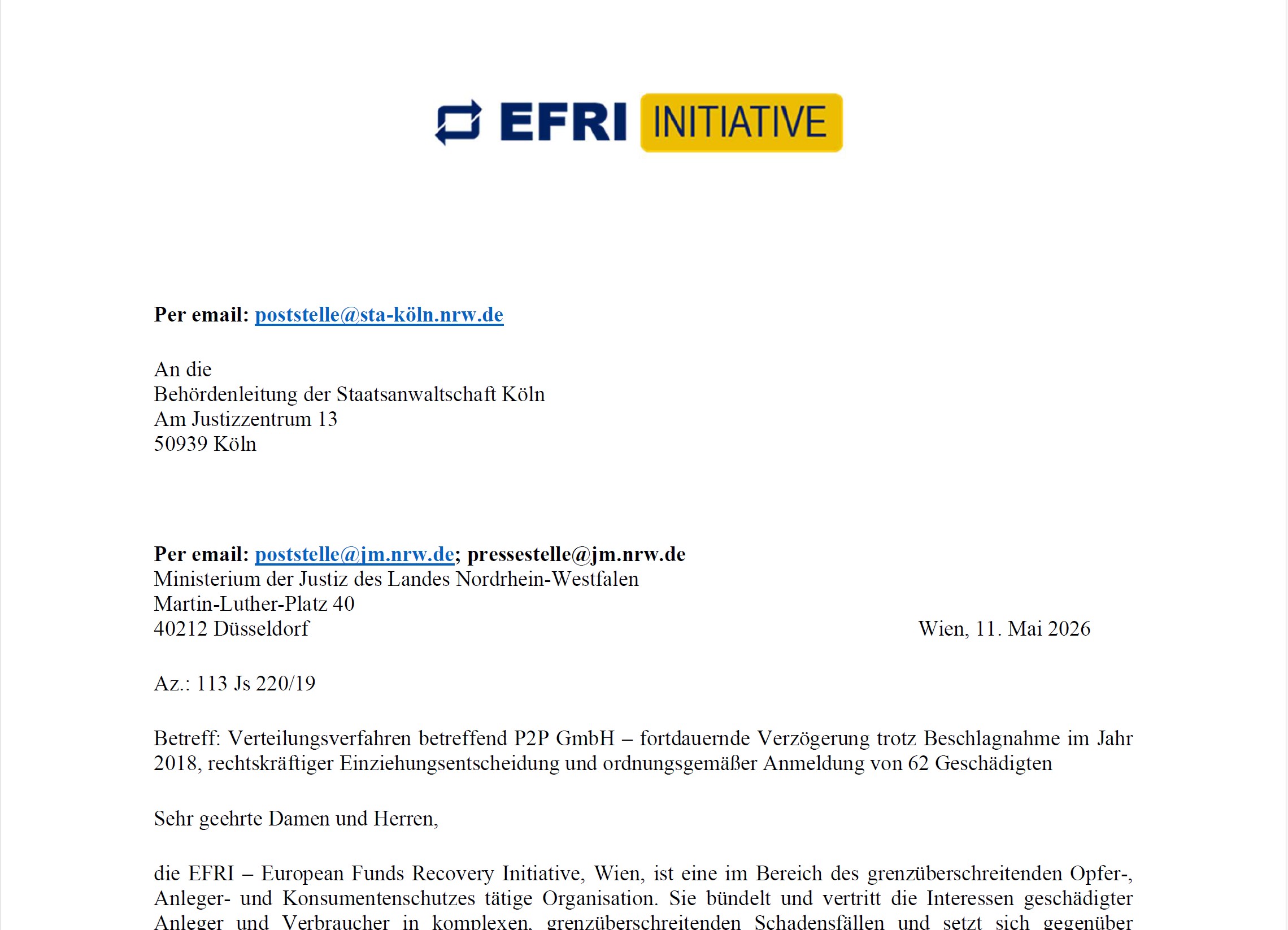
Today, EFRI sent a formal letter to the Ministry of Justice of North Rhine-Westphalia and to European institutions concerned with the rule of law, consumer protection and asset recovery. Here you can read the full letter (translation). We represent 62 victims from across Europe who have been waiting for more than eight years to recover frozen funds, yet the case still has not moved through the system in a way that gives those victims any meaningful sense of progress.
The reason why we are escalting now is simple: our experience in the P2P asset recovery case reflects a wider European reality that institutions prefer not to confront openly.
That is the real issue.
Europe does not lack asset recovery laws. It does not lack confiscation tools. It does not lack political declarations, victim-rights language or official statements about the importance of tracing, freezing and confiscating criminal proceeds.
Everyone knows the script
The European Commission describes confiscation and asset recovery as a strategic priority in the fight against organised crime. It says organised crime in Europe generates an estimated EUR 139 billion every year and notes that the confiscation of criminal proceeds in the EU remains at only about 2%. In other words: Europe knows asset recovery is essential, but Europe still recovers only a tiny fraction of criminal profits.
The EU’s own public justice information says the same in more basic terms: confiscation has long been seen in the European Union as one of the most effective tools against organised crime because it strikes at the profit motive. That point matters. Organised crime is not driven by ideology. It is driven by money. If the money is not effectively traced, frozen, confiscated and actually moved through the system, the criminal business model survives.
So, at the level of policy language, strategy papers and legal frameworks, Europe has no shortage of certainty. Asset recovery is always described as essential. Victims’ rights are always described as important. Cross-border cooperation is always described as a priority.
The problem in Europe in 2026 is no longer that nobody knows what should be done. The problem is that far too often, it still is not done.
A case that exposes the wider problem
The reason EFRI is speaking publicly about the P2P GmbH distribution proceedings is not simply because the facts are disturbing in isolation. It is because they illustrate a broader European problem with unusual clarity.
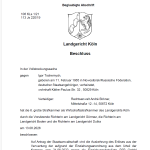
In this case, assets were already provisionally secured or seized in 2018. A final confiscation order for EUR 2,559,552.40 has been in force since 21 June 2022. On 30 July 2025, injured parties were formally called upon, through a notice under Section 459i(1) StPO, to register their claims. EFRI then coordinated the proper and timely filing of claims for 62 victims by the end of January 2026. Yet, according to the information available to EFRI, the matter still had not been forwarded to the competent court by 11 May 2026.
We think the sequence of this case matters because it removes the usual excuses.
This is not a case in which victims failed to act.
It is not a case in which no formal procedure existed.
It is not a case in which the authorities had not invited claims.
It is not a case in which there was no final confiscation order.
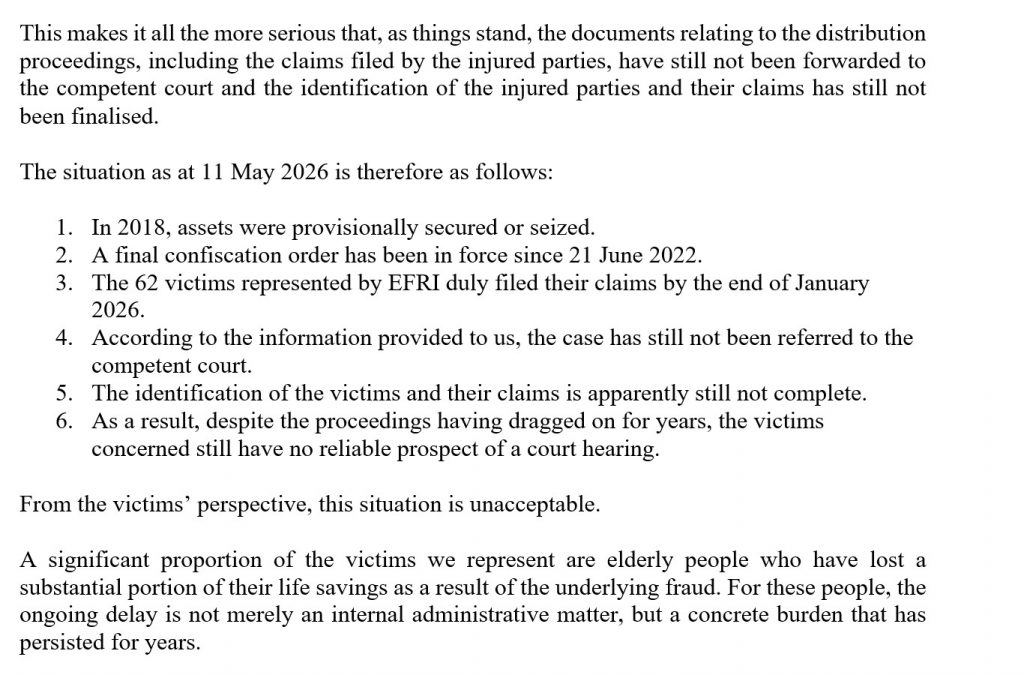
The assets were seized.
The order became final.
The victims were called upon to file.
The claims were filed on time.
And still the case did not move.
That is not a communication problem. It is a delivery problem.
What victims actually experience
Funds are rarely seized at all. But even when they are, victims can still be left waiting more than eight years to see any distribution. That leaves a stark question: is this ignorance of the damage done to victims, negligence, carelessness, or just indifference?
Many of the victims we represent are over 70, have lost substantial parts of their savings, are unwell, still suffering from the trauma experienced by the online fraud, and urgently need their money back. Yet the reality they face is delay, silence, and a system that appears not to care.
And yet what they face, again and again, is familiar: delay, silence, procedural drift, weak communication, and a system that often appears to treat victims and victim representatives as an inconvenience rather than as the people the process is supposed to serve.
There is a word for that experience: revictimisation.
When victims are forced to chase institutions for years, when responses come late or not at all, when the process remains opaque and when even a case with frozen assets and a final confiscation order fails to move visibly toward distribution, the system itself becomes another source of harm.
A credibility issue for European justice
The P2P case is therefore not just a German procedural issue. It is a European credibility issue.
If Europe wants to present asset recovery as a serious answer to organised crime and large-scale fraud, then it must be prepared to face the reality that victims still encounter years of inertia even in cases where money has been secured and confiscation has already become final.
That is why EFRI has decided to escalate this case not only at national level, but also before the relevant European institutions.
Not because we are naïve about what usually follows. Experience has taught us otherwise. Victims and victim representatives know the pattern well: no reaction, delayed reaction, deflection, pass-through, silence. We are no longer surprised by it.
But this is exactly why these cases must be documented publicly and confronted directly.
Because a justice system cannot claim success merely because assets were seized or because a confiscation order exists on paper. Success must be measured by whether victims can actually see timely, transparent and credible movement toward redress.
In too many cases, they still cannot.
And that is why asset recovery in Europe in 2026 remains strong on paper, but broken in practice.
Everyone knows what should be done. The real scandal is that, in far too many cases, it still is not done.