The criminal case we have been following for years has now reached a major procedural milestone.
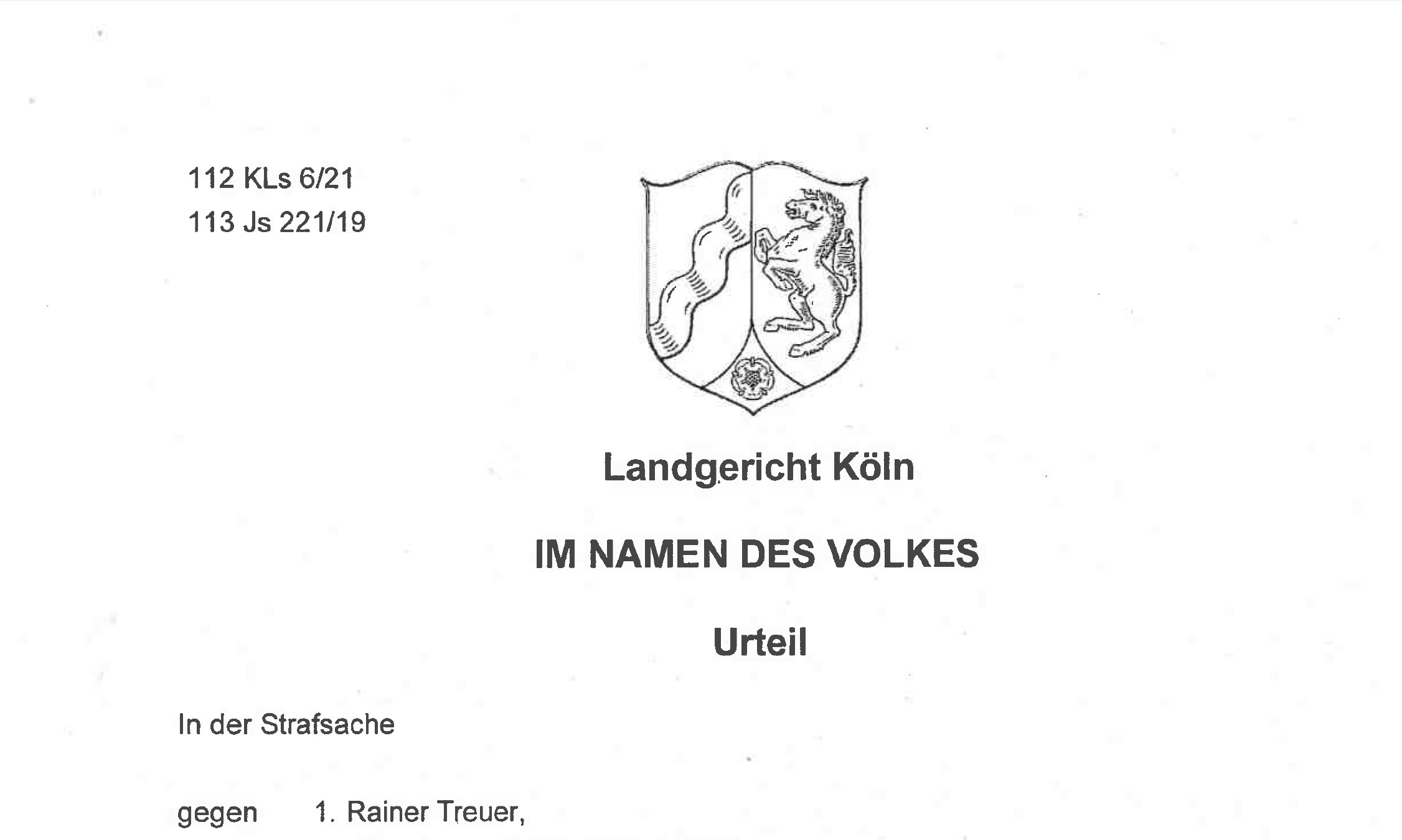
On 27 January 2026, the Regional Court of Cologne (Landgericht Köln) delivered its judgment in the joined criminal proceedings arising from 112 KLs 6/21 and 112 KLs 2/24. The written reasons were later signed in Cologne on 16 March 2026. According to the judgment, the underlying indictments had been filed by the Cologne public prosecutor on 10 September 2021 in case 113 Js 221/19 (B2G complex) and on 12 January 2024 in case 113 Js 42/21 (P2P complex and related allegations).
According to the written judgment available, Rainer Treuer was convicted of the intentional unauthorised provision of payment services in connection with B2G GmbH and of incitement to the intentional unauthorised provision of payment services in connection with P2P GmbH. The court imposed a total custodial sentence of two years and four months, with three months deemed served because of the excessive duration of the proceedings. The court also ordered the confiscation of B2G GmbH in the amount of EUR 671,549.52.
This is an important judgment. But it is not the full reckoning with the broader laundering structure that EFRI has been documenting for years.
Oleg Shvartsman’s case was not decided in this judgment
Oleg Shvartsman did not appear in the proceedings. His case was therefore not adjudicated in this judgment. That matters because the Cologne judgment of 27 January 2026 does not amount to a judicial determination of the broader allegation that Oleg Shvartsman and Rainer Treuer together operated a professional laundering structure or “money-laundering-as-a-service” model for online investment fraud. That broader characterisation comes from the wider factual record, from EFRI’s work, and from years of investigative reporting, but it is not what this particular judgment finally decided.
What the Cologne court did find
The written reasons describe B2G GmbH as a structure through which bank accounts were opened, incoming customer funds were received, and those funds were then forwarded onward for remuneration without the required authorization under German payment-services law. The court lists accounts used for that purpose at Kölner Bank, Sparkasse Koblenz, Deutsche Bank, Südwestbank, and UniCredit/HypoVereinsbank.
The court further found that the same model was later continued via P2P GmbH. After German accounts were closed because of suspicious account activity, the operation continued via multiple accounts at bunq B.V. in the Netherlands. According to the judgment, the funds were often not forwarded on a 1:1 basis but were first pooled and then transferred onward in larger bundled amounts, often to foreign recipients.
The written reasons state that funds paid into these accounts were often not transferred onward on a 1:1 basis, but rather bundled and then forwarded in larger blocks, often to foreign bank accounts. The court reproduced extensive transaction schedules showing onward transfers to a wide range of recipients.
The court quantified the volume of funds forwarded through B2G GmbH at EUR 33,577,475.80 over roughly one year of operation.
That matters because it confirms, at criminal-court level, that this was not treated as ordinary commercial activity. It was treated as an illegal payment-collection infrastructure operating without the required license.
Why the Judgment Still Falls Short of the Broader Problem
The Cologne court has now convicted Rainer Treuer for unauthorized payment-services conduct. But the real concern goes further.
Even in the wider proceedings concerning Oleg Shvartsman, the prosecutorial focus appears to remain centred on licensing violations, while the documented facts point to a potentially much broader laundering architecture involving multi-account structures, cross-border routing, and the industrial handling of victim funds. In EFRI’s view, treating such cases mainly as licensing breaches risks producing judgments that do not match the scale of modern online fraud or the role of professional financial enablers within it.
In EFRI’s view, treating such cases primarily as licensing breaches risks producing judgments that do not match the scale of modern online investment fraud or the role of professional financial enablers within it.
Why This Matters
For consumer protection, the deeper issue is not only whether payment services were provided without a license. The deeper issue is whether professional cross-border financial structures existed that enabled online investment fraud to scale, persist, and move victim money rapidly beyond reach.
From EFRI’s perspective, the Cologne judgment in the B2G / P2P case is therefore an important milestone. But it is not yet the full legal reckoning with the broader infrastructure behind large-scale online fraud.