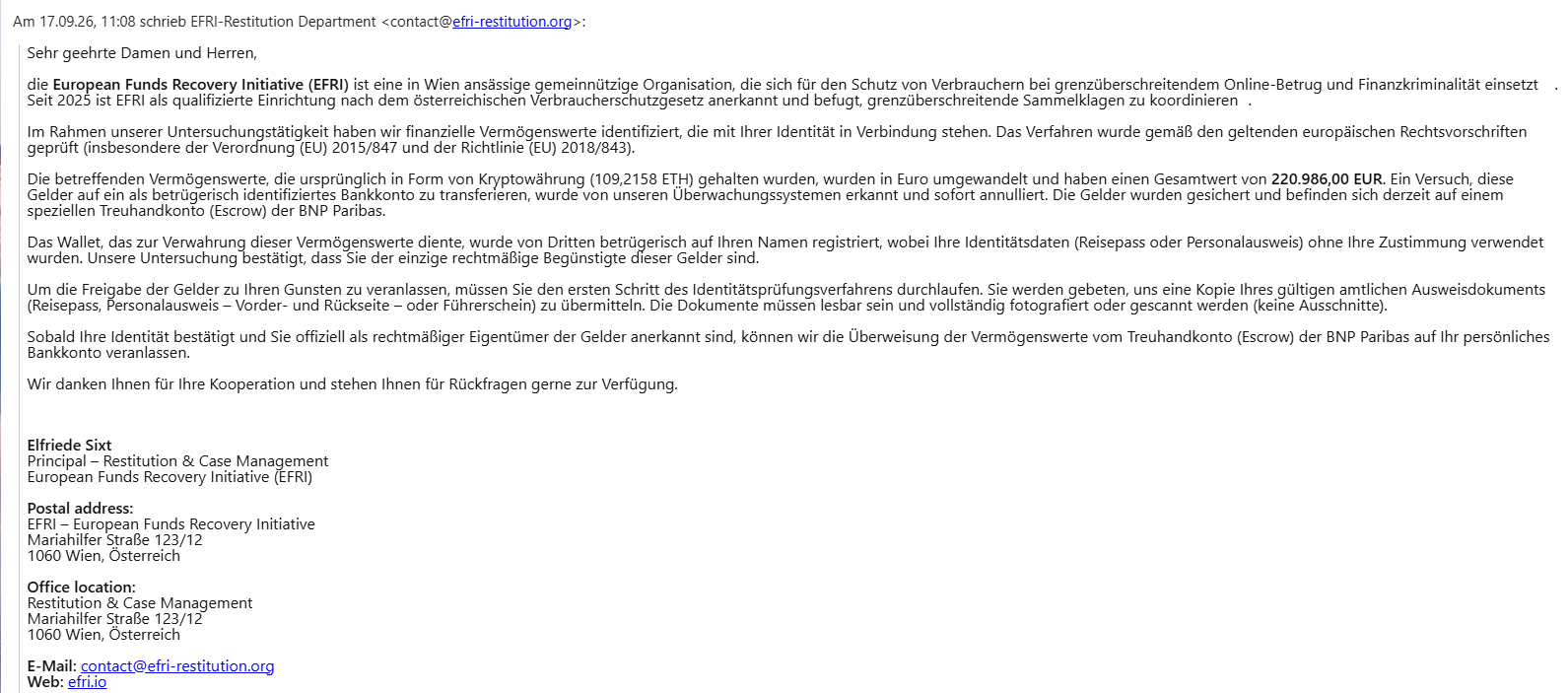
Fake EFRI Investigator ID: New Impersonation Scam Warning
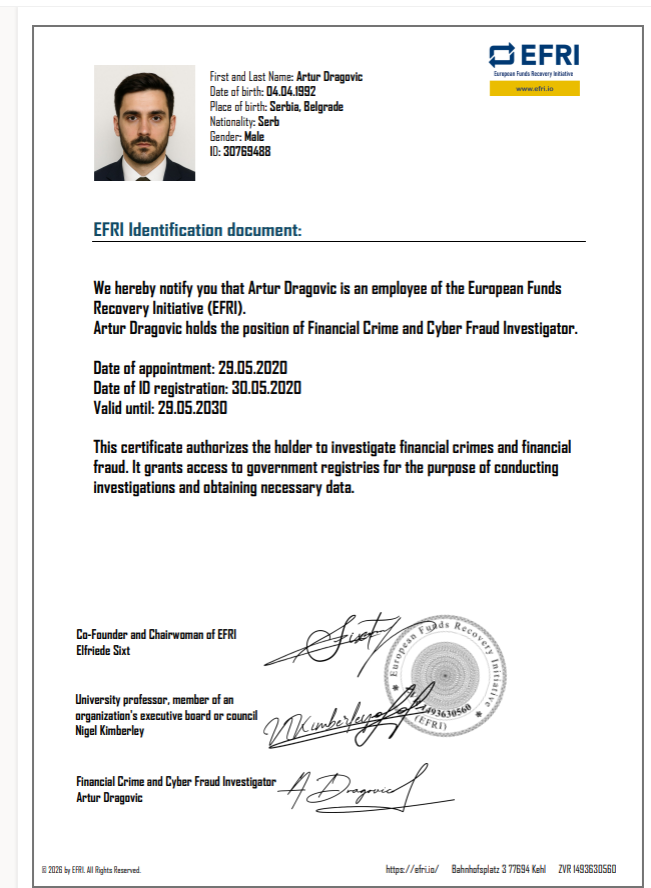
On 4 August 2026, EFRI was contacted by a person who had received an alleged “EFRI Identification Document” and wanted to know whether it was genuine. It is not.
EFRI did not create, issue or authorise this document. The person named in it is not an employee, investigator or authorised representative of the European Funds Recovery Initiative.
The Document Is Fabricated
The document identifies its holder as a “Financial Crime and Cyber Fraud Investigator” and claims that EFRI has authorised him to investigate financial crimes and obtain access to government registries. These statements are false.
The document does not confer any legal authority on its holder. EFRI cannot grant access to confidential government databases or registers, and no private organisation can create such powers merely by issuing an identification certificate.
EFRI is an Austrian non-profit consumer protection organisation. We support victims of financial fraud, analyse complex fraud schemes, coordinate legal proceedings, conduct research and submit information to competent authorities. EFRI is not a police authority, public prosecutor, financial regulator or government agency.
EFRI therefore cannot issue search warrants, freeze accounts, seize assets, access protected government systems or grant individuals governmental investigative powers
Genuine Information Is Being Misused
The fake document appears professionally designed and combines genuine publicly available information with fabricated details. It contains the EFRI name and logo, our official website, EFRI’s Austrian association registration number and the names of individuals connected with EFRI.
It also contains copied or fabricated signatures, an invented employment history, a fictitious identification number and a false description of the holder’s powers.
The use of some genuine information does not make the document authentic. This is a common method used in sophisticated impersonation scams. Criminals copy real names, logos, registration numbers and signatures and combine them with false identities, invented mandates and fictitious legal authority.
The document also lists an address in Kehl, Germany. EFRI is registered in Austria and does not maintain an office at the address stated in the document. The use of EFRI’s correct Austrian registration number together with a false German address shows how the document was assembled from publicly available information.
The Document May Be Used in a Recovery Scam
The document is likely intended to establish trust as part of a recovery scam.
Recovery scammers deliberately target people who have already lost money through investment fraud, cryptocurrency fraud, online trading schemes or other financial scams. They present themselves as investigators, lawyers, regulators, asset recovery specialists or representatives of victim organisations.
Once they have gained the victim’s trust, they may ask for identity documents, bank statements, details of previous losses, cryptocurrency wallet information, passwords, verification codes or remote access to a computer or mobile phone.
They may also demand payments for alleged taxes, compliance checks, insurance, legalisation, court fees or the release of supposedly recovered funds.
An official-looking identification document is designed to overcome the recipient’s natural suspicion. The victim may believe that the person has been verified by EFRI and is authorised to request sensitive information.
That assumption would be wrong. The person presenting this document has no authority to act for EFRI.
How to Verify a Genuine EFRI Contact
Anyone contacted by a person claiming to represent EFRI should verify that person independently through EFRI’s official contact channel at [email protected].
Do not use a telephone number, email address, website link or messaging account supplied by the person whose identity you are attempting to verify. A fraudster may control all of those communication channels and may therefore be able to confirm their own fabricated identity.
EFRI communicates through official EFRI channels. We do not appoint unknown individuals through private Gmail, Outlook or similar email accounts, and we do not issue secret mandates authorising individuals to access government information.
EFRI does not demand payments to unlock, activate, legalise or release allegedly recovered funds. Any legitimate membership fee or approved contribution to legal costs is communicated transparently through official EFRI channels and documented accordingly. Such payments are not linked to secret recovery opportunities, urgent deadlines or guaranteed repayments
What Recipients Should Do
Anyone who receives this document should stop communicating with the sender. No identity documents, bank details, passwords, verification codes, wallet credentials or remote computer access should be provided. No payment should be made.
Recipients should preserve the complete communication, including the original emails and email headers, telephone numbers, WhatsApp or Telegram accounts, domain names, website addresses, bank account details, cryptocurrency wallet addresses, attachments and payment instructions.
The material should be forwarded to [email protected].
Where money has already been transferred, the victim should contact their own bank, the receiving bank and the competent police authority without delay. Where passwords, identity documents or account access details have been disclosed, the affected accounts should be secured immediately.
Impersonation Scams Are Becoming More Professional
This incident shows how impersonation scams are becoming increasingly sophisticated. Criminals now use copied logos, realistic templates, fabricated employment records, electronic signatures, official-looking stamps and personal data obtained from public sources.
Artificial intelligence and modern design tools make it easier to produce convincing documents quickly and at very low cost.
A professional appearance is not evidence that a document is genuine. A registration number is not proof of authority. A photograph, signature, stamp or official-looking title does not establish that the holder represents the organisation named in the document.
The document shown in this warning is fake. Its holder has no authority to act on behalf of EFRI.