Seven Years of Work, 63 Victims, €1.48 Million in P2P Refunds Approved
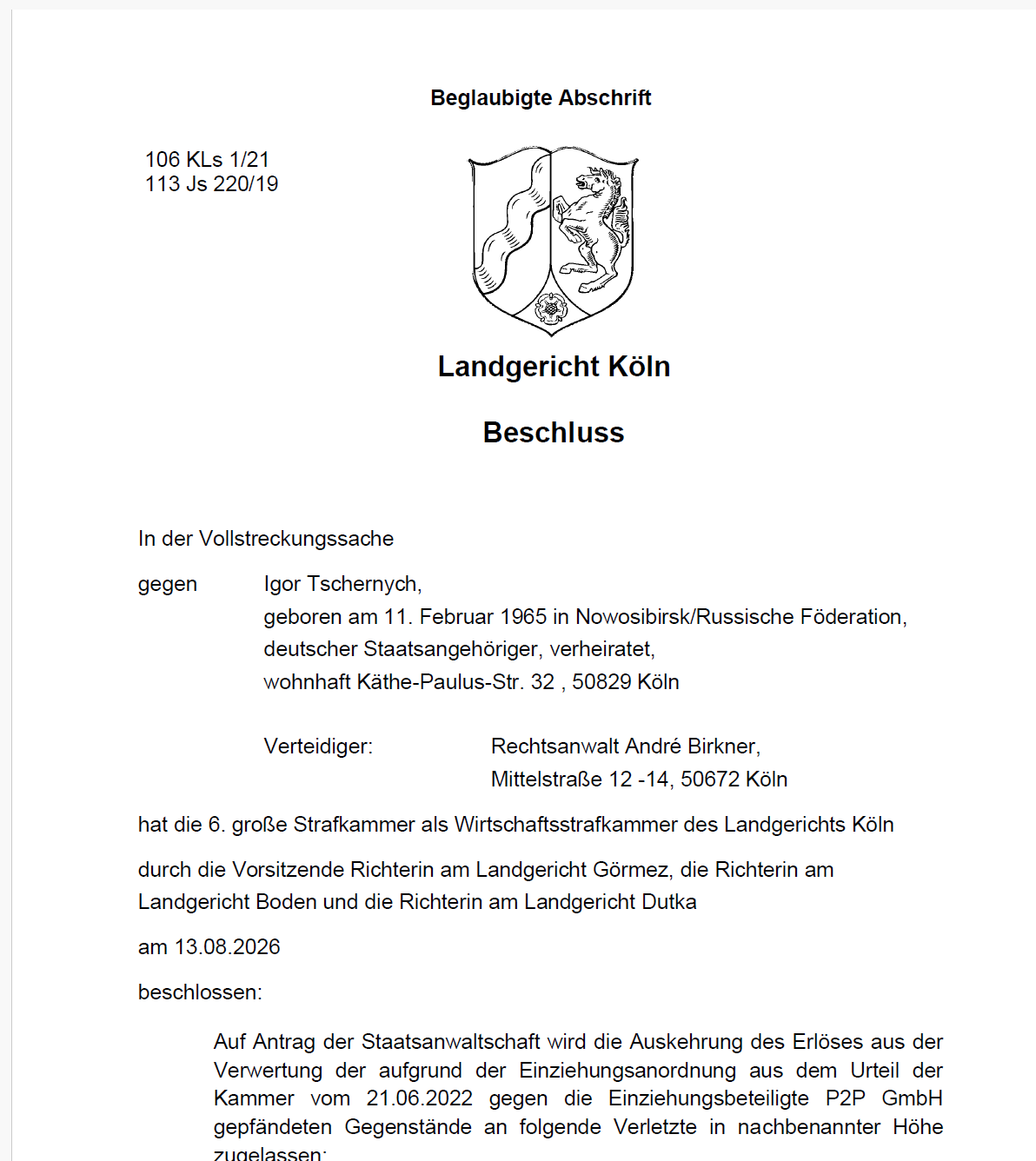
After years of victim identification, payment reconstruction and persistent follow-up, the P2P GmbH case is finally producing a concrete result for victims. The Cologne Regional Court has approved refunds totalling €1,479,152.91 for 63 victims coordinated through EFRI. The payment process has now been released and the transfers are expected to follow shortly.
For EFRI, this is more than the conclusion of a long-running case. It is proof that victim-centred asset recovery can work, but also that the current system still leaves major gaps that civil-society organisations like EFRI are forced to fill.
Victim Identification Was the First Challenge
EFRI’s involvement in P2P began already in 2019, when more than twenty victims were identified and reported to the Cologne Public Prosecutor’s Office. Over the following years, the victim group expanded significantly. A particularly important source was EFRI’s large pool of victims from different online fraud cases. By reviewing historic payment records across different fraud schemes and payment infrastructures, EFRI identified numerous additional individuals who had also transferred money to P2P GmbH.
This cross-case analysis ultimately resulted in a coordinated group of 63 victims. EFRI identified the victims, reconstructed their payments, collected the necessary banking documentation, structured their claims and coordinated their legal representation in Germany.
That work was necessary because the formal mechanism used in Germany to notify victims is poorly suited to cross-border online fraud.
Why Publication in the Bundesanzeiger Is Not Enough
The public prosecutor’s office invited victims to register their claims through a notice published in the Bundesanzeiger, the German Federal Gazette. Legally, this may satisfy the formal notification requirements. In practice, however, the mechanism is poorly adapted to the reality of international fraud victims.
The Bundesanzeiger is not a publication that ordinary German consumers routinely monitor. For victims living in Italy, Sweden, the Netherlands, Austria or other countries, the likelihood of discovering a German asset-recovery notice there is more or less not existing.
A publication mechanism of this kind may work as a formal legal notice. It does not function effectively as a cross-border victim-identification system.
This is precisely where EFRI had to step in. EFRI actively identified affected individuals collected the necessary information and administered the German recovery proceedings together with our German law representative (Vladislav Dimitrov).
That is a central lesson from P2P: asset recovery does not begin and end with freezing money. It also requires a functioning mechanism to identify and reach the people entitled to it. And Europe does not have such a functioning fiat money recovery approach for mass cross-border online fraud cases.
From Frozen Assets to Actual Redress
The P2P experience also confirmed another point EFRI has repeatedly raised in earlier publications. Frozen assets are not the same as recovered assets. For victims, the process is only complete when the money actually reaches them.
The underlying losses and asset seizures date back to 2018. The claims procedure itself took years to reach the point of distribution. In May 2026, EFRI had already documented this gap in its article Asset Recovery in Europe in 2026: Strong on Paper, Broken in Practice. At that time, the problem was simple: assets had been secured, victims had registered their claims, but there was still no reliable distribution perspective.
That has now changed.
The court has decided. The claims have largely been accepted. A total of €1,479,152.91 has been approved for 63 victims, and the money is now moving towards them.
This is a significant result for EFRI. More importantly, it is a significant result for the victims.
For some, recovering part of their money after so many years has consequences that go far beyond the financial figure itself. Some victims have told EFRI that the returned funds will finally allow them to obtain medical treatment or meet essential expenses that they had postponed. Others had been forced to delay their retirement because of their losses and may now finally be able to retire.
The result also demonstrates why coordinated victim representation matters. EFRI’s role was not limited to submitting claims. The work involved identifying victims across jurisdictions, reconstructing historical payments, linking those payments to the relevant German collection accounts, organising the necessary evidence and following the proceedings through to actual distribution.
The P2P case therefore points to another gap that Europe needs to address: mass cross-border fraud requires dedicated structures capable of organising victim recovery across national borders.
The €1.48 million result shows what can be achieved when this work is actually done.
The next Test: B2G GmbH
The next challenge is already waiting.
EFRI has followed the B2G GmbH case for years and has documented the role of B2G accounts in the collection and onward transfer of funds from online investment fraud.
The Cologne Regional Court has ordered the confiscation of €671,549.52 from B2G GmbH, and the Cologne Public Prosecutor’s Office has initiated the formal victim-notification procedure for that amount.
However, the available criminal-file records show that substantially larger amounts had previously been frozen or blocked in connection with B2G.
One particularly important position concerns approximately €1.05 million held at UniCredit Bank/HypoVereinsbank, which was subject to an asset-arrest measure initiated by the Munich Public Prosecutor’s Office in 2018.
The Cologne Public Prosecutor’s Office has now clarified that it remains responsible for €580,328.25 held in connection with Sparkasse Koblenz and €91,221.27 of the Südwestbank funds. Together, these amounts correspond exactly to the €671,549.52 covered by the confiscation order.
According to the information provided to EFRI by the Cologne Public Prosecutor’s Office, responsibility for the additional bank balances — including the approximately €1.05 million at UniCredit/HypoVereinsbank — lies with BaFin. BaFin already showed up in the B2G in 2018 as we reported.
The €1 Million Question
This leads to the next asset-recovery question:
What happened to the approximately €1 million frozen in 2018?
EFRI and lawyers acting for affected victims have sought information from BaFin. In response, BaFin has relied on its statutory confidentiality obligations and on the principle that it exercises its functions in the public interest.
EFRI does not dispute that financial supervision is subject to confidentiality requirements. But there is an important distinction between requesting confidential supervisory material and asking what happened to substantial funds that were frozen years ago and may still be relevant to identifiable victims.
The questions are basic: Where are the funds today? On what legal basis are they being held? Have they been released, transferred or otherwise disposed of? And if they remain secured, what procedure determines their ultimate destination?
Consumers Are Part of the Public Interest
BaFin’s reference to the public interest raises an important conceptual issue.
Under Section 4(4) of the German Financial Services Supervision Act (FinDAG), BaFin exercises its tasks and powers only in the public interest. At the same time, Section 4(1a) FinDAG expressly provides that, within its statutory mandate, BaFin is also responsible for the protection of collective consumer interests.
Consumers are therefore not external to the public interest. Consumer protection is expressly part of BaFin’s statutory mandate.
This does not override legitimate confidentiality requirements. But confidentiality and public-interest supervision should not make it impossible for identifiable victims to establish what happened to substantial funds frozen in connection with the transactions through which they suffered their losses.
From P2P to B2G: The Same Principle
P2P is therefore both a success and a lesson.
Asset recovery is not completed when money is frozen. It is completed when the money reaches the people who lost it.
For 63 P2P victims, that point has finally been reached.
B2G is next.