Hamblin v Moorwand: Why Victims Cannot Fight Alone
The Court of Appeal’s decision in Hamblin v Moorwand exposes a wider failure in fraud recovery. Victims are expected to prove what happened inside financial institutions without access to the relevant records, while the cost of obtaining justice can exceed the fraud loss many times over.
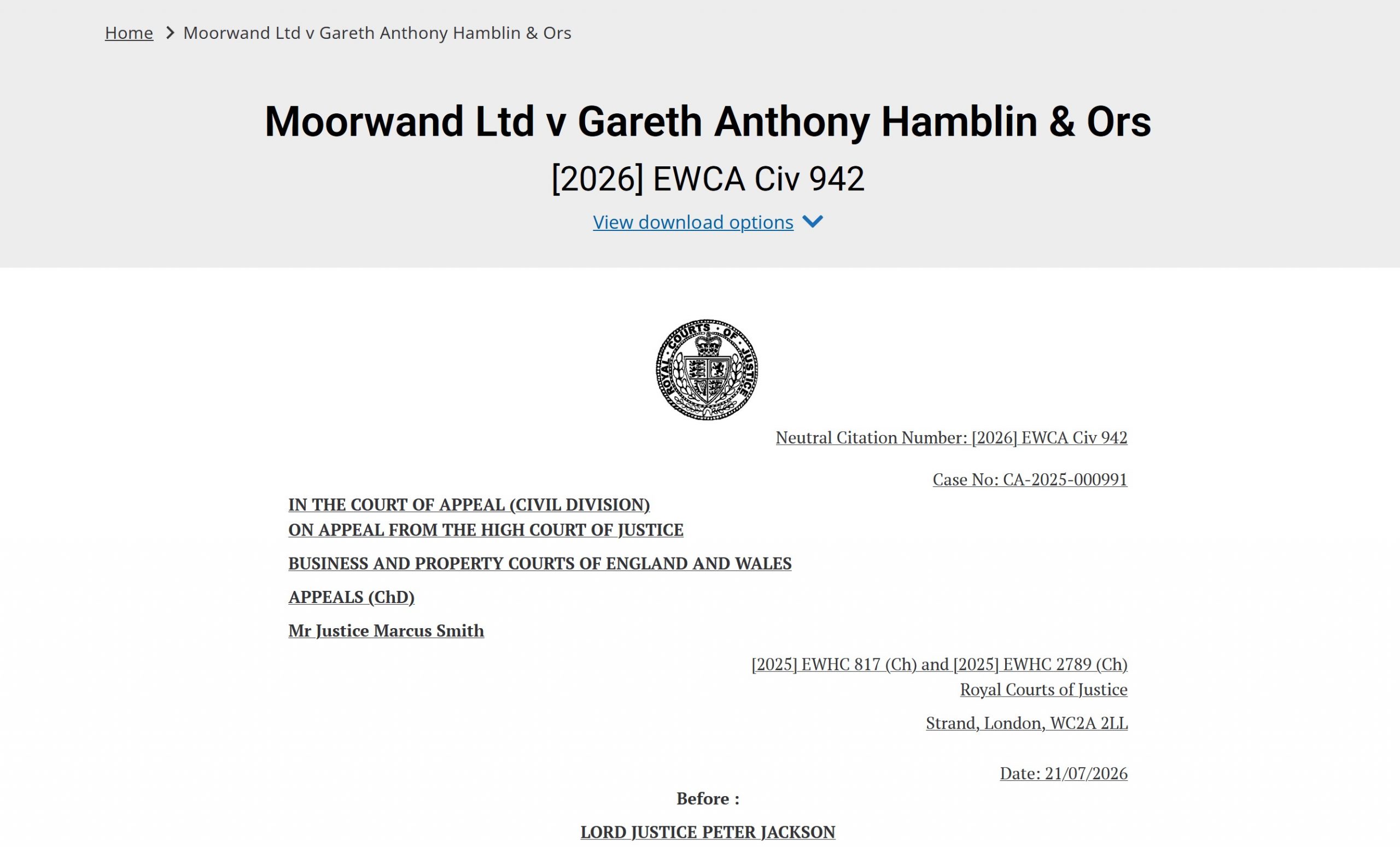
On 21 July 2026, the Court of Appeal restored the dismissal of Gareth and Marilyn Hamblin’s claim against Moorwand Ltd. The Hamblins had transferred £160,000 to an account held by RND Global Ltd with Moorwand, an electronic money institution. RND had been incorporated using the identity of an innocent person, and most of the money was rapidly dissipated through Bitcoin purchases and payments to unrelated businesses.
The original trial judge had concluded that Moorwand had not been put on inquiry that the outgoing payment instructions were unauthorised. Although the High Court later reached a different view (read our report here), the Court of Appeal held that it was not entitled to replace a factual assessment that remained reasonably open to the trial judge.
For the Hamblins, the distinction is academic. They lost their money, pursued the case through a trial and two appeals, faced combined legal costs of approximately £1 million, and still received no compensation from the payment institution that controlled the recipient account used to dissipate their money.
The case should therefore be understood as more than a technical judgment about the Quincecare duty. It demonstrates why individual fraud victims cannot be expected to investigate and litigate the conduct of payment institutions without institutional support.
The institution holds the evidence
A victim normally knows how the fraud was presented, where the money was sent and when it disappeared. The victim does not know what happened inside the recipient institution.
The decisive records are held by the institution itself. They include the customer due-diligence file, transaction-monitoring alerts, internal escalation reports, communications between compliance and management, suspicious-activity assessments and the reasons why an account was opened, retained or allowed to continue operating.
In Hamblin, the account-opening documents contained serious inconsistencies. A Moorwand employee had questioned whether a utility bill appeared fake. The account was nevertheless opened, received a substantial payment from private investors and rapidly transferred the funds into Bitcoin and unrelated businesses. Yet the victims still had to prove a highly specific matter: not merely that the account was suspicious, but that Moorwand should have realised that those issuing the payment instructions lacked authority to act for RND.
This illustrates a fundamental imbalance. The institution possesses the evidence, but the victim carries the burden of establishing the institution’s knowledge, its internal decision-making and the legal consequences of those decisions.
Disclosure may eventually provide access to some of those records. In much of continental Europe, however, broad pre-trial disclosure comparable to common-law discovery is largely unavailable. Victims are usually expected to identify specific documents and establish a plausible case before a court will consider ordering their production. Yet the information needed to meet that threshold is held by the defendant institution. Victims must therefore finance complex proceedings and assume substantial cost risks before knowing whether the decisive internal records will ever become accessible.
The litigation-funding trap
The same information imbalance makes litigation funding extremely difficult to obtain on reasonable terms.
Funders want to assess the strength of a claim before committing capital. In claims against banks and payment institutions, that assessment often depends on evidence of internal warnings, compliance failures, management knowledge and causation. But those materials are normally controlled by the proposed defendant and are unavailable before litigation.
Victims are therefore trapped in a circular system:
Without documents, there is no funding. Without funding, there is no realistic route to obtain the documents.
EFRI encounters this problem repeatedly. A large group of victims and substantial aggregate losses do not automatically produce financeable litigation. Funders still want documentary proof that the financial institution knew, ignored warnings or continued processing despite a recognised fraud risk. The strongest evidence is frequently contained in the institution’s own files.
The result is that potentially meritorious collective claims may never reach the stage at which the relevant evidence can be obtained. Funding terms, where offered, may consume a substantial part of any recovery because the funder must price the legal, evidential and enforcement risks created by this information deficit.
A £1 million route to recover £160,000
The second lesson from Hamblin is the cost of private enforcement.
The Court of Appeal recorded that the combined costs of the trial and two appeals had reached approximately £1 million, around seven times the original amount in dispute. The judgment itself recognised the disastrous proportionality of that outcome.
A legal right that requires expenditure many times greater than the underlying loss is not an effective remedy for an ordinary consumer. It is a theoretical entitlement available only to those capable of risking a second financial disaster after already becoming victims of fraud.
The imbalance is particularly severe in proceedings against regulated financial institutions. The institution has specialist lawyers, continuing access to its records, professional staff and the financial capacity to litigate through several instances. The victim must reconstruct a cross-border payment structure from the outside while bearing the risk of both sides’ legal costs.
The Hamblins should not have been left to carry that burden alone. Nor should other victims be required to test institutional responsibility through individual litigation costing multiples of the amount stolen.
Structural failures require public enforcement
Private litigation has an important role, but it cannot replace regulatory and public enforcement where there are indications of structural failures.
When repeated fraud complaints, suspicious transactions, defective onboarding, ignored alerts or persistent AML shortcomings point to an institutional pattern, authorities must investigate the financial institution itself. They have powers that victims do not possess. They can obtain internal records, compare cases, compel explanations, identify responsible managers and examine whether commercial incentives overrode compliance controls.
The United States provides a useful contrast. FinCEN and federal banking supervisors such as the OCC can investigate systemic AML failures, obtain internal records, impose penalties and require corrective action. Consumer redress is addressed separately by the Consumer Financial Protection Bureau, which can pursue financial institutions and secure compensation for affected consumers.
Europe distributes comparable responsibilities across national supervisors, FIUs, prosecutors and, increasingly, AMLA. This fragmented structure must not leave individual victims responsible for proving institutional failures through costly private litigation.
EFRI has previously called for a European equivalent of the US Consumer Financial Protection Bureau. The Hamblin case shows why such an authority is needed. Victims cannot realistically investigate the internal conduct of payment institutions, finance million-pound litigation and bear the risk of proving systemic failures one account at a time. Europe needs a public body with the mandate and resources to investigate financial institutions, secure internal evidence, pursue enforcement and ensure consumer redress.
Europe must stop outsourcing enforcement to victims
EFRI has previously called for a European equivalent of the US Consumer Financial Protection Bureau. The Hamblin case demonstrates why such an institution is necessary.
European authorities already receive extensive information through supervisory inspections, suspicious-transaction reports, consumer complaints, criminal investigations and cross-border requests for assistance. Yet this information is fragmented across supervisors, FIUs, prosecutors and other public bodies. Victims usually cannot access it and are still expected to establish civil liability independently.
The financial institution holds the internal records. Public authorities may possess additional evidence obtained through supervision or criminal investigations. The victim is left with the burden of proving knowledge, misconduct and causation without meaningful access to either source.
A European consumer-finance authority should be empowered to identify patterns across complaints, investigate financial institutions, compel the production of internal records, pursue enforcement and obtain redress for affected consumers. It should work alongside AML supervisors, FIUs and prosecutors rather than duplicate their functions.
The United States separates these responsibilities across several authorities. FinCEN and banking supervisors address systemic AML failures, while the CFPB can investigate consumer-financial misconduct and obtain compensation for harmed consumers. Europe’s fragmented institutional structure must not become an excuse for leaving enforcement to individual victims.
Private litigation should complement public enforcement. It cannot be expected to replace it.
What the Hamblin case really shows
The judgment does not mean that Moorwand’s controls were vindicated. It means that the Hamblins could not overcome the specific evidential and appellate barriers governing the claim they had brought.
That distinction is central. A court may identify serious irregularities yet still conclude that the claimant has not proved the precise form of knowledge required by a particular cause of action. When the necessary evidence is held by the defendant and litigation costs approach £1 million, that outcome cannot be dismissed as an ordinary failure of proof.
It reflects a system in which the party with the least information and the fewest resources carries the greatest burden.
Fraud victims need collective representation, viable funding structures and authorities willing to act when payment institutions repeatedly enable suspicious business models. Private litigation should be one part of enforcement, not the only mechanism available when regulatory controls fail.
The lesson from Hamblin v Moorwand is therefore broader than the limits of Quincecare liability. Victims cannot be expected to uncover institutional misconduct, finance years of litigation and absorb catastrophic cost risks on their own.
When evidence points to structural neglect, public authorities must investigate, establish responsibility and ensure that enforcement serves the victims as well as the integrity of the financial system.