Meta, TikTok and Google are facing consumer complaints in Europe over financial scam advertisements. But the key question goes beyond platform compliance: if regulators impose fines, why should the money disappear into public budgets while the victims remain uncompensated?
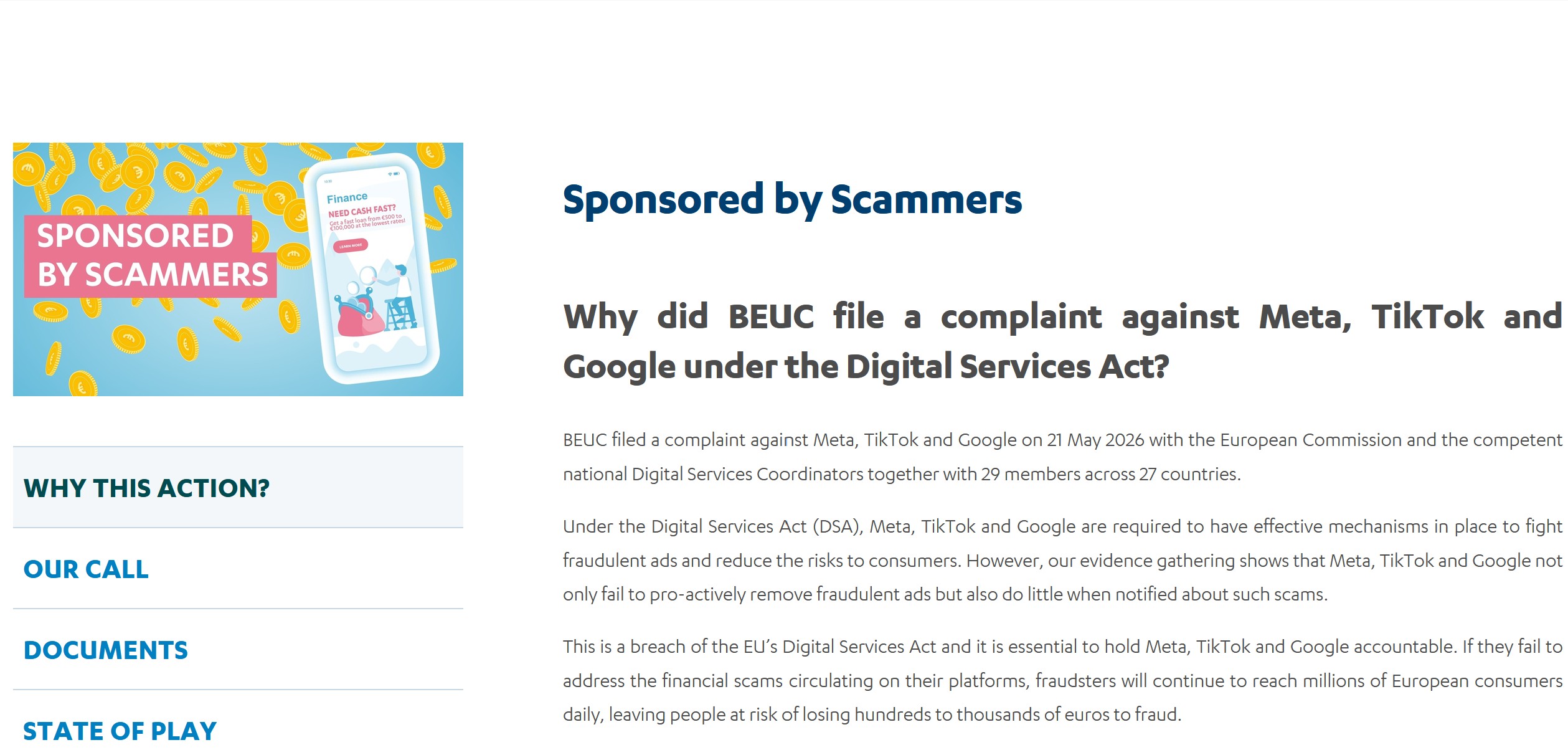
On 21 May 2026, BEUC, the European Consumer Organisation, together with 29 member organisations from 27 countries, filed complaints with the European Commission and national authorities against Meta, TikTok and Google. The complaints allege that these platforms fail to adequately protect consumers from fraudulent financial advertisements, despite their obligations under the EU Digital Services Act.
The evidence gathered by BEUC is significant. Between December 2025 and March 2026, consumer organisations in 13 countries reported 893 suspected unlawful financial scam ads. According to BEUC, only 27% of those ads were removed following the reports, while 52% of the reports were rejected or ignored.
The platform figures are striking:
- Meta: 503 suspected scam ads reported; 146 removed after notice, 216 rejected, 90 ignored, 51 already removed before follow-up.
- TikTok: 360 suspected scam ads reported; 79 removed after notice, 74 rejected, 73 ignored, 134 already removed before follow-up.
- Google: 30 suspected scam ads reported; 18 removed, 7 rejected, 5 ignored.
These figures matter because they turn the debate from abstract platform promises into measurable enforcement reality. The issue is not whether Meta, TikTok and Google have policies against scams. They all say they do. The issue is whether those systems work when concrete suspected financial scam ads are reported.
The EU has already started looking at financial scam risks
The BEUC complaint did not emerge in isolation.
The Digital Services Act has applied to the first designated Very Large Online Platforms and Very Large Online Search Engines since 25 August 2023. It created a new enforcement framework for systemic online risks, including illegal content, deceptive advertising and consumer harm.
On 23 September 2025, the European Commission sent formal DSA requests for information to Apple App Store, Booking.com, Google Play, Google Search and Microsoft Bing. The Commission asked how these services identify and reduce risks linked to financial scams.
For Apple App Store and Google Play, the focus included fraudulent apps imitating legitimate banking, investment or trading apps. For Bing and Google Search, the Commission expressly addressed links and advertisements leading users to fraudulent websites, often resulting in financial losses.
This is important. Financial scam ads are not only a content moderation problem. They are also an advertiser-verification problem, an ad-transparency problem and a systemic-risk problem.
DSA fines are no longer theoretical
The Digital Services Act now has real enforcement consequences.
On 5 December 2025, the European Commission imposed a €120 million fine on X for breaches of DSA transparency obligations, including issues related to its advertising repository and access to public data for researchers.
On 28 May 2026, the Commission imposed a €200 million fine on Temu under the DSA, finding failures in the assessment of systemic risks linked to illegal products and resulting consumer harm.
These cases were not about financial scam ads on Meta, TikTok or Google. But they show that the DSA has entered its sanctioning phase.
Under the DSA, the Commission can impose fines of up to 6% of a provider’s global annual turnover. If authorities establish serious or repeated failures in relation to financial scam advertising, the financial consequences for major platforms could be significant.
But fines do not repair victims’ losses
This is the core weakness in European enforcement.
A platform may earn advertising revenue from fraudulent campaigns. Consumers may be targeted through sponsored posts, fake investment offers, misleading trading ads, celebrity impersonations or deepfake promotions. Victims may then lose thousands, tens of thousands or even hundreds of thousands of euros.
If regulators later impose a fine, the platform is punished. The authority has enforced the law. The EU can point to regulatory action.
But the victim is still empty-handed.
That is not a technical issue. It is a structural failure.
A regulatory fine may discipline a platform. It does not restore the savings of a pensioner led from a sponsored advertisement to a fake trading platform. It does not compensate a consumer who trusted an advertisement because it appeared on a major regulated platform. It does not repair the damage caused by advertising systems that enabled financial fraud to scale.
Europe must therefore ask a simple question:
If Big Tech platforms are fined for failures linked to financial scam ads, should the money benefit only public budgets — or also the consumers exposed to and harmed by those scams?
Article 54 DSA is not enough without practical enforcement
Article 54 of the Digital Services Act recognises that users may seek compensation for damage or loss suffered due to a provider’s infringement of DSA obligations.
That is important. The DSA is not only a public-enforcement tool. It also acknowledges that users can suffer compensable harm when platforms breach their obligations.
But in practice, victims face serious obstacles. They must identify the specific advertisement, preserve evidence, prove exposure, trace the path from the ad to the scam website, document payments, establish the platform’s failure and prove causation.
Most victims cannot do this alone.
This is the enforcement gap: regulators can investigate platforms, consumer organisations can gather evidence, and authorities can impose fines — but victims are left to pursue complex and costly claims on their own.
Europe needs a Financial Scam Victim Redress Mechanism
EFRI believes that Europe must move beyond a model in which authorities collect penalties while victims remain uncompensated.
If very large online platforms are sanctioned for systemic failures to prevent, detect or remove financial scam advertising, all or at least part of the economic enforcement response should support victims.
Europe should create a dedicated Financial Scam Victim Redress Mechanism or fund. Such a mechanism could be supported by DSA fines, settlement payments, commitments or dedicated platform contributions in cases involving systemic failures linked to financial scam ads.
It should support:
- victim compensation;
- evidence preservation and access;
- collective redress;
- litigation support for qualified entities and victim organisations;
- cross-border enforcement against platforms, scam networks and other financial crime enablers.
This would not replace private claims. It would make them practically possible.
The real test for the DSA
The Digital Services Act was presented as a new era of platform accountability. The BEUC complaints now test whether that promise is real.
If the EU only fines platforms, it proves that it can punish Big Tech.
If the EU also creates a route for victims to recover losses, it proves that digital regulation can serve the people it was designed to protect.
Financial scam victims do not need another press release. They need redress.
A fine without compensation is not justice.
It is only a receipt issued to the regulator.