Banking Circle 2025: The Payments Bank Whose Largest Fee Line Is Not Payments
An EFRI financial-structure analysis based on Banking Circle S.A.’s audited financial statements for 2022–2025, its regulatory disclosures and its own product descriptions. It makes no finding of criminal or regulatory misconduct. Where the accounts do not permit a conclusion — notably on segment profitability or the identity of fiduciary clients — we say so. Throughout, the financial figures are those of the licensed bank, Banking Circle S.A.; the annual payment volumes and the group chairmanship refer to Banking Circle Group.
Banking Circle presents itself as modern payments infrastructure: more than €1.5 trillion in annual payment volumes, over 850 financial-institution clients and a network built to move money across borders at speed. Its audited accounts tell a more complicated economic story. Since 2023, Banking Circle has built a multi-billion-euro fiduciary business. By 2025, fiduciary commissions exceeded payment-fee income. Together with the substantial interest margin generated on client balances, the accounts suggest that Banking Circle’s profitability increasingly depends not only on processing payments, but also on monetising the liquidity brought into the bank by its institutional clients.
The payments bank
Banking Circle describes itself primarily as infrastructure for Payment businesses, banks and other financial institutions. It says it serves more than 850 regulated financial institutions and processes more than €1.5 trillion annually. Its public narrative centres on clearing, virtual IBANs, cross-border payments, FX and technology.
After reading the annual reports we think this description is incomplete. The audited accounts show that the economics of Banking Circle changed materially from 2023 onwards
A business that did not exist in 2022
At year-end 2022 Banking Circle reported no fiduciary operations.
In 2023 the bank stated expressly:
“In 2023 the bank started fiduciary operations.”
Within one year, fiduciary operations reached €1.241 billion (a figure shown as off-balance sheet position), producing €9.46 million in commissions. Banking Circle also became profitable for the first time, reporting €12.7 million compared with a €25.4 million loss in 2022.
Then the new business accelerated.
At year-end 2024:
Fiduciary operations: €6.075 billion
Fiduciary commission income: €71.66 million
Payment fee income: €56.89 million
The Directors’ Report stated that the sharp increase in fee income was driven mainly by fiduciary operations.
By 2025, the fiduciary year-end balance had fallen to €5.376 billion, but fiduciary commissions increased further to €80.8 million. Payment fee income was €69.6 million. Direct payment-fee expense of approximately €11.2 million left around €58.4 million of net payment-fee income before staff, technology, compliance, depreciation and other operating costs.
The progression is striking:
| Year | Fiduciary operations | Fiduciary commissions |
|---|---|---|
| 2022 | €0 | €0 |
| 2023 | €1.241bn | €9.46m |
| 2024 | €6.075bn | €71.66m |
| 2025 | €5.376bn | €80.80m |
Within two years Banking Circle created a fee stream of more than €80 million from a business that did not exist at year-end 2022.
What are the € 5.376 billion?
The scale of Banking Circle’s fiduciary business is clear from the audited accounts. The explanation of what the business actually consists of is remarkably brief.
The €5.376 billion year-end amount appears on page 18 of Banking Circle S.A.’s 2025 Annual Report, under the off-balance-sheet item “Fiduciary operations”. The corresponding 2024 amount was €6.075 billion. Beyond that single line, the balance-sheet disclosure provides no breakdown of the underlying assets.
The accounting treatment is explained only later, in Note 3.13 “Fiduciary operations” on page 36. Banking Circle states that clients place funds under fiduciary arrangements, that the bank acts “solely as an agent”, has no right to use or control the assets for its own benefit and does not assume the associated risks and rewards. The assets are therefore not recognised on Banking Circle’s balance sheet.
The Directors’ Report provides one further data point: page 5 states that Banking Circle introduced a Money Market Fund fiduciary product during 2025 and that this product represented approximately €427 million at year-end. That still leaves roughly €4.95 billion of the €5.376 billion fiduciary balance without any comparable public asset breakdown in the annual report.
The economic importance of the business becomes visible only in the income notes. Note 26 on page 49 reports €80.8 million of “Commission on fiduciary operations” for 2025, up from €71.7 million in 2024. That made fiduciary commissions larger than Banking Circle’s €69.6 million of payment-fee income.
Banking Circle therefore discloses a business involving €5.376 billion of client assets and €80.8 million of annual commission income across only a handful of passages in the 66-page audited report.
The report does not disclose:
the full asset allocation of the €5.376 billion;
the average fiduciary balance during 2025;
the maturity profile of the assets;
the principal custodians, banks, funds or other counterparties;
the detailed fee structure producing €80.8 million of commissions;
the concentration by fiduciary client;
or the proportion attributable to PSP/EMI safeguarding or other downstream-customer funds.
Those omissions may be entirely consistent with the applicable accounting disclosure requirements. But they leave an outside reader with remarkably little information about a business that, within only three years of being launched, has become Banking Circle’s largest separately disclosed fee-generating activity and, on the face of the 2025 accounts, one of the bank’s most important profit drivers. Because Banking Circle does not publish a segment cost allocation, the accounts do not permit us to calculate its standalone fiduciary profit. The €80.8 million revenue contribution nevertheless makes the business economically central to the bank’s overall profitability.
Payments may be the funnel
The 2025 profit and loss account shows why this matters. Banking Circle earned approximately €128.3 million in interest income and incurred around €37.0 million in interest expense, producing roughly €91.3 million of net interest income.
Set the principal streams beside each other:
Net interest income: ~€91.3m
Fiduciary commissions: €80.8m
Net payment fees before operating costs: ~€58.4m
Banking Circle does not publish a segment cost allocation. It would therefore be incorrect to state as fact that its payment business is loss-making. But direct payment fees alone are unlikely to explain the economics of a platform requiring hundreds of employees, clearing infrastructure, compliance, transaction monitoring, technology, reconciliation, cybersecurity and regulatory operations.
The liquidity generated around those payments appears far more important.
Banking Circle publishes no segment profit-and-loss account. But on any reasonable allocation of its ~€151 million cost base — the overwhelming majority of which (staff, clearing, compliance, transaction monitoring, technology) serves the payments and banking platform, not the low-touch treasury and fiduciary desks — the payments business does not cover its own costs. Its ~€58 million of net payment fees are carried by €91 million of interest margin and €81 million of fiduciary commissions. On the aggregate figures the payments operation is not a profit centre but a client-acquisition funnel, cross-subsidised by the liquidity those clients bring; the bank does not disclose the segment split that would show otherwise
One PSP, several revenue streams
Banking Circle’s institutional clients maintain balances because they use its payment infrastructure. Those relationships can generate revenue in several ways. First, client balances appearing on Banking Circle’s own balance sheet provide funding. Treasury places corresponding liquidity into central-bank balances, government securities and other highly liquid assets, producing interest margin. Second, qualifying client liquidity can enter fiduciary arrangements. The assets then sit outside Banking Circle’s balance sheet, while the bank receives fiduciary commissions.
The same institutional client can therefore generate payment fees (presumably the lowest part); deposit funding and interest margin; FX and other banking income; and fiduciary commission income. That is commercially rational and it is the fact that gives the governance question in Our Assessment its shape.
€1.5 trillion moved — €69.6 million in payment fees
Banking Circle currently says it processes more than €1.5 trillion annually (a Banking Circle Group figure). Its 2025 audited accounts report €69.6 million of payment-fee income (Banking Circle S.A.). If those figures were aligned in period and perimeter, the payment-fee income would equal only about 4.6 basis points of processed volume. They are not aligned — the volume is a group-level figure and the fee income is the licensed bank’s — so the ratio is indicative only.
But the orders of magnitude matter: moving enormous wholesale payment volumes generates thin direct fees; holding, investing and administering the associated liquidity can generate substantially more
Another earnings-quality consideration: software capitalisation
Banking Circle’s capitalisation of internally generated software is not a one-off feature of the 2025 accounts. It has been a recurring and material element of reported profitability since 2022.
| Year | Capitalised dev. expenditure* | Value adjustments | Net (cap. − adj.) | Intangibles at year-end | Net profit/(loss) |
|---|---|---|---|---|---|
| 2022 | €24.1m | €9.5m | €14.6m | €50.4m | €(25.4)m |
| 2023 | €27.2m | €13.5m | €13.7m | €64.7m | €12.7m |
| 2024 | €28.7m | €19.0m | €9.7m | €74.4m | €67.3m |
| 2025 | €42.1m | €23.8m | €18.3m | €92.7m | €81.0m |
*Additions to internally developed software projects (Note 8). Total 2023 additions to intangibles were €28.5m, of which ~€1.3m were other intangibles acquired with b4payments; the table isolates the development-project additions.
The intangible-asset balance has risen from €50.4 million at year-end 2022 to €92.7 million at year-end 2025, an increase of more than 80%. The mechanism matters for how profit is reported: qualifying development expenditure is recorded as an asset rather than charged in full against the current income statement, reaching profit and loss later through amortisation and, where needed, impairment. In every year reviewed, newly capitalised development expenditure exceeded the value adjustments recognised against intangibles in the same year — by roughly €14 million in both 2022 and 2023, and €18 million in 2025 — so a substantial part of current technology spend has consistently been carried into future periods rather than expensed now.
These figures are not an alternative measure of profit, and the result is not “overstated”: the accounting follows the applicable recognition and amortisation rules. But the scale is hard to ignore in the profitable years — €27.2 million capitalised against €12.7 million of net profit in 2023, €28.7 million against €67.3 million in 2024, and €42.1 million against €81.0 million in 2025, the last equivalent to roughly 52% of reported net profit. EY has treated the capitalisation and valuation of internally generated software as a Key Audit Matter throughout the period, pointing in 2022 to the “high volume of capitalizations” and, in each year since, to the management judgement involved in technical feasibility, future economic benefit and impairment.
Capitalising qualifying software development is standard practice and does not by itself indicate aggressive accounting. But in assessing Banking Circle’s underlying earnings, the amounts are too large to set aside: the strong profitability reported since 2023 has coincided not only with rapidly growing interest and fiduciary income, but also with a continuing, material capitalisation of technology expenditure.
and then Ralph Hamers shows up
On 20 April 2026 Ralph Hamers, the ex-CEO of ING and UBS became Chairman of the Group Board of Directors of Banking Circle Group.
Banking Circle said he would help:
“strengthen the operational and regulatory foundation for the next phase of scaled growth.”
That wording deserves attention. By then Banking Circle was no longer simply a fast-growing payments provider. Its audited accounts showed billions of client balances, more than €5 billion of fiduciary operations and a revenue model increasingly dependent on monetising client liquidity.
Whether Hamers is the right person to strengthen that regulatory foundation is a separate question. His record at ING — including ING’s huge AML failures and the acquisition of Payvision while the Houston investigation was already under way deserves separate examination. Hamers himself publicly supported the Payvision acquisition as ING CEO in early 2018.
The timing is particularly interesting because Hamers has now published his book: Do Your Thing: Lessons from Banking’s Biggest Digital Transformation, setting out his own account of banking digitalisation, transformation and leadership, often in the language of modern management theory. We will return separately to how that account compares with the regulatory and governance record of ING and the Payvision acquisition.
Our Assessment
This section is EFRI’s own evaluation. It is analysis and commentary, not a finding of fact or law.
Through its public narrative Banking Circle is payments infrastructure; through its audited accounts the economics are broader. Payments attract institutional clients whose balances then generate interest margin, and whose liquidity feeds a fiduciary business that by 2024 already earned more in commissions than payments did (€80.8 million has to be comparied with €69.6 million in 2025).
For EFRI that creates a structural tension: the same high-volume, high-balance client is often both commercially most valuable and the one whose customer base and flows most need scrutiny, so the commercial intent to acquire and retain runs directly against the duty to restrict, investigate or reject on AML, sanctions or fraud grounds. We are careful how far that goes. A fiduciary book held in money-market funds and government securities is not, in itself, high financial-crime risk, and the tension bites only insofar as that €5.376 billion contains safeguarding or idle liquidity from the same payment and virtual-IBAN clients (which the accounts do not disclose). The incentive is established; how it is managed is not.
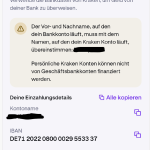
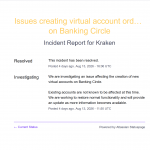
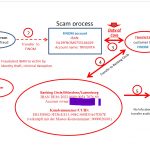
Where EFRI has seen that risk crystallise, it is at the payment and virtual-IBAN layer, not the fiduciary book: a Banking Circle virtual IBAN opened in a fraud victim’s own name in the FINOM/Triventa file, and Banking Circle virtual IBANs receiving victim funds in the OCCRP “Scam Empire” investigation. And there the accounts sharpen a contradiction in Banking Circle’s own defence. Banking Circle says it holds no records on the underlying customers of its clients — arguable for a pure conduit that only passes funds through. It is far harder to sustain once the same bank invests those funds as fiduciary agent for commission: an obliged entity providing a financial service on funds must be able to satisfy itself as to their source and beneficial ownership. If any material part of the €5.376 billion is PSP or EMI safeguarding money — the clients’ customers’ money, which such a book will tend to contain — Banking Circle is monetising funds beneficially owned by the very people it says it cannot identify. “We do not know the customer’s customer” and “we invest the customer’s customer’s money” cannot both be true.
Banking Circle would answer that its fiduciary client is itself a regulated PSP on which it may rely. That does not carry the weight: reliance does not extinguish the bank’s own responsibility, cannot cure the absence of any source-of-funds view on money it is itself investing, and “solely as agent”, off the balance sheet, is an accounting label, not an AML exemption, a Luxembourg credit institution is a full obliged entity for the funds it administers, and the EBA’s 2024 warnings on know-your-customer’s-customer gaps point the same way. The composition of the book is undisclosed, so the trigger is conditional; the legal consequence, once met, is not.
There is also an evident earnings-quality question. As recently as 2022, before the fiduciary business and before rates rose — Banking Circle reported a €25.4 million loss; its profits since track two things unrelated to processing payments, interest margin on client balances and fiduciary commissions. In 2025, staff and administrative costs alone were €121.4 million (€67.3 million of staff cost for a workforce of 805; €54.1 million other), against just €58.4 million of net payment-fee income; the €81.0 million profit rests on net interest income (~€91.3 million) and fiduciary commissions (€80.8 million), and is further supported by deferring technology cost through capitalisation. Strong interest income on client balances was common across transaction banks in the high-rate years of 2023–2025 and is no governance concern by itself, but strip these out and the payments operation does not appear self-supporting: its profitability depends on rates the bank does not control and on a fiduciary book it does not break down.
This matters more, not less, because Banking Circle is for sale. EQT has been reported since September 2024 to be seeking a majority-stake exit at a valuation of around US$2 billion. A sale sharpens the very tension identified here, the pull to show clean, fast growth ahead of an exit against the duty to restrict risky clients, and it is exactly what a buyer’s due diligence and the CSSF’s change-of-control review should test: how durable the earnings are, what the fiduciary book contains, and whether customer due diligence, KYCC and monitoring have scaled with the business. The regulatory question is not whether Banking Circle has AML policies — it does — but whether those controls have kept pace with both the complexity of the business and the commercial value of the clients they may sometimes have to reject. Payments explain how money enters the ecosystem; the accounts increasingly explain how Banking Circle makes money once it is there.
Against that background, Banking Circle Group’s choice of Ralph Hamers to help “strengthen the operational and regulatory foundation” warrants scrutiny. Hamers led ING during part of the period in which Dutch authorities later identified serious structural AML deficiencies, and he publicly backed ING’s acquisition of Payvision while the Houston investigation was already under way. Whether that is the governance record best suited to Banking Circle’s present regulatory challenge is a question we will examine separately.