EFRI Case Note, Part 2 of 2 — five decisions from Germany, the Netherlands and the United States (18 September 2024 to 21 August 2026), read against Directive (EU) 2024/1260. By EFRI | 26 October 2026. Case-law and legislative review as at 26 October 2026.
When prosecutors seize cryptoassets, recovery also depends on the state process. Whether and when value reaches the victim depends on how quickly the state acts, whether the assets are kept or sold, and whether confiscation is linked to compensation. By 23 November 2026, the Member States bound by Directive (EU) 2024/1260 must transpose its asset-recovery and confiscation framework (Art. 33(1)). It expressly includes cryptoassets and addresses both interlocutory sales and victims’ claims. The case law shows what the transposition needs to deliver.
Part 1: Fraud Victims, Crypto Exchanges and the Civil Route examines proceedings brought by victims themselves against exchanges and account holders. This second part turns to state intervention. The national decisions are examined under the rules applied in those cases; the Directive provides a benchmark for implementation, not a retroactive basis for those judgments. The US case is a comparison, not an application of EU law.
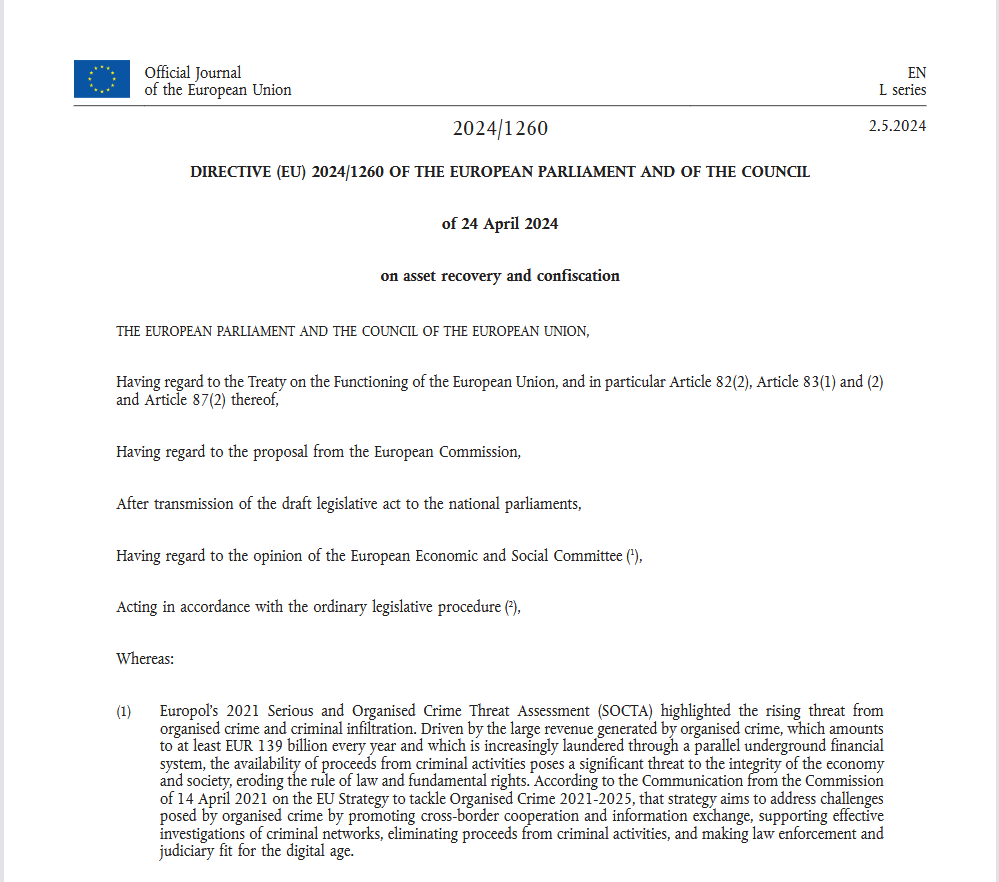
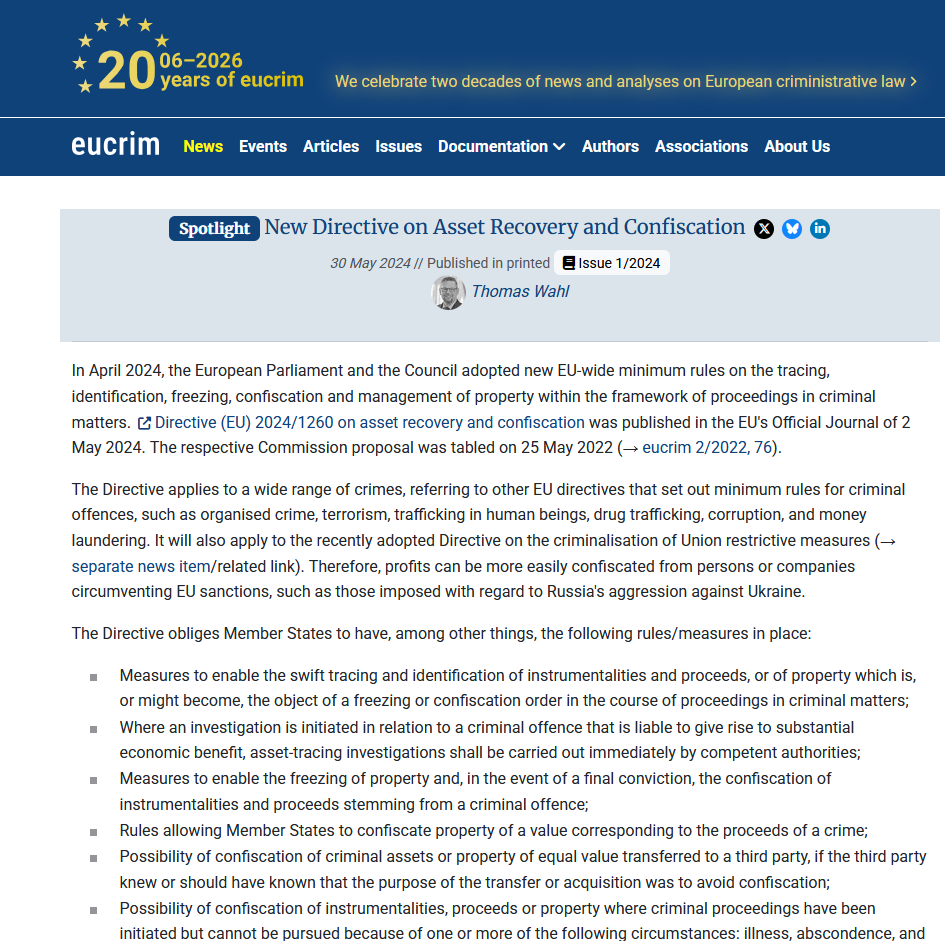
1. What the Directive requires
Cryptoassets are property for this framework. The definition of property expressly includes cryptoassets. Asset recovery offices must be able to obtain information on crypto-asset accounts and transfers swiftly, either directly or upon request, subject to procedural safeguards. Recital 23 identifies cryptoassets as property that can disappear very quickly (Arts. 3(2), 6(1), 6(3)(j), 6(4) and 6(6); recitals 12 and 23).
Speed, with defined conditions. Where an investigation concerns an offence liable to generate substantial economic benefit, asset tracing must begin immediately. Member States may, however, limit this particular requirement to investigations into offences liable to have been committed within a criminal organisation (Art. 4(3)). Immediate action must be taken where necessary to preserve property pending a freezing order (Art. 11(2)). Asset recovery offices must be empowered to take such action where there is an imminent risk that property they have traced for another Member State will disappear; that temporary action may last no more than seven working days. This is not a seven-day limit on every freezing order (Arts. 5(2)(b), 11(3)). A freezing order may continue only as long as necessary for possible subsequent confiscation, and property not subsequently confiscated must be unfrozen without undue delay (Art. 11(5)).
Interlocutory sale is an available power, not an automatic result. Member States must ensure that frozen property can be transferred or sold before final confiscation where it is perishable or rapidly depreciating, storage or maintenance costs are disproportionate, or management requires special conditions and expertise not readily available (Art. 21(1)). The affected person’s interests, including replaceability, must be considered. Unless the affected person has absconded or cannot be located, they must be notified and, except in urgent cases, given an opportunity to be heard before sale. The person must also be able to request a sale (Art. 21(2)). Sale proceeds must remain secured until a judicial decision on confiscation (Art. 21(3)). Effective challenges to sale orders, including the possibility of judicial suspension to prevent irreparable harm, must be available (Art. 24(6)).
Victims’ claims must be part of the process. Claims against the person subject to confiscation must be taken into account in the relevant tracing, freezing and confiscation proceedings (Art. 18(1)). Tracing authorities must be enabled to share relevant asset information, on request, with authorities deciding or enforcing restitution and compensation claims; spontaneous sharing may also be enabled (Art. 18(2)). Asset recovery offices must be able to trace property linked to such decisions at least in the cross-border situations specified in Art. 18(3).
Where a victim is entitled to restitution of property subject, or potentially subject, to confiscation, Article 18(4) requires its return under the conditions of Article 15 of Directive 2012/29/EU. That provision concerns recoverable property seized in criminal proceedings: following a competent authority’s decision, it must be returned without delay unless still needed for those proceedings. National law determines the conditions and procedure. This is a restitution rule, not a blanket entitlement to immediate compensation out of every frozen balance. Confiscation must not prejudice compensation rights, although Member States may limit that protection to cases where the offender’s lawful assets cannot cover the full compensation (Art. 18(5)).
The scope gap needs a precise description. The framework covers offences under the instruments listed in Article 2(1), including organised crime, money laundering and non-cash-payment fraud, and the offences specified in Article 2(2) committed within a criminal organisation. Investment fraud as a standalone category is not expressly listed. Whether a particular scheme falls within the confiscation framework therefore depends on the relevant offence and statutory conditions; fraud connected with money laundering or a qualifying criminal organisation can fall within it. Recital 10 refers to fraud and swindling in its discussion of offences committed within a criminal organisation.
There is, however, an important wider rule: Chapter II on tracing and identification also applies to all offences under national law punishable by deprivation of liberty or a detention order of at least one year (Art. 2(4)). The scope of tracing is therefore broader than the scope of every confiscation and compensation provision. Extending the complete regime clearly to investment fraud is an EFRI policy proposal, rather than an obligation stated in recital 10.
2. Preserving value: Hanau and The Hague
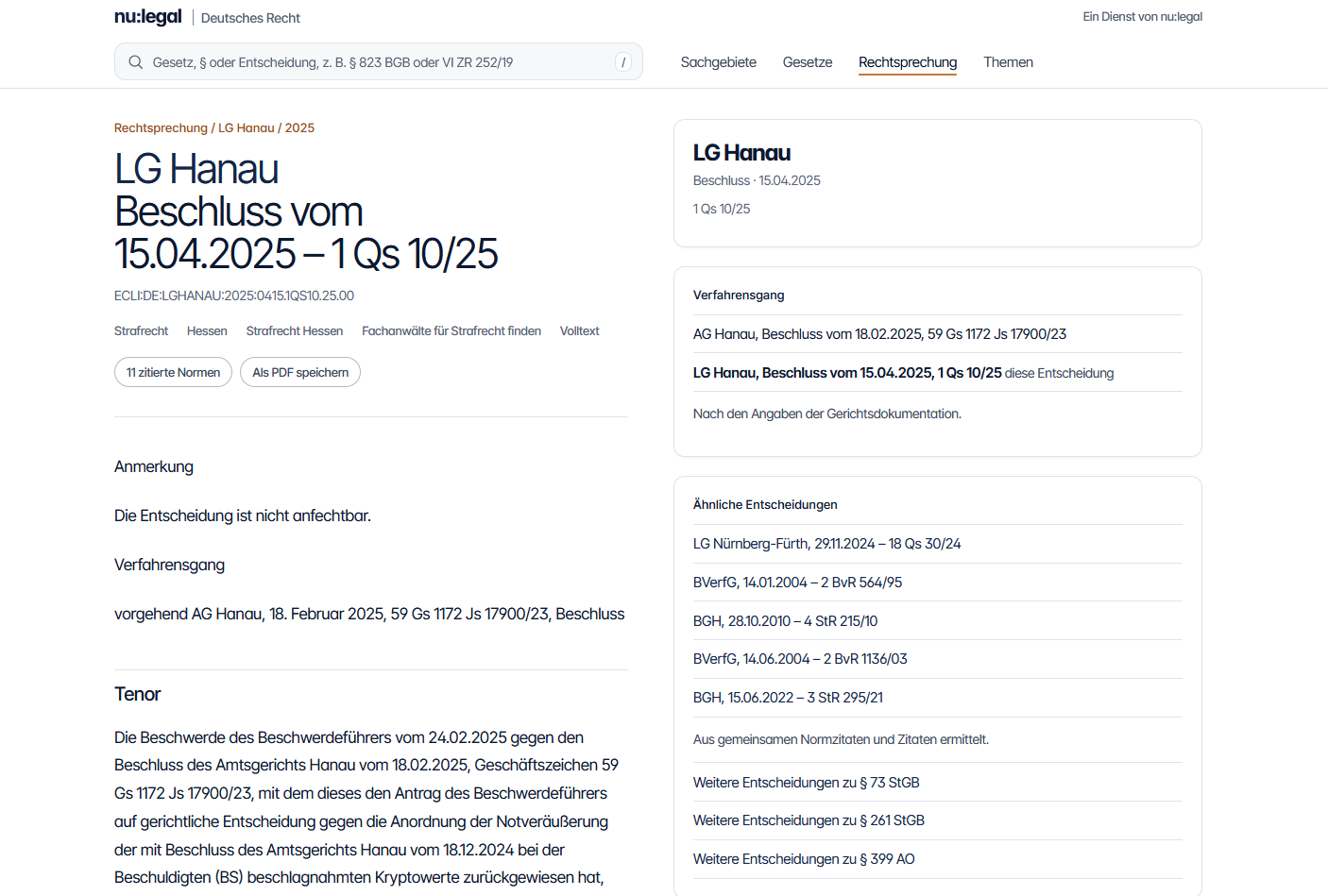
LG Hanau, 15 April 2025, 1 Qs 10/25, ECLI:DE:LGHANAU:2025:0415.1QS10.25.00 (non-official text).
Cryptoassets, mainly XRP and ADA (valued at €13,768.67 on 2 September 2024), had been seized on hardware wallets in a money-laundering investigation. A person convicted in the related main proceedings objected to their emergency sale, arguing that prices would rise. The court upheld the sale under § 111p StPO, treating a threatened loss of 10 per cent as substantial and finding that losses above that level can occur suddenly. The volatility was common knowledge, so no expert was needed, and prosecutors were not obliged to monitor the market permanently (Reasons, II). The sale proceeds replace the asset (§ 111p(1) StPO).
Rb. Den Haag, 24 September 2025, C/09/681421 / HA ZA 25-216, ECLI:NL:RBDHA:2025:18116 — civil claim against the State.
In October 2014, after an authorisation to sell under Art. 117 Sv, the prosecution sold 712 bitcoin for €191,352.02. In 2018 the court of appeal ordered the return of 585 of them, satisfied by payment of their sale value of €157,179.55 in July 2020. The claimant’s claim for the later price rise was dismissed: a valid authorisation had been given, bitcoin is unsuitable for storage, it is not for the prosecution to speculate, and there is no right to more than the sale proceeds (paras 3.3–3.8, 5.9–5.19).
Measured against the Directive. Both countries already have powers of sale, and both courts accepted volatility as relevant to their national rules. That does not establish complete compliance with Article 21. In particular, The Hague rejected an asserted legal requirement to hear the claimant before the historical sale (para 5.10), whereas Article 21(2) expressly provides notification and hearing safeguards, subject to its exceptions. German law already provides for hearing affected persons and judicial review of emergency sales (§ 111p(3) and (5) StPO).
Neither case decided the compensation claim of an investment-fraud victim. Their narrower lesson is that an authorised sale can preserve a cash value while removing exposure to future token-price gains. Allocation to victims is a separate question. § 459h StPO links certain confiscated assets and enforcement proceeds to persons with restitution or value-replacement claims, subject to its statutory conditions. In EFRI’s view, implementation should make the relationship between that type of distribution mechanism, Article 18 and Article 21(3) explicit. An interlocutory sale does not by itself establish any victim’s title or entitlement to payment.
3. From freeze to victim: the USDT case
D.D.C., Judge Christopher R. Cooper, 21 August 2026, United States v. Approximately 927,155.442 USDT, No. 25-cv-3914 (CRC) — default judgment and final order of forfeiture.
In December 2023, “pursuant to a law enforcement request, Tether froze the subject addresses and their balances” (five addresses, p. 3). The funds were linked to a “pig-butchering” scheme that allegedly cost more than a dozen victims over US$14 million (pp. 1–2). Forfeiture under 18 U.S.C. § 981(a)(1)(A) and (C) was granted only in August 2026. The government had told the court that a victim traceable to the property faced imminent foreclosure of their home, and that it could compensate that victim only after forfeiture (p. 4).
Measured against the Directive. Roughly 32 months elapsed between the issuer’s freeze and the forfeiture opinion. The record does not establish how quickly Tether acted after the request, that this entire interval was avoidable, or that any victim was subsequently paid. The government’s statement was specific: it said an order of forfeiture was necessary before it could compensate the victim facing foreclosure. This illustrates the distance between preservation and redress without proving that the same procedural barrier applies in Europe.
For EU implementation, restitution of property to an entitled victim under Article 18(4) must be distinguished from compensation out of confiscated value. Article 21(3) also requires interlocutory-sale proceeds to be secured until a judicial confiscation decision. In EFRI’s view, national procedures should identify entitled victims and determine restitution promptly; where compensation cannot yet lawfully be paid from preserved assets, any advance-payment scheme needs its own clear legal and funding basis. It cannot simply treat provisional sale proceeds as an unrestricted compensation fund.
4. Limits on state intervention: Rotterdam and Braunschweig
Rb. Rotterdam, 14 November 2025, ECLI:NL:RBROT:2025:14887 — complaint against seizure (Art. 552a Sv).
Binance had transferred 17.421003 BTC, valued at €1,019,544.86, to the prosecution on 18 October 2021 under a production order (Art. 96a Sv). The investigation drew on Sky ECC evidence; the complainant described himself as a professional bitcoin trader. The court upheld the seizure only for bitcoin equivalent to US$3,209.50. For the remainder, the prosecution had not substantiated a criminal origin despite years of investigation, and a small suspicious component did not taint the whole balance. The court ordered the return of the rest, or its sale proceeds (“Beoordeling rechtmatigheid”, “Beslissing”). Cassation was open to the prosecution.
OLG Braunschweig, 18 September 2024, 1 Ws 185/24, ECLI:DE:OLGBS:2024:0918.1WS185.24.00 (non-official text).
A person who had set up a wallet for the complainant allegedly kept the 24 passwords and used them to transfer 24,973,001 tokens worth €2,497,300.10. An asset restraint for that amount (AG Göttingen, 15 February 2024) was discharged by the LG Göttingen, and the OLG dismissed the prosecution’s further appeal. Using passwords already known “in the intended manner” was not overcoming an access safeguard (§ 202a StGB); §§ 263a, 269/270 and 303a StGB also failed, and the particular wallet-setup arrangement did not establish the duty to safeguard another person’s financial interests required by § 266 StGB (Reasons, II.1–4). The court did not decide who had actually initiated the transfers, because it found the alleged conduct insufficient on legal grounds. It did not determine all possible civil claims or hold that unauthorised crypto transfers are generally lawful.
Measured against the Directive. Neither case is a judgment awarding recovery to an investment-fraud victim. Both nevertheless show why the basis and extent of state interference matter. Article 11(5) limits the continuation of a freeze to what is necessary for possible confiscation, a discipline reflected in Rotterdam. Braunschweig concerned a specific criminal asset restraint: the size of the alleged loss could not substitute for the required suspicion of an offence. It does not exclude civil freezing remedies. For measures under the EU confiscation framework, the applicable offence must also fall within the relevant scope rules; the broader tracing rule in Article 2(4) must be considered separately.
5. Five decisions at a glance
Seizure, sale and forfeiture: the five decisions compared
| Decision | Measure and outcome | What it establishes |
|---|---|---|
| OLG Braunschweig, 1 Ws 185/24, 18.09.2024 | Prosecution appeal against discharge of an asset restraint dismissed | The alleged conduct did not establish the required suspicion of an offence; civil claims were not decided |
| LG Hanau, 1 Qs 10/25, 15.04.2025 | Challenge to emergency sale rejected | Sale under § 111p StPO upheld for the assets in this case; no victim distribution decided |
| Rb. Den Haag, RBDHA:2025:18116, 24.09.2025 | Civil damages claim against the State dismissed | Historical bitcoin sale upheld; the claimant had received the sale proceeds, not later token-price gains |
| Rb. Rotterdam, RBROT:2025:14887, 14.11.2025 | Seizure maintained only for the equivalent of US$3,209.50; return of remainder ordered | A suspected illicit component did not justify retaining the entire balance on the record before the court |
| United States v. Approximately 927,155.442 USDT, 21.08.2026 | Default forfeiture granted | The government sought forfeiture before compensating a victim; the opinion does not record an actual payment |
Our Assessment
Preserving value must lead to a lawful, timely route back to victims.
Directive 2024/1260 is the right instrument, but it preserves value without guaranteeing that victims are paid. It recognises cryptoassets as property, requires immediate tracing and urgent preservation under defined conditions, and requires a power to sell rapidly depreciating assets before final confiscation. The case law shows that national courts already accept sale for volatility (Hanau, The Hague). What it does not show is a fast route from preserved value to identified victims. The USDT case illustrates the gap: about 32 months separated the freeze and forfeiture, and the government sought an urgent decision because one victim faced foreclosure.
Three priorities for implementation
- Cover investment fraud clearly. Extend the full national recovery regime to investment fraud as such, so coverage does not depend on the scheme also satisfying another qualifying offence or organised-crime condition. Preserve the broader tracing coverage already required by Article 2(4).
- Connect preserved value to enforceable claims. Define how sale proceeds and confiscated assets are allocated to entitled victims, drawing on mechanisms such as § 459h StPO while respecting Article 21(3), competing rights and judicial safeguards.
- Decide restitution promptly and address urgent hardship. Make the restitution route under Article 18(4) and Article 15 of Directive 2012/29/EU effective where its conditions are met. Where an advance on compensation is proposed before confiscation is resolved, provide a separate lawful basis and funding arrangement.
These are EFRI’s implementation proposals. Redress by design means identifying victims, linking their claims to preserved value, determining entitlement and providing a defined route to payment.
Limits on freezing are not obstacles to victim protection. Rotterdam (14887) and Braunschweig are reminders that over-broad seizure undermines the legitimacy of the tool on which victims depend. Art. 11(5) codifies that discipline.
Success should be measured by value returned to victims. In EFRI’s view, Member States should report not only how much they freeze and confiscate under the Directive, but how much of it reaches the victims of the underlying fraud, and how quickly.
Sources
- Directive (EU) 2024/1260 of 24 April 2024 on asset recovery and confiscation — Arts. 2, 3(2), 4(3), 6(3)(j), 11, 18, 21, 33(1); recitals 10, 12, 23
- Directive 2012/29/EU (Victims’ Rights Directive), Art. 15 (unchanged in the consolidated text of 20 July 2026)
- § 111p StPO; § 459h StPO
- LG Hanau, 15.04.2025, 1 Qs 10/25 — non-official full-text reproduction
- OLG Braunschweig, 18.09.2024, 1 Ws 185/24 — non-official full-text reproduction
- Rb. Den Haag 24.09.2025, ECLI:NL:RBDHA:2025:18116
- Rb. Rotterdam 14.11.2025, ECLI:NL:RBROT:2025:14887
- United States v. Approximately 927,155.442 USDT, No. 25-cv-3914 (D.D.C. 21.08.2026)