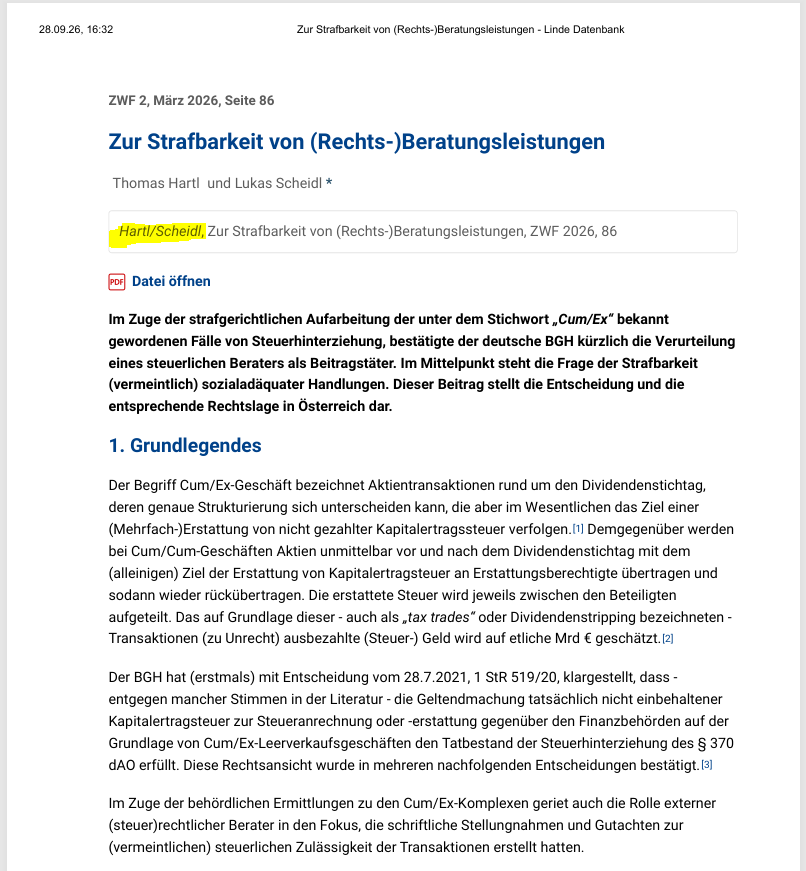
EFRI Briefing. German Federal Court of Justice (BGH), order of 7 July 2025 – 1 StR 484/24, upholding Regional Court Frankfurt am Main, judgment of 30 January 2024 – 5/24 KLs 7480 Js 208433/21; discussed in Hartl/Scheidl, “On the criminal liability of (legal) advisory services”, ZWF 2026, 86. Read together with BGH, judgment of 22 January 2014 – 5 StR 468/12, and BGH, judgment of 7 November 2024 – III ZR 79/23. Quotations from the German decisions are our translations.
Why a tax-advice case matters to payment service providers
In July 2025 the German Federal Court of Justice upheld the conviction of a former law-firm tax partner for aiding and abetting tax evasion in four Cum/Ex cases, confirming a sentence of three years and six months. The appeal was dismissed as manifestly unfounded; the order confirms rather than innovates. A recent Austrian article (Hartl/Scheidl, ZWF 2026, 86) reads it across to Austrian law and distils when “professionally typical” conduct – legal opinions, advisory work and, by extension, any routine commercial service – becomes criminal participation.
The authors write about (legal) advisers. But every element of their test has already been applied by the BGH to a payment service provider (2014, direct-debit processor) and carried into civil accessory liability under section 830(2) of the German Civil Code (2024). Together, the decisions give acquirers and their counsel a checklist of what a court will look for when a merchant turns out to have been running a fraud. This Briefing sets out that checklist. It does not comment on any pending matter.
Background: the Cum/Ex order and the Austrian reading
The defendant had written legal opinions on the tax treatment of Cum/Ex trades for a bank, knowing that they rested on an incomplete account of the facts and would be used to obtain refunds of tax that had never been paid. The BGH’s reasoning turns on two propositions. First, routine professional work is not immune: “neither everyday acts nor professionally typical acts are neutral in every case, because almost any act can be placed in a criminal context” (para. 4). Second, the line is drawn by a normative assessment of the individual case: advice given to professional standards stays within the permitted risk, but an opinion becomes “false” where its author knowingly suppresses a serious counter-view or knowingly works from an incomplete set of facts “in order to reach the desired legal result” (para. 5), as the defendant did “in order to conceal the true background of the transactions” (para. 7).
Hartl/Scheidl locate the same question in section 12 of the Austrian Criminal Code: any contribution that facilitates, secures or otherwise furthers the offence suffices; it must have had a concrete effect on the course of the offence, but need not have been a necessary condition; neither proximity in time nor direct contact with the principal is required; mere knowledge or toleration is not a contribution. The participant must know the offence “by its nature and in broad outline”. For professionally typical conduct the authors apply a social-adequacy filter – protected interest, functional link between contribution and offence, substitutability, potential to encourage and report the BGH’s two-track distinction (ZWF 2026, 88 f.): where the principal’s conduct aims exclusively at an offence and the helper knows it, the contribution always loses its everyday character; where the helper merely considers misuse possible, liability requires a recognisably crime-prone principal and a risk so high that the helper could no longer rely on not furthering an offence.
Among the BGH decisions the authors cite for the “high risk” track are two on financial services: bank employees helping customers move funds offshore (5 StR 624/99) and a direct-debit service provider (5 StR 468/12). The transfer to payment services is already in the case law.
The payment-services precedent: 5 StR 468/12
A direct-debit processor collected monthly fees of EUR 49–59 for “competition entry services” sold by telephone from call centres abroad; the merchant’s business was later found to be attempted fraud throughout. The processor’s compliance staff had repeatedly flagged elevated return-debit rates; the managing director continued processing until a police search and was convicted by the Regional Court Berlin of aiding and abetting attempted fraud.
The BGH set the conviction aside – not because a payment processor cannot be an accessory, but because the trial court had not done the work. Three passages carry the test.
On the objective side, the processor’s contribution had an unmistakable criminal purpose, because the principals’ conduct “aimed exclusively at the commission of fraud” (para. 30). Positive knowledge of even a small part of the fraud would have sufficed: it is enough “if the defendant’s knowledge related only to a – however small – part of the claims collected” (para. 31).
On the subjective side, mere possibility is not enough. The court must find facts showing that the recognised risk was so high that the processor “made the furtherance of recognisably crime-prone principals his own concern” – that is, “whether there were indications which made it appear at least highly probable to the defendant that the entire activity he furthered was designed to commit attempted fraud, or at any rate that part of the claims to be collected derived from such offences” (para. 32).
On the evidential use of return rates, the BGH spelled out what a court must establish: the actual level of the rates and the comparison values known to the processor (para. 33), the statistical significance of the deviation, and the exclusion of non-criminal explanations such as aggressive but non-deceptive selling or low product value (para. 34). Only where there is “a sufficiently clear significance, recognisable to the defendant, specifically as to criminal conduct of the principals” can the rates support the inference of a recognised high risk.
The judgment is often read as protective of service providers: statistics alone, without benchmarks, do not convict. It is equally a blueprint – it tells claimants which facts to put before the court: the rates, the benchmarks the provider itself used, the other warning signals, and the provider’s reaction to them.
The civil-law transposition: III ZR 79/23 and III ZR 137/24
The Third Civil Senate has adopted the same framework for accessory liability under section 830(2) of the Civil Code. In the 2024 decision, concerning the tax adviser of a company that ran a Ponzi scheme – it held that the contribution need not have caused the loss but need only have “furthered or facilitated the act, or strengthened the principal in his resolve”, and that the accessory need not know “all the details, but the central features of the principal offence and its furtherance by his conduct” (para. 34). It imported the two-track test word for word (paras. 35–36) and set the civil standard of proof: no “unattainable evidential requirements”, and – the second headnote – no assessment that examines each piece of circumstantial evidence in isolation “without an overall weighing of all circumstances for and against participation” (paras. 38–40).
In March 2025 the Senate added two practical points. Routine services “already give rise to civil liability as aiding and abetting (section 830(2) Civil Code) where the natural person acting knows that her contribution furthers a criminal act” (III ZR 137/24, para. 31). And the argument that the scheme would have worked without the defendant’s involvement is “of no relevance” (para. 33): substitutability is no defence.
Transfer to acquirers: the checklist
A court faced with an acquirer whose merchant operated an investment-fraud platform will ask six questions.
- Did the merchant’s business aim exclusively at fraud? This decides which track applies. Where criminal courts have found that no trading took place and the platform was a façade for extracting deposits, there is no lawful component to which the acquirer’s service could have been confined – and the exception Hartl/Scheidl note for contributions limited to lawful components (ZWF 2026, 88, citing BGH 5 StR 326/23, para. 43) does not arise.
- What did the acquirer see? The 2014 judgment lists the categories: chargeback rates, the benchmarks the provider itself applied, internal compliance warnings, statements by the merchant. For a card acquirer, the comparison values the Berlin court failed to establish are usually written into its own merchant agreement – the chargeback ratio at which scheme rules and standard terms treat activity as excessive and permit suspension, reserves or termination. Issuer fraud reports and public regulator warnings naming the merchant are further signals. The acquirer’s own suspicious-transaction reports are the strongest: they record what it knew, in its own words.
- Could the signals be explained innocently? Paragraph 34 of the 2014 judgment requires the court to exclude non-criminal explanations. For a merchant coded as a securities broker that accepts deposits into trading accounts, the usual innocent explanations – cancellation rights, returned goods, non-delivery – are structurally unavailable. What remains is the customer’s complaint that the service was not what it purported to be: the fraud allegation itself.
- How did the acquirer respond? Here the Cum/Ex order adds what the 2014 case lacked. The BGH’s concept of solidarisation with the principal – the point at which routine conduct loses its everyday character – is met by conduct that aligns the helper’s interest with the offence. For an adviser, that was tailoring the facts to the desired result. For an acquirer, the equivalents are overriding an internal compliance recommendation to terminate, re-pricing the relationship for the recognised risk instead of ending it, or tightening the contract (exclusivity, minimum volumes) as the risk became visible. Each converts a service available to any merchant into a service rendered to this merchant because of, not despite, what was known.
- Did the contribution matter? Not in the sense of but-for causation: the contribution need only have furthered the offence, and the availability of another provider is irrelevant (5 StR 624/99; III ZR 137/24, para. 33). Where the acquirer processed the deposit through which a victim entered the scheme, the functional link is not in doubt: the payment is the victim’s disposition of assets, an element of the fraud itself.
- Has the court weighed the whole picture? The second headnote of III ZR 79/23 guards against the most common way these claims fail: a judgment that addresses each warning signal separately, finds each explicable, and never asks what they mean together.
The other side of the ledger
Three cautions deserve equal weight. Courts will not infer knowledge from elevated statistics without benchmarks and without excluding alternative explanations; a claimant who pleads “high chargebacks” and nothing more will lose. Legitimate reliance remains the default for the “possibility” track (5 StR 468/12, para. 29). And an Austrian literature view would require actual knowledge rather than conditional intent for professionally typical conduct (ZWF 2026, 88, fn. 25); German law does not adopt that threshold, but claimants who can plead positive knowledge are on firmer ground in both jurisdictions.
Our Assessment
The significance of the Cum/Ex order for victims of online investment fraud lies in its method. The BGH has now said in three settings, bank employee, direct-debit processor, legal adviser, that the “routine service” defence is not a category exemption but a question of what the provider knew and how it reacted, and the Third Civil Senate has made that test the standard for damages claims. For the acquirer of a fraudulent trading platform the test is demanding, but answerable from documents the acquirer itself generated: chargeback and fraud-report statistics against its own contractual thresholds, suspicious-transaction filings, compliance correspondence, and pricing and contracting decisions after the warnings arrived.
That matters because the alternative routes are narrowing. The BGH as well as the OGH have held that the duties under the national Anti-Money-Laundering Acts are not protective laws in favour of individual investors (judgment of 21 April 2026 – XI ZR 232/23), so a defective AML programme does not by itself found liability. What a defective or overridden AML programme does is prove knowledge and knowledge is what accessory liability turns on. This is the practical core of EFRI’s position that the enabler is the defendant: the payment intermediary is the one participant in these schemes that is findable, solvent and, by regulatory design, documented. The records it must keep for its supervisor are the records that establish what it knew. It is burdensome, to get hold of these records but not impossible.
One reservation keeps the assessment honest: the 2014 judgment cuts both ways. These cases are won or lost on the evidential record about rates, benchmarks and reactions, not on the proposition that processing payments for a fraud is wrong. Victim-side counsel should plead the acquirer’s own numbers against its own thresholds, identify each decision taken after the warnings, and ask for the overall weighing that III ZR 79/23 requires (like we try to do). Where that record exists, Hartl/Scheidl’s closing sentence applies to acquirers as much as to advisers: decisive are the social adequacy of the service and the state of knowledge of the participant.
Sources: BGH, order of 7 July 2025 – 1 StR 484/24; Regional Court Frankfurt am Main, judgment of 30 January 2024 – 5/24 KLs 7480 Js 208433/21; BGH, judgment of 22 January 2014 – 5 StR 468/12; BGH, judgment of 1 August 2000 – 5 StR 624/99 (BGHSt 46, 107); BGH, judgment of 7 November 2024 – III ZR 79/23 (NJW 2025, 165); BGH, judgment of 6 March 2025 – III ZR 137/24; BGH, judgment of 21 April 2026 – XI ZR 232/23; Hartl/Scheidl, Zur Strafbarkeit von (Rechts-)Beratungsleistungen, ZWF 2026, 86; Weiß, Strafbare Beihilfe zum unerlaubten Erbringen von Zahlungsdiensten, RdZ 2025, 92