Scam advertising on Facebook and Instagram is not a niche problem—it’s a systemic consumer-protection risk, with cross-border impacts and real financial harm. Recently, Reuters published a series of investigations alleging that fraud and prohibited ads remain widespread on Meta’s platforms, supported by internal documents and on-platform tests.
For consumer organisations like EFRI, the public record now contains enough reporting and enough regulatory activity on both sides of the Atlantic to justify a sharper conversation about liability for Meta’s evident support of online crime: what has already been done by authorities, what is still missing, and why collective redress may be necessary.
Key takeaways for consumers and policymakers
Reuters reports that internal Meta documents projected a meaningful share of revenue from scam or prohibited ads and described “high-risk” scam ad volume at a massive scale.
Reuters’ on-platform test clearly showed “too good to be true” crypto-style ads reaching tens of thousands of users, allegedly facilitated by agencies listed in Meta’s official Partner Directory.
The European Commission has already opened multiple proceedings against Meta under the Digital Services Act (DSA) (for deceptive advertising and political content). It has separately fined Meta under the Digital Markets Act (DMA) for its “consent or pay” approach.
In the U.S., Meta has faced primary FTC privacy enforcement, DOJ action in the housing ads context, and a long-running FTC antitrust lawsuit (which a federal judge ruled against in November 2025).
What Reuters has reported about scam ads on Meta
1) Internal documents: revenue incentives and “high-risk” scam ad scale
Reuters reported that internal documents showed Meta projected roughly 10% of 2024 revenue, around $16 billion, could be tied to ads for scams and banned goods, while also describing an internal estimate of approximately 15 billion “higher risk” scam ads shown per day across its platforms.
Reuters further reported that the documents described a threshold-based enforcement logic: advertisers were banned only when automated systems were at least 95% certain that fraud was occurring, while “likely scam” advertisers below that threshold could be penalised (for example, via higher ad rates).
Meta disputed Reuters’ framing, with a spokesperson saying the documents reflected a “selective view” and that the internal 10% estimate was “rough and overly-inclusive,” while declining to provide an updated figure.
2) A feedback loop risk: clicking scam ads can trigger more scam ads
Reuters reported that internal documents noted users who click scam ads are likely to see more such ads due to ad-personalisation systems that optimise for engagement/interest signals.
From a consumer-protection standpoint, this allegation matters because it shifts the problem from “isolated bad ads” to potentially self-reinforcing exposure patterns, especially for vulnerable users.
3) Reuters’ test: “Trusted Experts” and a pathway to running banned ads
In another Reuters report, Ben Horowitz, the journalist, created “get rich quick” crypto-themed ads promising a weekly return of 10% (an implausible annualised rate) and reported that the ads ran anyway, appearing in the feeds of more than 20,000 users across multiple regions and generating inquiries.
Reuters reported that the journalist used agencies listed in Meta’s official “Partner Directory,” where some were described as “trusted experts” / “Badged Partner,” and that some agencies were willing to support the placement of banned ads.
After Reuters presented evidence, Meta deleted its partner directory and said it was placing some partners and the program under review, Reuters reported.
4) Reuters’ China-focused investigation: large revenue, large alleged abuse, internal trade-offs
Reuters also reported that Meta’s China-related ad sales grew into a central revenue line. At the same time, internal documents reviewed by Reuters described a significant portion tied to scams and other prohibited content. The report describes a short-lived crackdown that reduced the share of problematic ads, followed by a pause/pivot and a resurgence.
Meta told Reuters that a China-focused anti-fraud team was always meant to be temporary and disputed that Zuckerberg ordered its disbanding.
5) Escalating scrutiny in the U.S.: Senators urge FTC/SEC action
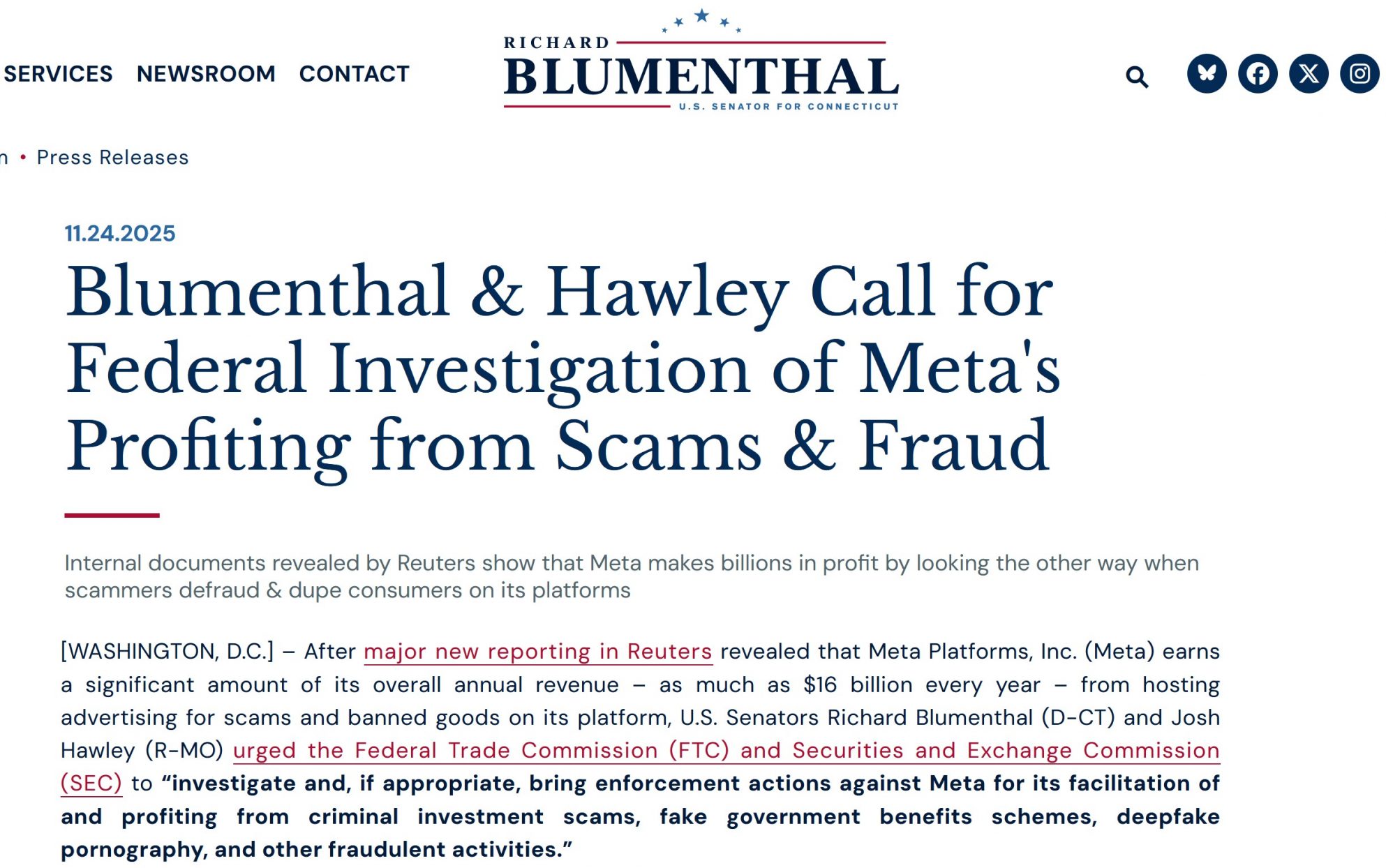
Reuters reported that U.S. Senators Josh Hawley and Richard Blumenthal urged the FTC and SEC to investigate Meta’s ad practices after Reuters’ earlier reporting explicitly calling for enforcement action (including disgorgement and penalties “where appropriate”).
What the EU has already done against Meta
EU action relevant to scam-ad risks spans platform governance (DSA), competition/market structure (antitrust), data/ads models (DMA), and cross-border data protection (GDPR) are as follows:
Digital Services Act: formal proceedings and preliminary findings
30 April 2024 — DSA formal proceedings opened (Facebook & Instagram).
The Commission opened proceedings to assess whether Meta may have breached the DSA. The suspected areas included policies relating to deceptive advertising and political content, as well as concerns around mechanisms like notice-and-action, user redress/complaints, and data access for researchers.16 May 2024 — DSA proceedings opened on minors’ protection.
The Commission raised concerns about potential “behavioural addiction,” adequacy of age verification, and protections for minors on Facebook and Instagram.24 October 2025 — Preliminary findings under the DSA.
The Commission preliminarily found Meta (and TikTok) in breach of obligations to grant researchers adequate access to public data, and preliminarily found Meta in breach of obligations to provide simple mechanisms to notify illegal content and to allow users to effectively challenge moderation decisions.
Digital Markets Act: a fine over “consent or pay,” plus later commitments
23 April 2025 — DMA non-compliance decision and fine.
The Commission fined Meta €200 million, finding that Meta breached the DMA obligation to give consumers the choice of a service that uses less personal data (in relation to Meta’s “Consent or Pay” model for Facebook and Instagram).8 December 2025 — DMA commitments accepted; new option expected in January 2026.
The Commission stated Meta would give EU users a choice between a fully personalised ads service and a “less personalised” ads service, with new options expected to begin in January 2026.
EU competition enforcement: antitrust fine over Marketplace tying and data advantages
14 November 2024 — Antitrust fine: €797.72 million.
The European Commission fined Meta €797.72 million for tying Facebook Marketplace to Facebook and imposing unfair trading conditions on other classified ads providers advertising on Meta’s platforms (including data-use advantages), and ordered Meta to end the conduct.
GDPR: record-level cross-border enforcement
May 2023 — €1.2 billion fine for Meta Ireland in the data transfers context (Ireland DPC / EDPB).
Ireland’s Data Protection Commission announced its final decision following an EDPB binding decision, including a €1.2 billion administrative fine and corrective measures relating to data transfers.
What U.S. authorities have already done against Meta
FTC: major privacy enforcement (2019)
July 2019 — FTC imposes $5 billion penalty and a sweeping privacy order.
The FTC described the $5 billion penalty and imposed new privacy restrictions and compliance obligations as part of a settlement related to Facebook’s privacy practices.
DOJ: housing ads enforcement (fair housing / discrimination context)
June 2022 — DOJ settlement on housing ad delivery.
DOJ announced a settlement with Meta requiring changes to its ad delivery system in connection with allegations relating to housing discrimination.January 2023 — DOJ update on implementation milestones.
DOJ reported on Meta’s partnership with the department to implement the modified ad system.
FTC antitrust case: a long-running attempt to unwind Instagram/WhatsApp
- November 18, 2025 — Reuters reports a federal judge ruled Meta does not hold a social media monopoly (FTC loses at trial).
Reuters reported that Meta defeated the FTC’s attempt to unwind the Instagram and WhatsApp acquisitions, with the judge citing competition and shifts in the market definition.
Scam-ad scrutiny specifically: pressure building (letters, investigations referenced by Reuters)
- November 24, 2025 — Senators urge FTC and SEC to open investigations.
Reuters reported the senators’ letter urging enforcement action, and Meta’s response disputing the allegations. - Reuters also reported that internal documents indicated the SEC was investigating Meta for running ads for financial scams.
Reuters noted this as an internal-documents claim; Reuters reported the SEC did not respond to questions for that report.
Why EFRI sees collective redress as the logical next step
Regulatory proceedings are essential—but they are not the same thing as consumer compensation.
In EFRI’s member research, more than 70% of our members who were scammed reported that scam ads, primarily on Facebook, played a decisive role in their lures.
EFRI is therefore assessing potential legal avenues focused on consumer protection and platform accountability. This article summarises public reporting and official actions; it does not constitute legal advice.
If you were targeted by scam ads on Facebook or Instagram
Practical steps that could help both your own recovery and any broader enforcement/redress effort:
Preserve evidence immediately: screenshots, ad screenshots, page/handle names, timestamps, payment receipts, chat logs, URLs, and (if visible) the ad library entry.
Stop payments and notify your bank/PSP: ask about chargeback possibilities and fraud reporting channels.
Report to authorities: police/cybercrime units, financial market regulators (if investment-related), and consumer protection bodies.
Report to Meta as well: even if you expect little, reporting creates a trace.
Watch for follow-on fraud: scammers often re-target victims.