Decisions of Malta’s Arbiter for Financial Services against Foris DAX MT Limited (Crypto.com), April to September 2026
EFRI analysis | 25 November 2026
On the reading of Malta’s Arbiter for Financial Services, a crypto-asset service provider does not discharge its duty to assess whether a self-hosted address is owned or controlled by its customer by asking the customer to tick a box. Between April and June 2026, the Arbiter, Alfred Mifsud, attached financial consequences to that principle for Foris DAX MT Limited, the Maltese Crypto.com entity. In seven cases he ordered Foris to compensate scam victims whose crypto-assets had been sent, on a bare ownership declaration, to self-hosted addresses controlled by fraudsters. The awards as ordered total €78,410.70, before interest.
The decisions also mark the limits of that route. Every award was set at 40% of the assessed loss, one with an arithmetic discrepancy. Transfers made before 30 December 2024 were excluded, and in one award case so was a transfer below €1,000, although a later award included such transfers. Claims failed where transfers had been declared to a named third party, where the provider proved a technical wallet link, and where the destination was a hosted account at an affiliated exchange outside Malta. The first award, in ASF 062/2025, is under appeal. In every case the decisive transaction is the crypto transfer out of the regulated account, not the bank payment that funded it.
Which transfers the Travel Rule covers
Regulation (EU) 2023/1113 (OJ L 150, 9.6.2023, p. 1), the recast Transfer of Funds Regulation, applies to transfers of crypto-assets where the provider of the originator or of the beneficiary has its registered office in the Union (Article 2(1)), but not to person-to-person transfers without any crypto-asset service provider (Article 2(4), third subparagraph, point (b)). A self-hosted address is a distributed-ledger address not linked to a crypto-asset service provider or an equivalent non-EU entity (Article 3, point (20)); it may belong to the customer or to anyone else.
For a transfer to a self-hosted address, the originator’s provider must obtain and hold the originator and beneficiary information and ensure that the transfer can be individually identified. Above €1,000, it must also take adequate measures to assess whether the address is owned or controlled by the originator (Article 14(5)); Article 16(2) mirrors this for incoming transfers. The provider must not allow the initiation of, or execute, a transfer before ensuring full compliance with Article 14 (Article 14(8)). The €1,000 threshold applies only to the ownership-or-control assessment. The Regulation applies from 30 December 2024 (Article 40).
Malta’s FIAU adopted the EBA Travel Rule Guidelines as its own guidance; its adoption notice states that they become legally binding from 30 December 2024, including for Virtual Financial Assets Act licence holders in the MiCA transitional period (pp. 1–2). ESMA Q&A 2295 (2 October 2024) states that providers in the transitional period are not MiCA crypto-asset service providers until authorised, but that this does not exempt them from Regulation (EU) 2023/1113, which has no transitional period. According to ASF 062/2025, Foris received its MiCA licence on 27 January 2025, after the disputed transfers (p. 31, fn. 34). The Arbiter nonetheless referred to both Article 27 of the Virtual Financial Assets Act with Rule R3-1.2.2 of the VFA Rulebook and Article 66(1) of MiCA, each requiring honest, fair and professional conduct in clients’ best interests (pp. 33–34). The Travel Rule obligation applied throughout.
What the EBA Guidelines require of the assessment
The EBA Travel Rule Guidelines (EBA/GL/2024/11, 4 July 2024) separate identifying a self-hosted address (paragraphs 77–80) from verifying who controls it. Paragraph 83 provides that providers should use at least one of five methods (the Guidelines are worded as “should”; in Malta they bind through the FIAU’s adoption): (a) unattended or (b) attended remote verification; (c) a predefined test transfer from and to the address; (d) a digitally signed message; or (e) other suitable technical means allowing a reliable and secure assessment, provided the provider is fully satisfied that it knows who owns or controls the address. The choice of method depends on the address’s technical capabilities, the robustness of each method and the money-laundering risk; where no single method is reliable enough, a combination should be used (paragraphs 84–85). A verified address may be whitelisted, subject to controls for changes in risk, and should be removed if ownership or control changes (paragraph 86). Paragraphs 87–88 call for a risk assessment and at least one risk-mitigating measure under Article 19a(1) of Directive (EU) 2015/849, and paragraph 90 for reporting suspicious transfers to the FIU. Paragraph 89 deals with addresses controlled by third parties, which are therefore not prohibited as destinations. A customer declaration is not among the listed methods.
The compensation cases turn on that gap: whether the provider had a proper basis for accepting the claimed link between customer and address, and whether the missing check contributed to the loss. A warning that transfers are irreversible answers a different question.
The legal basis for individual awards
Under the Arbiter for Financial Services Act (Cap. 555), the Arbiter decides what is fair, equitable and reasonable in the circumstances (Article 19(3)(b)), having regard to the law, supervisory guidelines, good industry practice and consumers’ legitimate expectations (Article 19(3)(c)). He may order compensation for loss caused by the conduct complained of, with interest for all or part of the period from the start of that conduct until payment (Article 26(3)(c)(iv)). The awards are therefore individual decisions, not an EU-wide refund right or a statutory 40% rate.
Since 1 October 2025, a fraud victim with an immediate, genuine and legitimate interest is deemed an eligible customer of any financial services provider involved in the suspicious fraudulent payment transaction; consumer associations and voluntary organisations are also eligible (Article 2). The complainants in the cases below were Foris’s own customers. The complaint must first be raised with the provider (Article 21(2)(b)), in writing within two years of first knowledge of the matters complained of (Article 21(1)(c)). Compensation is capped at €250,000 per claimant plus interest and costs (Article 21(3)(a)). Appeals lie to the Court of Appeal (Inferior Jurisdiction) within twenty days of notification of the decision or of any clarification or correction (Articles 26(4) and 27). Only providers that are or were licensed or otherwise authorised in Malta fall within the Arbiter’s jurisdiction.
The first award and its pending appeal
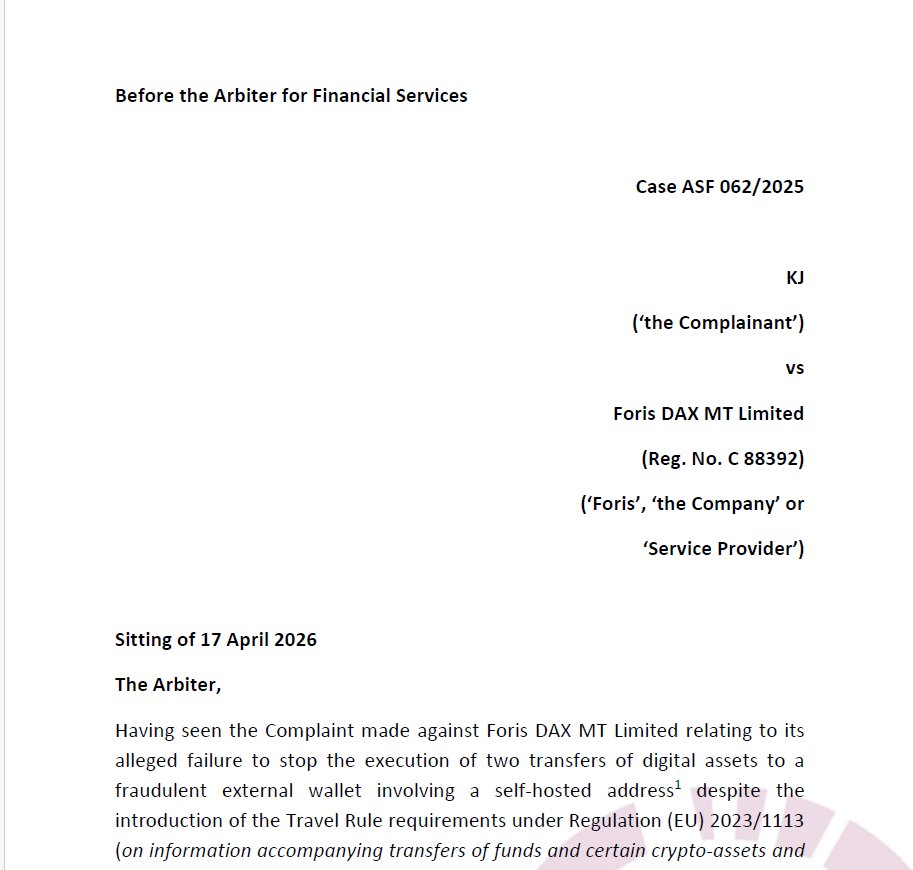
ASF 062/2025, KJ v Foris DAX MT Limited, 17 April 2026, concerns transfers of 13,945 USDT on 1 January 2025 and 16,035 USDT on 16 January 2025 to a self-hosted address, funded by €13,800 and €16,300, €30,100 in total. The complainant claimed €30,000 (the base the Arbiter used), plus €20,000 for additional work, moral damage and stress; December 2024 transfers fell outside the complaint (pp. 2–3, 9). Drawn in through the platform 9bxz.com, the complainant declared ownership of the wallet on the fraudsters’ instructions, and Foris whitelisted it on that declaration alone. The Arbiter held that Foris had to apply the methods in paragraphs 83–86 of the Guidelines; compliance is “not just a box-ticking exercise” (pp. 36–44). Foris did not dispute that the complainant reported the scam to it on 2 January 2025, yet the account was not flagged for enhanced monitoring before the second transfer (p. 46).
The Arbiter reasoned that proper verification would have shown a “fair probability” that the complainant did not control the wallet, requiring Foris to freeze or suspend the transfers and seek clarification (p. 44). The Arbiter also found substantial contributory negligence: the complainant had not checked the platform, made an incorrect declaration, ignored warnings about external wallets and kept following the fraudsters after suspecting fraud (pp. 44–45, 47). The Arbiter awarded €12,000, 40% of €30,000, with 2.15% interest (the ECB main refinancing rate) from the decision; no moral damages; each party bore its own costs (p. 47). He brought the decision to the attention of the MFSA and the FIAU (p. 48). The OAFS register records an appeal, Court of Appeal No. 93/2026, registered on 21 May 2026 and shown as pending on 25 November 2026, the date of a listed sitting. The award has not been confirmed on appeal; if it is, interest runs from the Arbiter’s decision (p. 47, fn. 67).
The later awards
ASF 076/2025: the €1,000 threshold
ASF 076/2025, YV v Foris DAX MT Limited, 30 April 2026, concerned an employment scam; the complainant had also given the fraudsters the account credentials. Two USDC transfers went to self-hosted wallets: about €929.73 on 7 March and €2,749.26 on 17 March 2025 (pp. 1–2, 15). The Arbiter treated the first, below €1,000, as “not covered by the protection of MiCA and Travel Rule regulations” and awarded €1,099.70, 40% of the second, with 2.15% interest (p. 32).
ASF 186/2025: four transfers to two wallets
ASF 186/2025, ZO v Foris DAX MT Limited, 15 May 2026, concerned four USDC or USDT transfers to two self-hosted wallets on 1, 6 and 13 January and 3 February 2025, funded by €11,163; the complainant sought 70% (pp. 2, 12). Finding no verification (p. 28), a causal link and greater fault on the complainant’s side (pp. 35–36), the Arbiter awarded €4,465 with 2.15% interest (pp. 37–38). A claim about delayed information failed because it had not contributed to the loss (p. 38).
ASF 232/2025: a BNB transfer and unreconciled funding
ASF 232/2025, 21 May 2026, dismissed thirteen pre-30 December 2024 payments by reference to ASF 119/2025, 045/2025 and 054/2025. It assessed a transfer of 15.26166 BNB on 29 January 2025, to a wallet declared to be the complainant’s own, valued at about US$10,072 on a BNB price of about US$660 (pp. 18–19). Foris acknowledged only €2,000 of funding; the Arbiter considered it probable that two further €4,000 payments of 27 and 28 January 2025 financed the purchase (pp. 10, 19). He found a breach of Article 14(5) and of Foris’s fiduciary and duty-of-care obligations (pp. 25–26, 31–34) and awarded 40% of the US-dollar loss, converted at 1.0396 to €3,875, with 2.15% interest (p. 35). The pseudonym ZO, also used in ASF 186/2025, does not show that the complainants in ASF 186 and 232 are the same person.
ASF 254/2025: transfers on both sides of 30 December 2024
ASF 254/2025, UD v Foris DAX MT Limited, 29 May 2026, arose from the Vatradecoin fraud. Of a €96,000 claim, the Arbiter assessed only the 2025 transfers, valued at €36,916 in BTC terms (pp. 1–3, 19–20). The complainant had ticked the “owner of this wallet address” box without naming the wallet, and the address was whitelisted (p. 25). The absence of any internal or third-party alert flagging the wallets did not replace a paragraph 83 check (pp. 13, 21, 26, 29). Verification would have shown a “fair probability” that the wallet was not the complainant’s (p. 33); alongside substantial contributory negligence, the Arbiter awarded €14,766, 40%, with 2.15% interest (pp. 33–36).
ASF 206/2025: a published arithmetic discrepancy
ASF 206/2025, OP v Foris DAX MT Limited, 5 June 2026, also concerned Vatradecoin. Nine pre-30 December 2024 transfers (22,395 USDT) did not qualify (pp. 3, 18–19). The operative order awards €29,296, in figures and words, as 40% of the loss, with 2.15% interest (p. 37). The quantum is inconsistent: the components €21,785 and €52,155 are stated to total €73,490 (pp. 4, 21) but total €73,940, and a table on p. 20 shows €73,500. Forty per cent of the stated total is €29,396 and of the correct sum €29,576; the award matches neither. We report the award as ordered and flag the discrepancy; it affects the quantum, not the verification reasoning.
ASF 310/2025: below-threshold transfers included
ASF 310/2025, VI v Foris DAX MT Limited, 15 June 2026, concerned the THSYU investment scam. Eleven transfers between 3 March and 4 May 2025 (€1,774), followed by €4,000, €999 and €25,500 on 26, 27 and 30 May, went to a wallet declared by tick-box declaration to be the complainant’s: €32,273 in all (pp. 2, 23). The absence of a fraud alert did not discharge the verification duty; AML suspicion was left to the FIAU (pp. 20–22). Foris produced no evidence of the paragraph 83–86 methods, and its policies were found inadequate (pp. 23–28, 31); the complainant bore the major part of the loss (pp. 32–34). The Arbiter awarded €12,909, 40%, with 2.40% interest (pp. 34–35), described as the current ECB main refinancing rate (fn. 48); the ECB announced that rate on 11 June 2026, effective 17 June 2026. Unlike in ASF 076/2025, transfers not exceeding €1,000 were included in the base; the reasoning does not address them separately.
The decisions rejecting compensation
ASF 073/2025: transfers declared to a third party
ASF 073/2025, IT v Foris DAX MT Limited, 24 April 2026, concerned seventeen transfers declared to a wallet of a named third party, identified as the alleged scammer; only two, of €217 and €600, named the complainant as owner, each below €1,000 (pp. 3, 11). Distinguishing ASF 062/2025 (p. 17), the Arbiter held that a €50,000 surge in turnover after four quiet years was not necessarily a fraud signal, found that warnings had probably been given, and dismissed the complaint (pp. 17–18). The decision does not place third-party self-hosted addresses outside the Travel Rule; paragraph 89 of the Guidelines covers them.
ASF 235/2025: a technical wallet link
ASF 235/2025, TC v Foris DAX MT Limited, 17 July 2026, concerned a Crypto.com Onchain wallet, a self-custodial wallet serviced by Growth Labs, a Cayman Islands company (p. 11). The Arbiter repeated that self-declaration is insufficient (p. 27) but accepted Foris’s linking procedure (tick-box ownership confirmation, registered email, email confirmation, passcode and two-factor code, which Foris says requires the same device) as satisfying paragraph 83(e), although the complainant said the fraudster had dictated it and that the complainant understood it as necessary to move funds to his bank account (pp. 11–12, 29–31). Turnover about four times the €60,000 expected at onboarding was not causally linked to the loss; the complaint was dismissed (pp. 32–33).
ASF 084/2026: a hosted destination outside Malta
ASF 084/2026, UT v Foris DAX MT Limited, 23 September 2026, concerned funds sent to the complainant’s own account at Crypto.com Exchange, operated by Foris DAX Limited, a Cayman Islands company outside the Arbiter’s jurisdiction (pp. 11, 14). As the destination was hosted, the self-hosted-wallet procedures did not apply, and the complaint was dismissed (pp. 15–17). Such provider-to-provider transfers remain subject to the Regulation’s information duties (Article 14(1)–(4)).
The public record of outcomes
| Decision | Date | Assessed basis | Award; interest p.a. | Appeal status (OAFS register) |
|---|---|---|---|---|
| ASF 062/2025 | 17 Apr 2026 | 40% of €30,000 | €12,000; 2.15% | Appeal 93/2026 pending |
| ASF 073/2025 | 24 Apr 2026 | – | Dismissed | Not appealed |
| ASF 076/2025 | 30 Apr 2026 | 40% of €2,749.26 | €1,099.70; 2.15% | Not appealed |
| ASF 186/2025 | 15 May 2026 | 40% of €11,163 | €4,465; 2.15% | Not appealed |
| ASF 232/2025 | 21 May 2026 | 40% of US$10,072 | €3,875; 2.15% | Not appealed |
| ASF 254/2025 | 29 May 2026 | 40% of €36,916 | €14,766; 2.15% | Not appealed |
| ASF 206/2025 | 5 Jun 2026 | 40% of loss stated as €73,490* | €29,296*; 2.15% | Not appealed |
| ASF 310/2025 | 15 Jun 2026 | 40% of €32,273 | €12,909; 2.40% | Not appealed |
| ASF 235/2025 | 17 Jul 2026 | – | Dismissed | Not appealed |
| Total | Seven awards | €78,410.70 |
* As printed. Interest runs from each decision; each party bears its own costs. Status per the OAFS decisions register on 25 November 2026, which records procedure, not payment. ASF 084/2026 is omitted as it did not concern a self-hosted address.
What the decisions indicate
A comparable claim must first reconstruct the transfer chain: each outgoing asset and amount, the destination address, the declaration made, the checks actually performed, and whether the transfer was made on or after 30 December 2024 and exceeded €1,000. A bank statement does not establish these. The claim must then show what a compliant check would probably have revealed and how that would have prevented the loss; ASF 235/2025 shows that a claim may fail where the provider proves a technical check. Open questions remain: appeal 93/2026, whether Article 66(1) MiCA can apply before authorisation, the inconsistent treatment of sub-€1,000 transfers, whether split transfers to one address can be aggregated, and third-party declarations.
Our Assessment
In our view, accepting a bare customer declaration as proof of control, as found in seven decisions, is a serious control failure. The person under criminal manipulation is the person least able to validate the story being used to take the money. A provider that records the customer’s mistaken answer has documented the deception; it has not tested it. General scam warnings are no substitute for a verification duty that the Arbiter treats as part of the standard of care owed to the customer.
ASF 235/2025 shows the next problem: a technically successful wallet link does not exclude manipulation; the complainant said the fraudster dictated each step, and the Arbiter made no finding on that. The answer to the obvious causation objection, that a coached victim would have passed any check, is that a failed or contradictory check is itself a risk signal on which paragraphs 87–88 call for action; the decisions rest on that step, not on a ban on third-party addresses. Supervisors should ask whether providers’ wider fraud response, including monitoring against the customer’s own onboarding profile, is adequate. That is a question about the wider protective response, not a claim that the Travel Rule guarantees the legitimacy of every investment.
The allocation of 60% of the loss to the victim in every successful case deserves scrutiny. The Arbiter found substantial contributory negligence in every case. What we question is the uniform ratio: 40% whether the complainant shared credentials, kept going after suspecting fraud or ticked a box, and we doubt that one ratio reflects such different degrees of fault. The 40% is an adjudicative choice, not a legislative ceiling. Interest only from the decision is likewise a choice: Article 26(3)(c)(iv) permits it from the start of the conduct complained of.
The route is narrow but real: pre-30 December 2024 transfers and the Cayman exchange fall outside it, yet since 1 October 2025 the Act also deems a fraud victim an eligible customer of any Maltese-authorised provider involved in the transaction. These decisions give concrete grounds for demanding evidence of what a provider actually checked before crypto-assets left for a self-hosted address: the method used, what it established and how contradictory information, such as a prior scam report, was handled. The pending appeal and the dismissed cases define the questions that still require careful argument.