Online financial fraud is an organised-crime industry that uses global advertising platforms and European payment accounts. Criminal enforcement has not improved since 2019, and artificial intelligence is widening the gap. The EU’s response in October 2026 was a possible voluntary code of conduct and a Payment Services Regulation that leaves most deceived victims without a refund and takes back a refund right the Court of Justice had confirmed two weeks earlier. The European Parliament votes in December. It should not approve Article 57 as it stands.
EFRI Policy Analysis | 18 November 2026
Legal status: This analysis examines the Council’s first-reading position on the Payment Services Regulation (PSR), doc. 8543/1/26 REV 1, adopted on 29 October 2026. The Regulation has not yet entered into force.
1. An organised-crime industry
Europol’s EU Serious and Organised Crime Threat Assessment 2025 (18 March 2025) states that online fraud schemes have reached an unprecedented size, variety, sophistication and reach, and are expected to outpace other forms of serious and organised crime. Its Internet Organised Crime Threat Assessment 2026 (28 April 2026) calls fraud the fastest-growing area of organised crime.
UNODC (Inflection Point, April 2025) describes hundreds of industrial-scale scam centres generating just under US$40 billion a year. The UN Human Rights Office (A Wicked Problem, February 2026) puts their workforce at no fewer than 300,000 people from 66 countries, many of them trafficked.
The industry is not confined to South-East Asia. Scam Empire (OCCRP, Swedish Television and partners, March 2025) documented two operations with call centres in Israel, Georgia, Bulgaria, Cyprus, Spain and Ukraine that took at least US$275 million from some 32,000 victims since 2021, supplied by marketing affiliates, payment service providers and banks. EFRI knows these structures from its own casework: 1,750 investment-fraud victims from 20 countries with documented losses of €62.5 million (SSRN 5456554), coached by call-centre agents payment by payment, their money processed by payment institutions licensed in the EU.
So far this industry has been limited by the number of people it can put on the phone. Artificial intelligence removes that limit. What Europe has seen until now is the beginning: a scam tsunami is building.
2. Criminal enforcement: no improvement since 2019
EFRI has accompanied victims through criminal complaints and cross-border investigations since 2019. These are its findings from daily casework.
- Resources: Fraud units are understaffed and overwhelmed. Officers say so openly. In the proceedings EFRI follows there is no sign that police or prosecutors use AI or any automated analysis.
- Complaints are recorded badly: The quality of the first interview has declined. Payment chains, recipient accounts and platform data are frequently not recorded at intake. What is recorded is investigated only superficially; what is not recorded is not investigated at all.
- Complaints are discontinued. The standard outcome, unchanged since 2019, is a discontinuation because the perpetrators cannot be identified and the traces lead abroad. In one case, a German public prosecutor’s office discontinued proceedings on that ground in March 2026 and reopened them only after the victim had assembled the cross-border evidence himself (see EFRI, A €314,000 Pass-Through at a DNB-Licensed EMI).
- Cross-border requests take as long as they did in 2019. The European Investigation Order (Directive 2014/41/EU) requires a decision within 30 days of receipt and execution within 90 days of that decision, subject to extension and postponement (Articles 12 and 15). In the files EFRI has seen, those deadlines are routinely missed, and requests to Bulgaria, Malta, Cyprus and Poland have remained unanswered. Missing them has had no consequence.
- Prosecutions reach the call centre, not the owners: The Europol and Eurojust operation announced on 3 November 2026, with seven arrests over losses put at more than €4 million, is typical in scale. The “Wolf of Sofia” network shows what happens at the top. Gal Barak was convicted in Vienna in 2020 for the damage done to Austrian victims, a small fraction of the total, and served a short part of a four-year sentence. To EFRI’s knowledge no indictment has followed in Germany, where far more victims live, and none anywhere in Europe against Gery Shalon, whom the Austrian court files analysed by EFRI show as a central figure of the network and who, according to Bloomberg News (26 June 2024), is the subject of European arrest warrants. In September 2026 EFRI asked the Generalstaatsanwaltschaft Bamberg for the status of its proceedings.
Seven years of casework permit one conclusion. Criminal enforcement, as we experience it, does not deter the organisers and certainly does not return the victims’ money.
3. Victims: no help, no support
The police take the complaint and, in most cases, discontinue it. The bank answers that the payment was authorised or that the customer was grossly negligent. The platform that carried the advertisement does not answer at all.
The law gives the victim little more. The revised Victims’ Rights Directive (Directive (EU) 2026/1472 of 17 June 2026) brings a helpline and stronger rights to information, but its one provision on money, an advance on unpaid compensation, is optional and limited to violent intentional crime, as is the Compensation Directive (2004/80/EC). A person who has lost her life savings to an organised criminal network has, in EU law, a right to be informed and no right to be compensated. In EFRI’s casework even the right to be informed about the case (Article 6(1) of Directive 2012/29/EU) is not complied with: victims do not learn what has become of their complaint. They are left without help from their banks and from the state. See EFRI, EU Victims’ Rights Reform: A Missed Chance For Online Fraud Victims.
According to the EU Agency for Fundamental Rights (Online fraud – people’s experiences across the EU, 29 May 2026), only 15% of victims report the fraud to the police. In the Global Anti-Scam Alliance’s European survey (9 June 2026), 6% of those who did recovered money. EFRI sees what stands behind these figures every day:
- Blame instead of help: Victims are told, by police officers and bank staff alike, that they should have known better. Many do not tell their own families. The gross-negligence defence turns that blame into a legal standard.
- No specialised support: Victim-support services were built for violent crime. Nobody explains to a defrauded pensioner her rights, the next steps or where to turn.
- Re-victimisation: Victims’ data are sold on. “Recovery” firms, fake lawyers and fake authorities contact them and take what is left. EFRI’s own name has been used for this.
- Lasting consequences, and no one cares: The losses in EFRI’s cases are retirement savings. EFRI knows pensioners who went back to work. When it contacted about 180 victims of 2016 to 2019 fraud schemes again in 2024, many of the older ones had become seriously ill or had died without recovering anything. This is an observation from casework, not a survey; nobody in Europe collects such data.
4. The PSR: where the evidence lies with the bank, the customer must sue
The PSR (Council position of 29 October 2026, doc. 8543/1/26 REV 1, accepted by the Commission in COM(2026) 609 final of 3 November 2026) contains real preventive law: verification of payee, transaction monitoring by both providers, fraud-data sharing. The Council’s statement of reasons (ADD 1, point 12) calls it a “strict liability framework”. Most provisions apply 21 months after entry into force.
For a customer who authorised a payment under deception, the text contains two refund rules. They differ in one decisive respect: who holds the evidence.
Impersonation of the customer’s own bank (Article 60, Article 59 of the April text): Where a third party pretends to be the consumer’s payment service provider, using communication channels attributed to it, the provider must refund the fraudulent authorised payments within 15 business days, unless it shows fraud or gross negligence by the consumer. The consumer must notify the provider and report to the police. Here the victim can prove her case. The spoofed message, the call log and the police report are in her hands. The rule is workable. It is also narrow: the Parliament’s first-reading position of 23 April 2024 would have covered the impersonation of any public or private entity, and the Council’s version covers only the victim’s own bank. A consumer deceived by a fake broker is outside it.
Monitoring not carried out (Article 87(3)): A provider, including the payee’s provider, that does not carry out the required transaction monitoring is liable to the payer for the damage, and the burden of proof is on the provider. On paper this reaches the investment-fraud victim. In practice everything it depends on lies with the bank alone: whether monitoring ran, what it flagged, what the bank did with the alert, what the receiving institution knew about its account holder. The payer’s provider must give the payer evidence that both providers carried out the monitoring, and must refund if it cannot. But the text sets no standard for that evidence. A statement that the system ran satisfies it. What the system showed, the victim does not see.
That is the problem. A burden of proof is a rule for a judge. It does nothing until there are legal proceedings, and before that the bank decides its own case. It tells the customer that its system ran and that the claim is refused. The Regulation requires it only to give reasons and to name the bodies the customer may turn to: a complaint, an alternative dispute resolution procedure in which banks must participate but whose outcome the text does not make binding (Article 105), or a court.
So wherever the bank has made the mistake and holds the proof of it, the customer must sue. Only in the proceedings does the bank have to show that it complied with its duties. A person who has just lost her savings has to find a lawyer, advance the costs and carry the risk, without knowing what the bank’s files contain. Most do not. The refusal is then final, and the burden of proof is never tested. Article 87(3) also attaches liability only to monitoring that was not carried out, not to monitoring that ran and stopped nothing, and leaves the technical standard to the EBA (recital 142).
Collective redress does not close the gap: Qualified entities such as EFRI can bring cross-border representative actions under Directive (EU) 2020/1828. But such an action has to be financed, consumers from other Member States must opt in one by one (Article 9(3)), and a court can order the defendant to disclose evidence only once the claimant has presented enough evidence of its own to support the action (Article 18). The claimant needs the bank’s files to get access to the bank’s files. There are many open questions around collective redress actions: EFRI knows that very well.
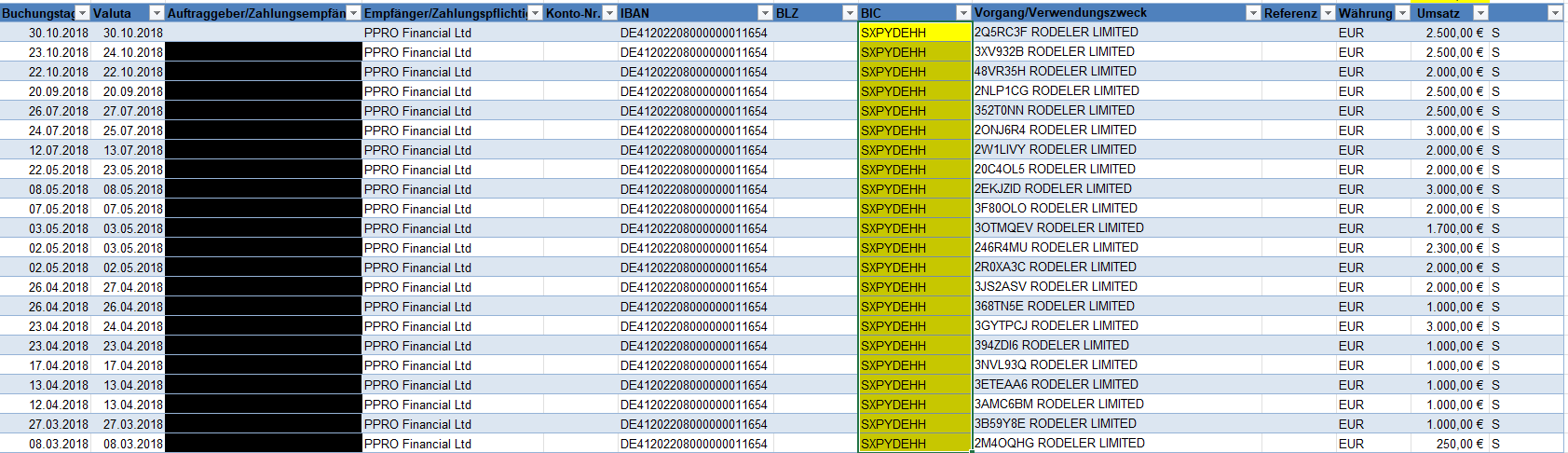
EFRI’s own Payvision file shows what this means in practice. What role a licensed Dutch payment institution played in processing the payments of thousands of victims of one fraud network could be shown only from the files of criminal proceedings in Germany and Austria, which EFRI obtained and worked through over several years. No individual victim can do that, and where the complaint is discontinued, which is the rule, there is no file to read.
The platforms are treated more gently. Article 62 obliges very large platforms to request an authorisation number from advertisers of financial services and to make “best efforts”, by automated tools, to check it; the advertiser alone is responsible for its accuracy. Under Article 82(2) a hosting provider that loses its liability exemption must compensate the payment service provider, but only for payments refunded under Articles 57 and 60.
5. Tukowiecka and Article 57: the refund-first rule is taken back
In Case C-70/25, Tukowiecka (ECLI:EU:C:2026:852, judgment of 15 October 2026), a customer of PKO BP followed a fraudulent link to a copy of her bank’s website and entered her credentials. A third party transferred 3,000 zloty (about €700). The bank refused a refund, alleging gross negligence.
The Court held that Articles 73(1) and 74(1) PSD2 do not allow this (paragraph 52). Article 73 requires the refund immediately and at the latest by the end of the following business day; Article 74 allocates the loss afterwards (paragraph 42). The only exception is where the provider has reasonable grounds for suspecting fraud by the payer and communicates them in writing to the national authority; suspected gross negligence is not within it (paragraphs 33 and 34). The provider must refund first, may then claim the loss back, and bears the burden of proof (paragraphs 40 and 46). Refusing at the outset would leave the consumer to litigate at her own cost (paragraph 45). See EFRI, CJEU: Banks Must Refund Phishing Victims First — Gross Negligence Is No Excuse.
The judgment did not change the law. It stated what Articles 73 and 74 PSD2 have said since 2018. For years, however, banks refused refunds by alleging gross negligence, and courts in several Member States, among them Germany and Austria, accepted that defence against the refund claim. The law was clear, and the victims still had to go to court to get it applied, and lost. Most never went. A phishing victim who has lost a few thousand euros cannot afford a lawyer and the cost risk of a case against a bank. The refusals stood because they were never challenged.
That is the arithmetic on which Article 57 rests. A rule that makes the victim sue will rarely be tested, whatever it says about the burden of proof.
Article 57 of the Council’s position (Article 56 of the April text) adds the exception the Court refused to read into PSD2. Under paragraph 1 the provider need not refund immediately where it has objectively justified reasons to suspect that the payer breached the security obligations in Article 53 intentionally or through gross negligence, provided it gives the payer those reasons in writing. It then has 15 business days to refund or to justify its refusal (paragraph 2). The safeguards are real: the burden of proof stays with the provider, authentication alone does not prove gross negligence, and the provider must invite the payer’s account of events before it concludes (Article 56(2) and (3)). What changes is who holds the money and who must sue:
- The suspicion that suspends the refund is the bank’s own. No authority sees it before it takes effect; an authority is informed only if the bank concludes that the payer acted fraudulently (Article 57(2)(b)). Under PSD2 even the suspicion of fraud must be communicated to the authority in writing.
- The money stays with the bank during the investigation.
- After a refusal, the consumer must start a complaint or court proceedings. That is the outcome the Court described in paragraph 45.
Artificial intelligence makes this worse. A gross-negligence standard asks whether the customer should have noticed the deception. When the bank’s website, the caller’s voice and the video image are synthetic and flawless, there is nothing left to notice, and the standard will be applied to attacks no customer can recognise.
The provision was agreed in November 2025 and is not a reaction to the judgment. But the Parliament’s ECON Committee approved the text on 5 May 2026, the Court ruled on 15 October, and the Council adopted the text unchanged fourteen days later. The Parliament has never voted on Article 57 in knowledge of the judgment. Its plenary vote at second reading, indicatively scheduled for 14 December 2026, is the first and last occasion to do so.
6. On the DSA side: A voluntary code of conduct
On 26 October 2026 the European Commission announced that it is consulting on a possible voluntary Code of Conduct on online fraud and scams under Article 45 of the Digital Services Act (DSA). It is what the PSR itself prescribes as the answer on the platform side: Article 61(5) of the Council’s position requires the Commission and the European Board for Digital Services to encourage and facilitate a voluntary code, and Article 89(2)(b) has a new fraud platform issue recommendations for it. For very large platforms such a code has some legal weight (Articles 35(1)(h) and 37(1)(b) DSA). It remains voluntary, DSA sanctions do not reach banks through it, and it gives no victim a claim.
But binding duties already exist (Articles 34 and 35 on systemic risk, Articles 26 and 39 on advertising transparency), and they have been in force for years. The Commission has adopted one non-compliance decision under the DSA so far, the €120 million fine against X of 5 December 2025, which concerned its verification badge, its advertisement repository and researcher access. None concerns scam advertising. The Commission opened formal proceedings against Facebook and Instagram on 30 April 2024, expressly covering deceptive advertising. On 21 May 2026 BEUC and 29 member organisations filed DSA complaints against Meta, TikTok and Google: of nearly 900 financial scam advertisements flagged, only 27% were removed. On 27 August 2026 the Polish Minister of Digital Affairs asked the Commission to fine Meta €250 million.
Given the scale of losses caused by scam advertising on Meta and other platforms, the Commission’s response borders on farce: after two and a half years of proceedings against Meta without a decision on advertising, it now proposes to negotiate voluntary commitments with the very companies it is investigating. See EFRI, Prevention Without Redress: Another EU Scam Response That Leaves Victims with the Loss and Poland Wants Meta Fined €250 Million Over Scam Ads.
7. Our Assessment: what EFRI calls for
Europe cannot prosecute this industry, and AI will widen the gap. That makes the civil side decisive. The only actors within reach are the intermediaries: the platforms that sell the advertising, the banks that execute the transfers, the institutions that open the accounts. Each earns revenue on the chain, and none of it is at risk when the chain turns out to be a fraud.
Measured against that, the October decisions fail. A voluntary code is a half-baked response to the scam tsunami threatening European consumers. It barely scratches the surface of a crisis that demands binding rules, effective enforcement and real redress for victims. Wherever the proof of the bank’s failure lies with the bank, the PSR leaves the customer to sue for it. Article 57 leaves the victim of an unauthorised payment worse off than the Court of Justice says she is today. EFRI calls for three things.
- Tukowiecka written into the PSR. The Parliament should use its second reading to delete the gross-negligence exception from Article 57(1), so that only a suspicion of fraud, communicated to the national authority, can suspend the refund. The Committee’s commitment of May 2026 predates the judgment. If the Regulation is adopted unchanged, the Commission must propose the correction before it applies. Until then Tukowiecka is the law, and national authorities should sanction refusals based on gross negligence.
- Shared liability along the scam rail. Fraudulently induced payments must be treated as unauthorised, so that the bank refunds first and it is the bank, not the victim, that has to prove its case in court. This is a demand to the legislator, not a reading of the text: the PSR calls such payments “fraudulent authorised payment transactions” (Article 60) and keeps them outside the refund-first rule. The payer’s provider reimburses the victim by default, subject to narrowly defined exceptions, above all the payer’s own fraud or collusion. The loss is then allocated by recourse to the actor that controlled the breached duty: the receiving provider, the acquirer, the platform that carried the advertisement, the telecom operator (see EFRI’s Shared Liability Framework Proposal for the PSR).
- Fast cross-border access to account information. Police and prosecutors must be able to obtain account-holder, onboarding and transaction data from a provider in another Member State within days. Member States must report how many European Investigation Orders in fraud cases they execute within the legal deadlines, and the Commission must act against those that persistently do not.
Beyond these: fines and disgorged revenue from fraudulent advertising must fund a European Fraud Victim Redress and Recovery Fund. Fraud victims must be recognised as victims, with specialised support and access to state compensation. The Commission must decide the pending DSA proceedings before it negotiates any code. And the EU needs an official annual estimate of fraud losses.
A payment system is judged by what happens to the customer when the payment order was obtained by a crime that the system’s own operators were in a position to detect, and were paid to process.
European Funds Recovery Initiative (EFRI)
Sources
- Europol, EU Serious and Organised Crime Threat Assessment 2025 (EU-SOCTA), 18 March 2025.
- Europol, Internet Organised Crime Threat Assessment (IOCTA) 2026, 28 April 2026.
- UNODC, Inflection Point: Global Implications of Scam Centres, Underground Banking and Illicit Online Marketplaces in Southeast Asia, April 2025.
- UN Human Rights Office (OHCHR), A Wicked Problem, February 2026.
- OCCRP, SVT and partners, Scam Empire, March 2025.
- E. Sixt, Restoring Trust in European Payment Rails: A Framework for a Shared Liability Reform, SSRN 5456554, 8 September 2025.
- EFRI, A €314,000 Pass-Through at a DNB-Licensed EMI: The FINOM/Banking Circle/Triventa Account.
- Directive 2014/41/EU regarding the European Investigation Order in criminal matters, Articles 12 and 15.
- Eurojust, International investment fraud scheme dismantled: seven arrests, 3 November 2026.
- S. Weinglass, M. Riley and J. Leopold, Bloomberg News, FBI’s Star Cooperator May Have Been Running New Scams All Along, 26 June 2024; R. Kahan, Ynetnews, While working for FBI Israeli builds online criminal syndicate.
- European Union Agency for Fundamental Rights, Online fraud – people’s experiences across the EU, 29 May 2026; Directive (EU) 2026/1472 of 17 June 2026 amending Directive 2012/29/EU (Victims’ Rights Directive); Council Directive 2004/80/EC relating to compensation to crime victims; EFRI, EU Victims’ Rights Reform: A Missed Chance For Online Fraud Victims.
- European Banking Authority and European Central Bank, 2025 Report on Payment Fraud, EBA/REP/2025/40, 15 December 2025.
- Global Anti-Scam Alliance, State of Scams in Europe 2026, 9 June 2026; methodology note on the 2026 reports.
- European Commission, Commission brings banks and online platforms together in the fight against online scams, 26 October 2026.
- BEUC, Sponsored by Scammers, DSA complaints against Meta, TikTok and Google, 21 May 2026; European Commission, Commission fines X €120 million under the Digital Services Act, 5 December 2025.
- Regulation (EU) 2022/2065 (Digital Services Act), Articles 26, 34, 35, 37, 39, 45 and 46; Directive (EU) 2015/2366 (PSD2), Articles 64, 69, 72, 73 and 74. Directive (EU) 2020/1828 on representative actions, Articles 9 and 18.
- Council of the European Union, Position of the Council at first reading on the Payment Services Regulation, doc. 8543/1/26 REV 1, and Statement of the Council’s reasons, doc. 8543/1/26 REV 1 ADD 1, adopted 29 October 2026; compromise text of 17 April 2026, doc. 8221/26.
- European Commission, COM(2026) 609 final, 3 November 2026.
- Court of Justice of the European Union, judgment of 15 October 2026, Case C-70/25, Tukowiecka, ECLI:EU:C:2026:852; Press Release No 147/26; Opinion of Advocate General Rantos of 5 March 2026.
- UK Payment Systems Regulator, APP scams reimbursement requirement, in force 7 October 2024; APP scams reimbursement dashboard, Q1 2026.