EFRI asks German prosecutors: What happened to the “Wolf of Sofia” investigations?
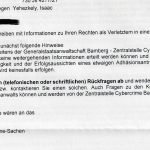
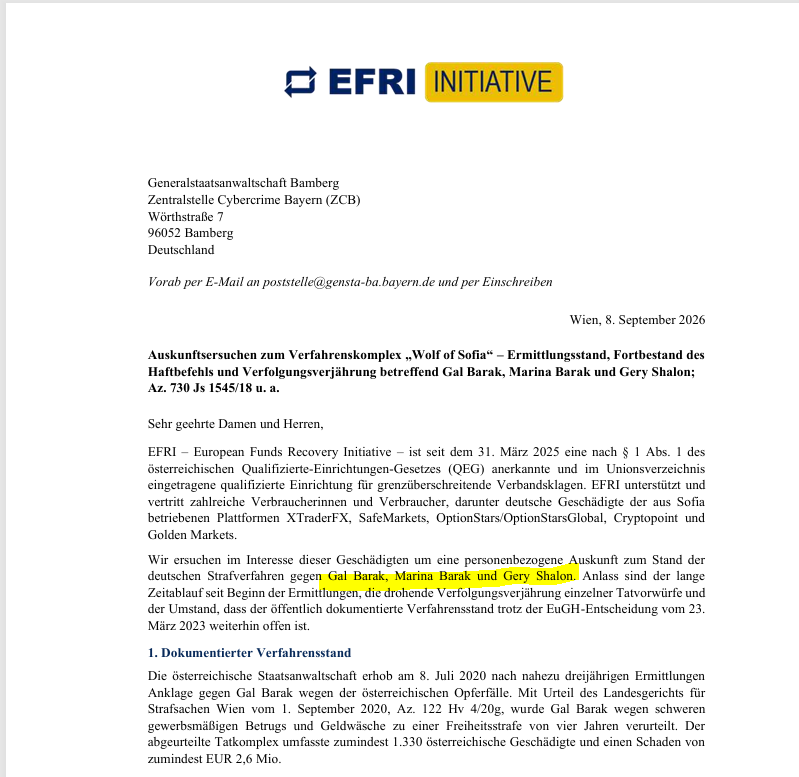
Today EFRI has formally asked the Generalstaatsanwaltschaft Bamberg and its Central Cybercrime Unit (ZCB) for clarification on the status of the German criminal proceedings concerning Gal Barak, Marina Barak and Gery Shalon.
The request comes against the background of the long-running investigations into the so-called “Wolf of Sofia” criminal network and the increasing relevance of statutory limitation periods.
Gal Barak was convicted by the Vienna Criminal Court on 1 September 2020 for aggravated commercial fraud and money laundering in relation to Austrian victims. The Austrian proceedings established that the fraudulent trading platforms operated around Barak caused losses to at least 1,330 Austrian victims. EFRI’s analysis of seized customer data, however, identified approximately 35,000 victims across multiple jurisdictions and aggregate losses exceeding EUR 200 million.
German prosecutors have investigated parts of the same criminal network for years. In the 2021 indictment against Tal-Jacki Zecharia Fitelzon (a call-centre executive), Gal Barak was described as the head of the organisation, while separate proceedings against Gal Barak, Marina Barak and other members of the leadership level had already been opened. A German arrest warrant against Gal Barak was issued in December 2020.
The legal position became particularly important after the Court of Justice of the European Union ruled in March 2023 that the Austrian conviction did not necessarily prevent Germany from prosecuting separate fraud offences committed against German victims. In other words, the principle of ne bis in idem does not automatically bar prosecution where the underlying victims and material facts are different.
Yet, more than three years after that ruling, the publicly available status of the proceedings remains unclear.
What EFRI is asking
EFRI has therefore asked the German authorities to clarify, separately for Gal Barak, Marina Barak and Gery Shalon:
- whether criminal proceedings remain pending and under which case numbers;
- whether charges have been filed;
- whether the German and European arrest warrants against Gal Barak remain in force;
- which measures have been taken to interrupt or suspend the applicable limitation periods;
- whether individual offences or periods have already become time-barred; and
- which asset-seizure and confiscation measures have been pursued.
The limitation issue is particularly relevant because the documented criminal activity dates back to 2015–2019. Under German law, interruption of limitation periods generally operates on a person-specific basis. Procedural steps taken against one defendant therefore do not automatically preserve prosecution against other alleged members of the organisation.
The unresolved case of Marina Barak
The German proceedings are also important for another reason: Marina Barak’s criminal responsibility remains unresolved from EFRI’s perspective.
In 2022, EFRI published a detailed analysis of her Austrian acquittal under the title “MARINA BARAK – was her preliminary Acquittal a Misjudgement?”. Based on the evidence available from the criminal proceedings, EFRI concluded that the acquittal was a misjudgment. Among other things, the case files showed her long-standing involvement in the organisation, her role in its financial and administrative structures, and the continued operation of the fraudulent platforms after Gal Barak’s arrest.
EFRI also pointed to facts that, in our view, were difficult to reconcile with the conclusion that she had been unaware of the fraudulent nature of the business: repeated customer and criminal complaints, regulatory warnings concerning the platforms, frozen bank accounts, offshore companies, sham invoices and her involvement in the organisation’s contractual and financial arrangements.
The Austrian proceedings concerned offences against Austrian victims. Germany is therefore not being asked to overturn an Austrian judgment. Rather, the German authorities must determine whether separate offences against German victims and other distinct acts attributable to Marina Barak can and should still be prosecuted.
This distinction matters. The CJEU made clear in the Gal Barak case that ne bis in idem does not prevent a second Member State from prosecuting materially different acts involving different victims merely because they form part of the same broader criminal scheme.
For EFRI, this gives the German authorities an opportunity to address an accountability gap that has remained open for years. The Austrian acquittal should not become the final word on Marina Barak’s potential criminal responsibility for acts affecting German victims.
What about Gery Shalon?
This question is especially important in relation to Gery Shalon.
EFRI examined Shalon’s alleged role in the European cybercrime ecosystem in our article “Can we finally charge Gery Shalon for his Crimes in Europe?”. That article highlighted his documented links to the wider network around Gal Barak, Uwe Lenhoff and the infrastructure used to operate fraudulent trading schemes.
The present request to the German prosecutors follows directly from that investigation.
The key question is no longer whether European authorities have accumulated information about the senior figures behind these schemes. The question is whether that information is being converted into timely criminal proceedings before prosecution becomes legally impossible.
EFRI considers the prosecution of call-centre employees and lower-level participants necessary, but insufficient. Criminal enforcement should ultimately address those who allegedly created, controlled and economically benefited from the infrastructure behind large-scale investment fraud.
Years have passed, but the wounds left by these crimes have not healed. Many victims are still living with the financial and personal consequences, while key questions of accountability remain unresolved.
EFRI has asked the Generalstaatsanwaltschaft Bamberg for a written response by 29 September 2026.