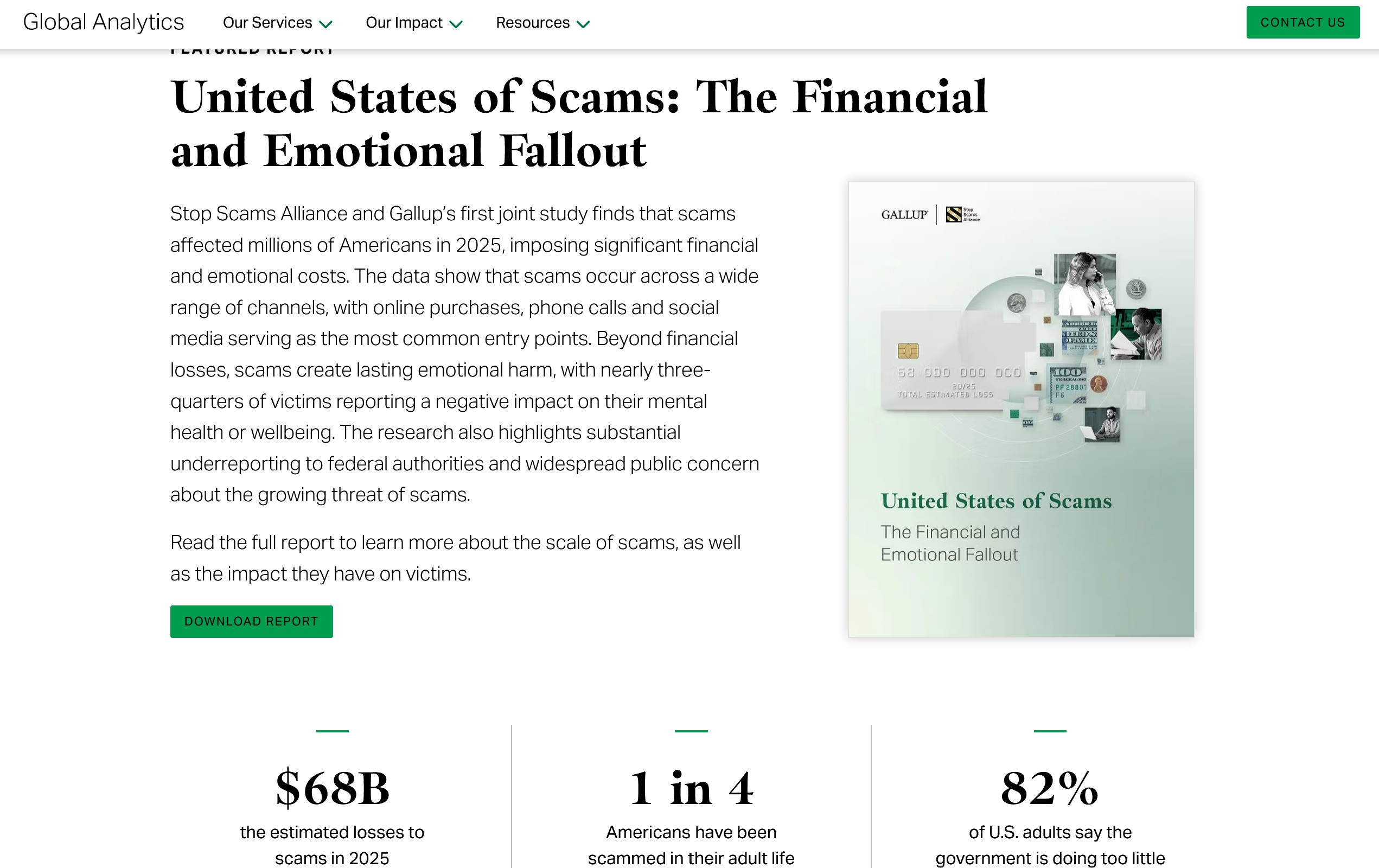
$68 Billion Lost to US Scams — Europe Lacks the Loss Estimate
A landmark new study puts a hard number on a problem victims have long felt in their bank accounts and their mental health. According to the new study “United States of Scams: The Financial and Emotional Fallout”, published in June 2026 by the Stop Scams Alliance and Gallup, U.S. adults lost roughly $68 billion to scams in 2025, more than four times the $16 billion recorded in the Federal Trade Commission’s (FTC) complaint data for the same year. Gallup attributes that gap partly to scams that are never reported to federal authorities and partly to differences in method.
For everyone working in victim protection, that gap between real losses and reported losses is the headline. It confirms what fraud-recovery advocates have argued for years: official statistics capture only a fraction of the harm. Below is a detailed summary of what the study found — and why Europe still lacks an equivalent official annual loss estimate, despite now having stronger EU-wide data on online fraud victimisation, reporting and impact.
15 Million Victims in a Single Year
The report is based on a nationally representative, probability-based survey of 5,173 U.S. adults, conducted by web and mail between 8 January and 18 February 2026. That method allows the study to capture scams that were never formally reported to any authority.
Its central findings are stark:
- 6% of U.S. adults an estimated 15.1 million people say they were personally scammed out of money in 2025.
- Another 4%** reported that someone else in their household was scammed, bringing the total to 10% of households affected in a single year.
- 24% of adults say they have been scammed at some point in their adult life, and 10% have been scammed more than once.
- Scam attempts are relentless: 41% of Americans are targeted by an attempted scam every single day, mostly via email, phone calls and social media.
Victimization is not evenly spread. Lower-income adults, people of color and those without a bachelor’s degree reported higher rates but scam rates were broadly similar across age groups, dismantling the myth that scams are mainly an “older person’s problem.”
That finding is politically important. Scams are not a niche risk for the elderly. They are a mass consumer-protection problem affecting the general population.
$68 Billion Lost And Most of It Never Comes Back
The financial toll is severe and concentrated among those least able to absorb it:
Gallup estimates that U.S. adults lost $68 billion to scams in 2025, equivalent to roughly $186 million stolen every day. More than half of the scam cases reported to Gallup involved losses of $500 or less, but the average loss was $5,578, because the most damaging scams reached tens of thousands of dollars.
The distribution matters. A “typical” scam may look small in statistical terms, but for many households it is financially destabilising. Gallup reports that in 21% of scam-affected households, the incident caused severe financial hardship, and in another 25%, it caused moderate financial hardship. Among households earning less than $80,000, the harm was substantially worse: 28% reported severe hardship and 30% moderate hardship.
The recovery picture is equally bleak. In most scam cases, the loss is not meaningfully repaired. This is the central policy failure: victims are treated as individual losers in private transactions, while the fraud ecosystem operates as an industrialised cross-border business model.
To put that in perspective, the study notes that about a third of U.S. adults (31%) could cover no more than $500 of an unexpected expense from savings so for many households, even a “typical” scam is a serious financial shock.
How Scams work and how they unfold
No single channel dominates. Among scams reported to Gallup, 17% began with an online purchase, 15% with a phone call, 12% via a social media post and 10% with a text message. Once contact was made, scammers used multiple channels to keep victims engaged with phone calls (21%), text messages (19%), email (17%) and direct messages (16%) were the most common primary methods, and half of all scams (50%) spanned two or more channels.
This matters for regulation. A scam may begin with a misleading social-media advertisement, continue through encrypted messaging, use a fake trading platform or fake merchant website, and end with a bank transfer, card payment, crypto transfer or payment-app transaction. Looking at only one channel — the platform, the bank, the payment app or the telecom provider — misses the structure of the crime.
The modern scam is not a single event. It is a chain.
That chain often includes impersonation, false authority, fake investment opportunities, fraudulent websites, advance-fee demands, bogus technical-support claims and the misuse of trusted brands. AI and deepfakes are now part of that landscape. Gallup’s report indicates that AI or deepfake elements were reported in a meaningful share of scams, but that figure is likely conservative because many victims cannot reliably detect whether synthetic media or AI-assisted manipulation was used.
The Emotional Toll Can Be Worse Than the Financial One
One of the report’s most important contributions is quantifying harm that never appears in loss statistics
- Nearly three-quarters (73%) of those who were scammed say it had a negative impact on their mental health or wellbeing 28% “very negative,” 45% “moderately negative.” Even when another household member was the direct victim, 65% still reported a personal emotional impact.
- 46% of victims’ households faced at least moderate financial hardship, including 21% who described it as severe. Among households earning under $80,000, that rose to 58% (28% severe, 30% moderate).
Qualitative interviews with 20 victims reinforced the pattern: many said the feelings of betrayal, shame and violation outlasted and outweighed the money itself.
The Reporting Blackhole
The Gallup study’s sharpest policy implication is underreporting.
Official U.S. data showed around $16 billion in reported fraud losses for 2025, while Gallup estimates actual scam losses at $68 billion. That means the complaint-based figure may capture only a minority of the real economic damage.
The reasons are familiar:
Victims often do not believe reporting will help them recover their money. They doubt that reporting will stop future scams. Many do not know where to report. Others are ashamed, overwhelmed or traumatised. And when they do report, they often receive no meaningful feedback, no reimbursement and no visible enforcement result.
This is not a victim-behaviour problem. It is a system-design problem.
If reporting does not produce visible consequences, victims rationally stop reporting. Then policymakers rely on incomplete data. Then institutions claim the problem is smaller than it is. The cycle protects the system, not the victims.
A Threat the Public Wants Governments to Confront
Public concern is near-universal. 98% of adults see scams as a threat, with 66% calling them a “major” threat. And 82% believe the government is doing too little to prevent them a rare point of bipartisan agreement (87% of Democrats and 76% of Republicans). Asked how scam education should be delivered, adults pointed to social media (61%), television or radio (55%) and communications from financial institutions (51%).
Europe Now Has Victimisation Data — But Still No Comparable Loss Estimate
Europe is no longer without authoritative EU-wide victimisation data on online fraud.
In 2026, the European Union Agency for Fundamental Rights (FRA) published “Online Fraud — People’s Experiences Across the EU”, based on Eurobarometer survey wave 104.2. The survey covered 26,453 respondents across all 27 EU Member States, aged 15 and over. Respondents were randomly selected and the results were weighted to match the demographic profile in each Member State by gender, age, urbanisation and region.
The FRA findings are significant. One in four people in the EU — 24% — had fallen victim to online fraud in their lifetime. Respondents had been deceived via instant messages or emails into transferring money, making payments or disclosing personal data.
The most common form was fake online shopping: 35% of victims had been defrauded by someone pretending to sell goods or services. Impersonation scams were also widespread: 25% of victims had been defrauded by someone pretending to be a family member or acting on behalf of one, 24% by someone pretending to be a business or work contact, and 22% by someone pretending to represent a bank. 20% had experienced investment fraud.
The FRA data also confirms a serious reporting gap. Only 15% of victims reported the fraud to the police. Overall, 44% reported it to the police or another organisation, including banks, platforms, consumer-protection bodies or employers. That means 56% of victims did not report the incident to the police or to any listed organisation or service at all.
The impact is not only financial. FRA found that 63% of victims reported at least one negative impact. 34% changed their online behaviour, 28% reported a loss of trust, and smaller but still relevant groups reported financial difficulties, mental-health consequences, disruption to family life or physical-health consequences.
This is an important development. Europe now has official, EU-wide, representative data confirming that online fraud is a mass victimisation and victims’ rights issue.
But the comparison with the U.S. Gallup/Stop Scams Alliance study also shows what is still missing.
The FRA study measures lifetime experience of online fraud through instant messages and emails. It does not produce an annual EU-wide loss estimate comparable to the U.S. estimate of $68 billion lost in 2025. It also does not fully capture all scam channels, all payment rails, reimbursement outcomes or the full economic damage suffered by victims.
So the problem is no longer that Europe lacks victimisation data.
The problem is that Europe still lacks a recurring, official, EU-wide loss-and-harm measurement system comparable to the U.S. study’s annual loss estimate. Europe now knows that online fraud is widespread. What it still does not know — at least not from an official recurring EU-wide source — is the full annual financial damage, the reimbursement gap and the institutional accountability gap.
That distinction matters.
Without prevalence data, policymakers can deny the scale of victimisation. Without loss data, they can still underestimate the economic harm. And without reimbursement data, banks, platforms, telecom providers and payment intermediaries can avoid scrutiny for the losses that remain with victims.
The closest official benchmark for an exact loss number still remains the European Commission’s report “Survey on Scams and Fraud experienced by consumers”, issued in January 2020. That survey found that 56% of EU consumers had been exposed to at least one scam or fraud over a two-year period, with estimated cumulative consumer losses of up to €24 billion over that period.
EFRI’s Take: Europe Must Stop Treating Scam Losses as Isolated Consumer Mistakes
EFRI’s view is simple: the Gallup/Stop Scams Alliance study should be read together with the new FRA findings. The U.S. study provides the annual loss estimate Europe still lacks. The FRA study confirms that online fraud is already a mass victimisation and victims’ rights issue across the EU.
The real scandal is not only that U.S. consumers lost an estimated $68 billion in one year. The real scandal is that official complaint data captured only a fraction of the apparent harm. The FRA findings now show that Europe has its own serious reporting gap: only 15% of online-fraud victims reported the fraud to the police, and 56% did not report it to the police or to any listed organisation or service at all.
That means European institutions may still be designing policy on the basis of incomplete loss and reimbursement data.
That is unacceptable.
For years, scam victims have been treated as isolated individuals who made bad decisions. That framing is wrong. Modern scams are not random one-off incidents. They are organised, scalable and infrastructure-dependent. They rely on advertising platforms, search engines, social-media accounts, telecom channels, payment systems, bank accounts, merchant acquiring, crypto rails, fake websites, shell companies and professional money-laundering networks.
The victim may be alone at the moment of payment. But the crime is not individual. It is systemic.
EFRI therefore draws five conclusions.
First, Europe needs a recurring, official, EU-wide online-fraud victimisation and loss survey using a transparent and comparable methodology. FRA has provided an important victimisation baseline. It should not remain a one-off snapshot, and it must be expanded to measure annual financial losses, reimbursement outcomes and institutional responses.
Second, Europe must measure more than money. Scam harm includes psychological injury, loss of trust, family damage, shame, fear and long-term exclusion from digital life. These harms must become visible in policy, supervision and litigation.
Third, reporting systems must be redesigned around the victim. A system that victims do not understand, do not trust and do not benefit from will always undercount the problem. Europe needs simple reporting channels, cross-border case routing, feedback loops and clear links between reporting, enforcement and reimbursement.
Fourth, reimbursement cannot remain the exception. Where banks, payment providers, platforms, telecom companies or other intermediaries fail to detect, prevent or interrupt foreseeable scam patterns, victims should not be left to bear the loss alone. The legal and regulatory debate must move from victim blame to infrastructure accountability.
Fifth, Europe needs a Financial Scam Victim Redress Mechanism. Fines, settlements, supervisory penalties and platform contributions in cases of systemic failure should not disappear into public budgets while victims remain uncompensated. Where enforcement reveals widespread institutional failure, part of the financial consequence should be directed toward victim redress.
The Gallup study gives the United States a number: $68 billion lost in one year. The FRA study gives Europe authoritative victimisation evidence. What Europe still lacks is the equivalent official annual loss figure.
The absence of that number is not evidence of a smaller problem. It is evidence of a remaining measurement failure.
Sources: Stop Scams Alliance & Gallup, “United States of Scams: The Financial and Emotional Fallout” (June 2026); European Union Agency for Fundamental Rights (FRA), “Online Fraud — People’s Experiences Across the EU” (2026). Figures cited are drawn from the published reports.