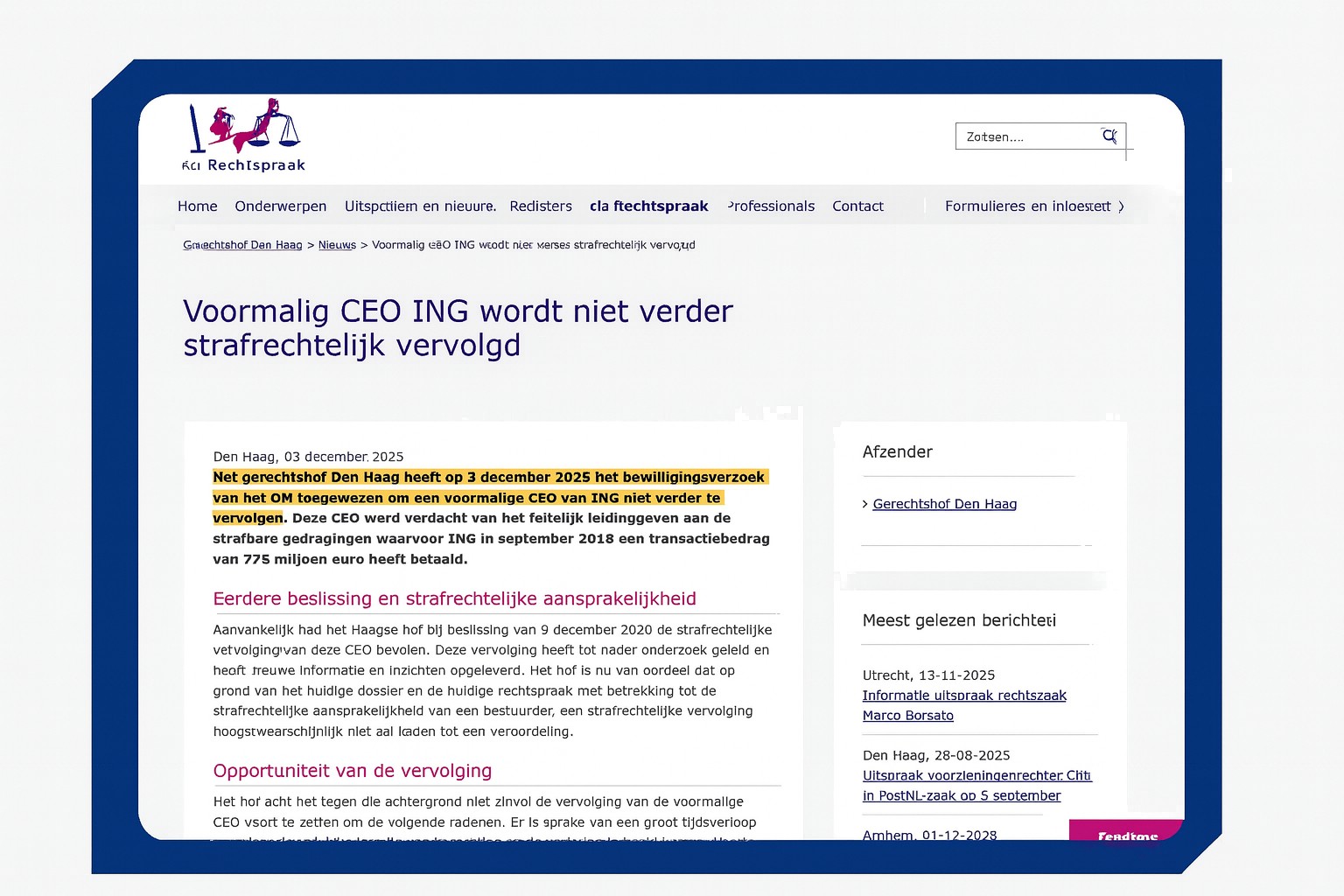
On 3 December 2025, the Court of Appeal in The Hague granted the Dutch prosecutor’s request to stop the criminal prosecution of ING’s former CEO in the so-called “Houston” money-laundering case (ECLI:NL:GHDHA:2025:2436).
From now on, it is clear: after almost a decade of debate around ING’s role in massive AML failures, no senior executive will face a full criminal trial, despite a record-breaking settlement and a devastating factual record in the 2018 Houston report.
What the Dutch court decided on 3 December 2025
According to the court’s official press release, the Hague Court of Appeal has approved the prosecution service’s request (“bewilligingsverzoek”) to discontinue the case against the former CEO, who was suspected of “factually leading” the criminal conduct for which ING paid a €775 million settlement in 2018.
The court lists several reasons why it considers further prosecution neither useful nor proportionate:
Based on the current case file and current case law on directors’ criminal liability, a conviction is considered “highly unlikely”.
The long passage of time raises issues of reasonable-time requirements and limitation (verjaring).
Continuing the case would consume substantial capacity of both the prosecution service and the judiciary.
The earlier decision to open the case already “confirmed the norm” that bank directors are not above the law.
ING has since paid €775 million (fine plus disgorgement) and implemented remediation programmes under supervisory oversight.
Other board members and managers shared responsibility for compliance; the CEO was not the only one in a “responsible position”.
The court also weighs the personal interests of the former CEO and the fact that he answered questions and explained his role as CEO of a complex international bank.
Formally, this is not a classic acquittal after trial; it is an opportunistic termination of the prosecution. In practical terms, however, the effect is the same: there will be no judgment on the merits, and no individual criminal accountability at the top of ING.
What the Houston Report said about ING´s AML failue:
This outcome stands in sharp contrast to the Houston report published by the Dutch prosecutor in 2018, a detailed factual account of ING’s AML failures in the Netherlands between 2010 and 2016.
The Houston report and the accompanying news release describe, among other things:
Years of structural violations of the Dutch Anti-Money-Laundering and Counter-Terrorist-Financing Act (Wwft) by ING Netherlands.
Serious shortcomings in customer due diligence (CDD): incomplete files, insufficient identification of beneficial owners, and inadequate risk assessments.
Dysfunctional transaction monitoring: alerts that were not handled in time or at all, under-resourced monitoring teams, poorly configured systems.
Repeated internal and external warnings from supervisors and auditors that were not followed by timely, effective action.
The conclusion that hundreds of millions of euros in suspicious flows moved through ING NL accounts, with the bank failing to act as gatekeeper of the financial system.
To resolve this, ING accepted a record settlement of €775 million – €675 million as a fine and €100 million as disgorgement of unlawfully saved costs – precisely because the violations were long-lasting, structural and serious.
Crucially, already in 2018 the prosecution stated that, given the legal framework and evidentiary challenges, it could not prosecute natural persons for the offences covered by the settlement.
From corporate fine to no personal accountability
The ING Houston money-laundering case now looks like this:
The Dutch prosecution documents massive, systemic AML failures at ING NL.
ING pays €775 million and implements remediation under supervisory pressure.
In 2020, the Hague Court of Appeal ordered that the former CEO should still be prosecuted personally.
After additional investigation, the prosecution in 2024 concludes that evidence against the CEO is not strong enough for a likely conviction under existing standards for directors’ criminal liability.
In December 2025, the same court now agrees to stop the case altogether for reasons of low conviction prospects, elapsed time, and resource constraints.
For victims and the wider public, the message is straightforward: the institution admits serious wrongdoing and pays a huge fine; the individuals in charge walk away without a verdict.
No accountability for ML failures in The Netherlands
From the perspective of EFRI and the many victims of online investment fraud who were funneled through ING and its subsidiaries, this is a deeply troubling signal.
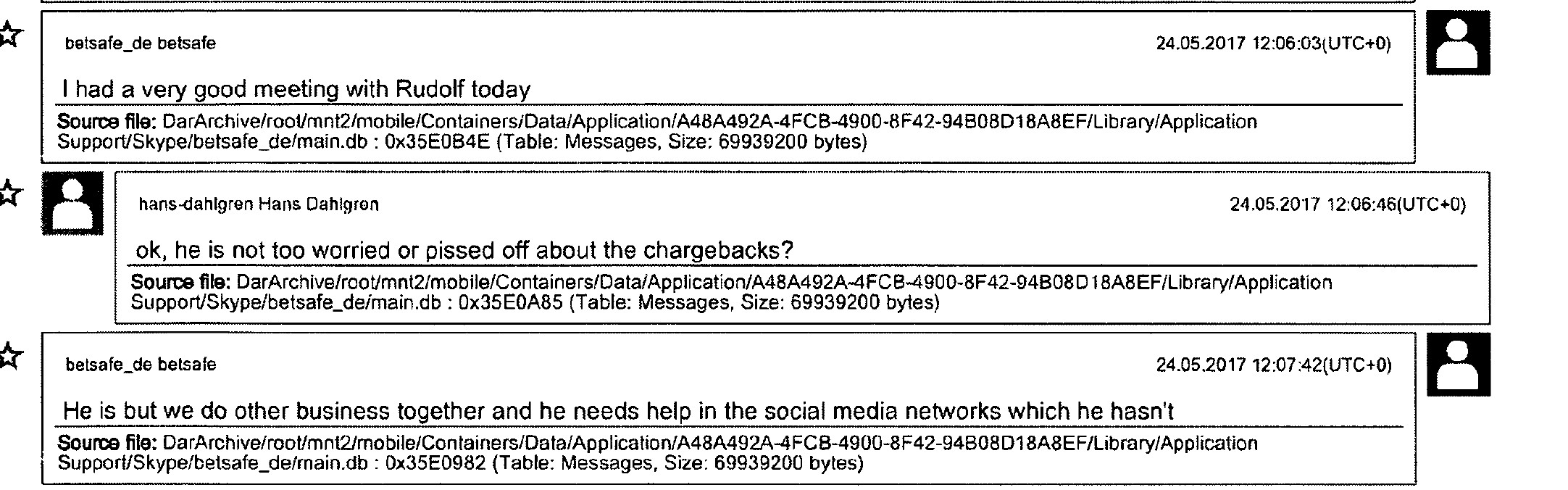
But it is, sadly, no surprise after watching the laughably low penalty of €330k for Booker (ex-CEO of Payvision). Booker even spent his holidays with Uwe Lenhoff, but the Dutch prosecutor was convinced that he had no knowledge of Uwe Lenhoff’s business model.
But it is not only the Netherlands. This is the classic pattern of “corporate fines without personal accountability” that we see in many significant financial-crime cases. As we all know, corporate fines are by now part of the business model of big banks and certainly no reason for them to stop processing illicit money.
Why this decision is harmful for the enforcment of AML in Europe
From EFRI’s perspective, especially in light of the victims of online investment fraud processed through ING and its former subsidiary Payvision, today’s decision has several harmful consequences.
1. Systemic failures are confirmed – but no one is responsible
The Houston report confirms that ING’s AML systems failed for years, allowing criminal schemes to move money almost undisturbed through ING accounts.
Yet the legal outcome is:
The bank pays and “moves on”.
The supervisors close their files once remediation plans are agreed.
No individual executive is convicted for the systemic breakdown that harmed thousands of victims.
For victims, this looks like a system that recognises the damage but refuses to name and sanction those who enabled it at the top.
2. Too rich to be jailed remains reality
The court explicitly notes that continuing the prosecution would be a heavy burden on the resources of the prosecution service and the judiciary.
Seen from the outside, this reinforces the perception that:
Complex, resource-intensive white-collar cases are quietly deprioritised, especially when they involve systemically important banks.
The criminal justice system is not structurally equipped to hold large financial institutions and their leadership to account, even when regulators and prosecutors have already documented serious violations.
For retail investors and consumers who have lost life savings in frauds channelled through regulated banks, this is exactly what “too rich to be jailed” looks like in practice. This ruling erodes EU financial integrity at its core.